NEWS

Induction Magnetic Rings

Induction Magnetic Rings: Market Trends, Applications, and Manufacturing Technology

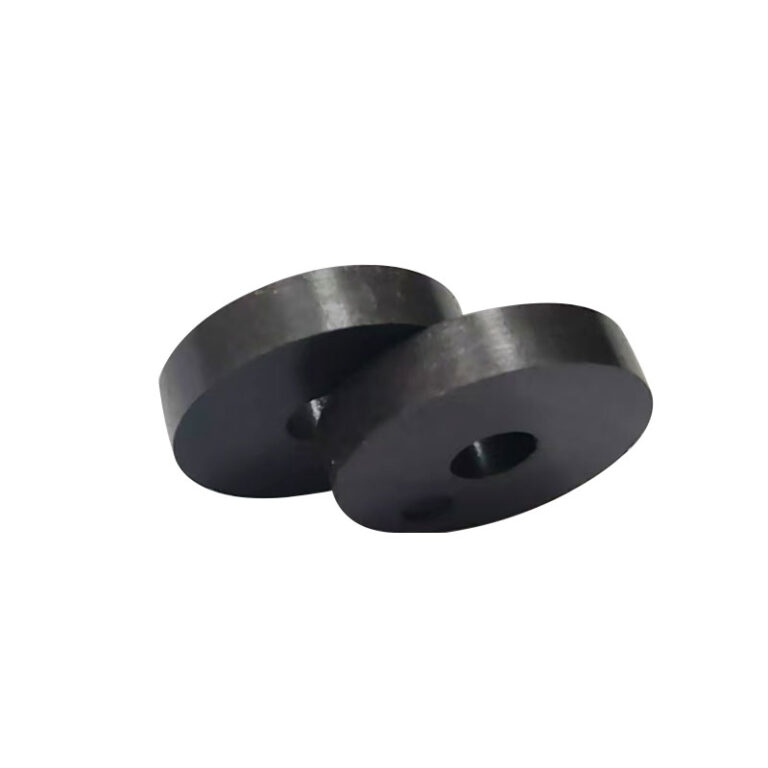
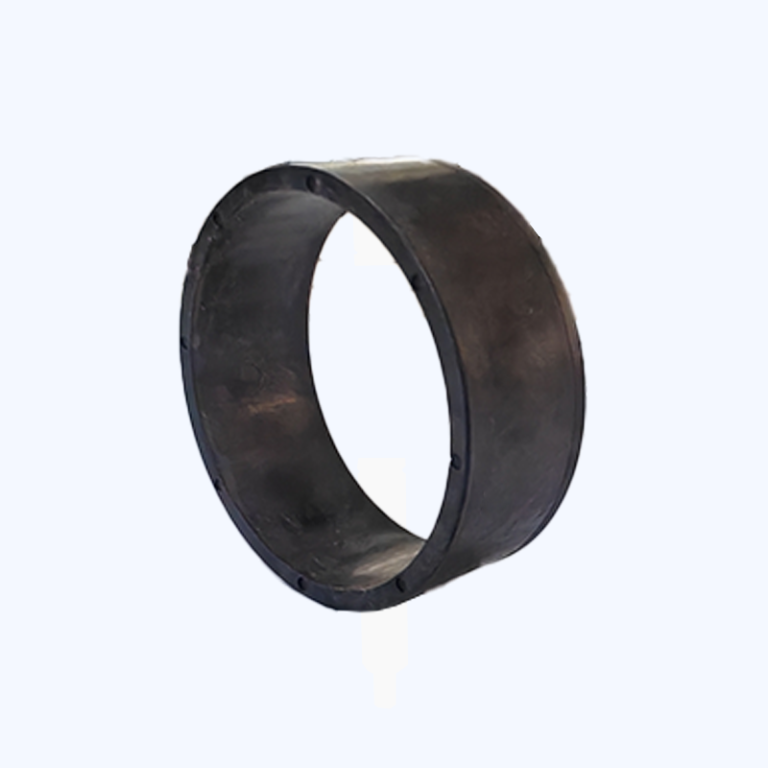
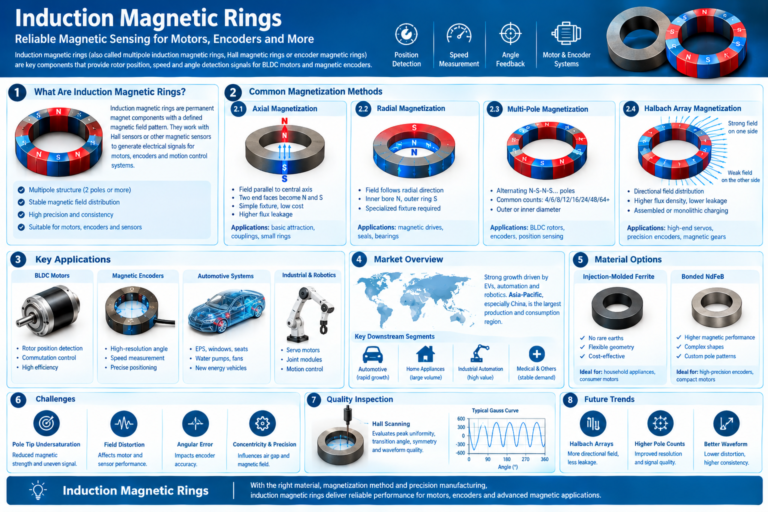
Induction magnetic rings are important permanent magnetic components used in motor position detection, rotational speed measurement, magnetic encoders, and motion control systems. They work with Hall-effect sensors or other magnetic sensing technologies to convert changes in magnetic fields into electrical signals. As brushless motors, automotive electrification, industrial automation, and robotics continue to develop, the demand for accurate and reliable magnetic sensing components is increasing. Manufacturers are placing greater emphasis on multipole magnetization, magnetic field uniformity, dimensional accuracy, and long-term operating stability. For motor manufacturers and magnetic sensing system designers, understanding the structure, applications, and manufacturing requirements of induction magnetic rings is essential for selecting suitable components. What Are Induction Magnetic Rings? Induction magnetic rings are permanent magnetic components designed to generate a defined magnetic field pattern for non-contact sensing. Unlike conventional magnets primarily used for attraction or holding force, these components are engineered to provide magnetic signals that can be detected by sensors during rotation or movement. A typical assembly consists of a magnetic ring, a Hall-effect sensor or another magnetic sensing element, and an electronic control system. As the ring rotates, alternating magnetic poles pass the sensor, generating electrical signals that can be used to calculate rotational speed, position,
Multi-Pole Magnetic Ring Magnetization

Multi-Pole Magnetic Ring Magnetization for Motors and Magnetic Encoders

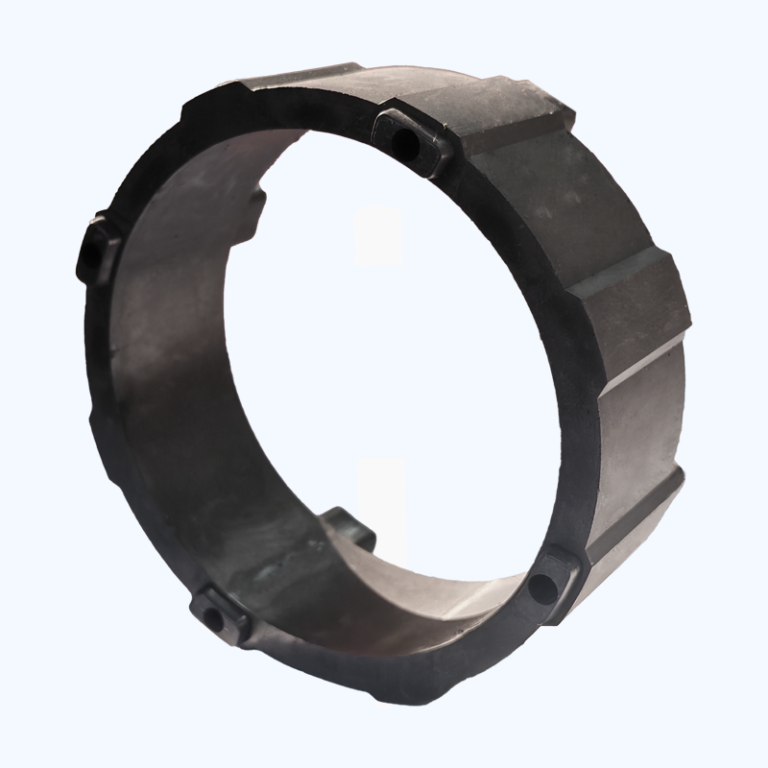
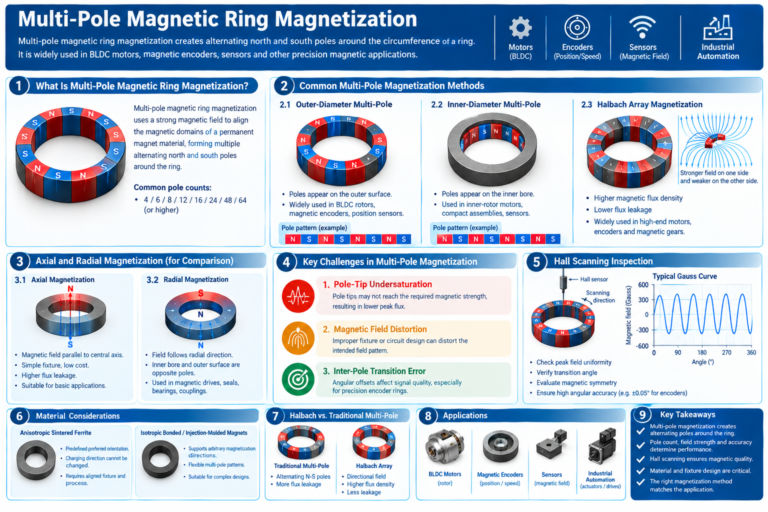
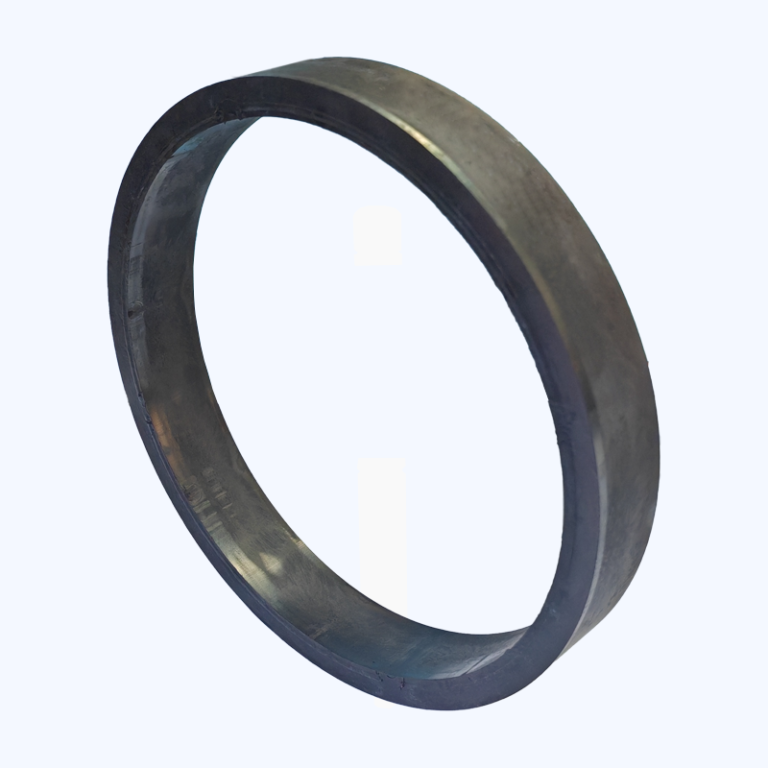
Multi-Pole Magnetic Ring Magnetization is an important manufacturing process for permanent magnetic components used in motors, magnetic encoders, sensors, and other rotary systems. Unlike simple two-pole magnetization, multi-pole charging creates alternating north and south poles around the circumference of a magnetic ring. The number of poles, magnetic field strength, pole width, transition angle, and magnetic uniformity all influence the performance of the finished component. For this reason, precise charging equipment and magnetic inspection are essential when producing high-quality multi-pole magnetic rings. What Is Multi-Pole Magnetic Ring Magnetization? Multi-Pole Magnetic Ring Magnetization creates multiple alternating magnetic poles around the circumference of a permanent magnetic ring. A typical pattern can be represented as: N-S-N-S-N-S-N-S The exact number of poles depends on the application. Common configurations include 4, 6, 8, 12, 16, 24, 48, and 64 poles, while specialized encoder applications may require even higher pole counts. During charging, a specially designed fixture generates a strong magnetic field at specific locations around the ring. The magnetic field aligns the internal magnetic domains and establishes the required pole pattern. After the charging field is removed, the magnetic material retains remanent magnetization. Why Multi-Pole Magnetic Ring Magnetization Matters The main purpose of Multi-Pole Magnetic Ring

Injection Molded Magnetic Components

Injection Molded Magnetic Components for Precision Motor and Sensing Applications

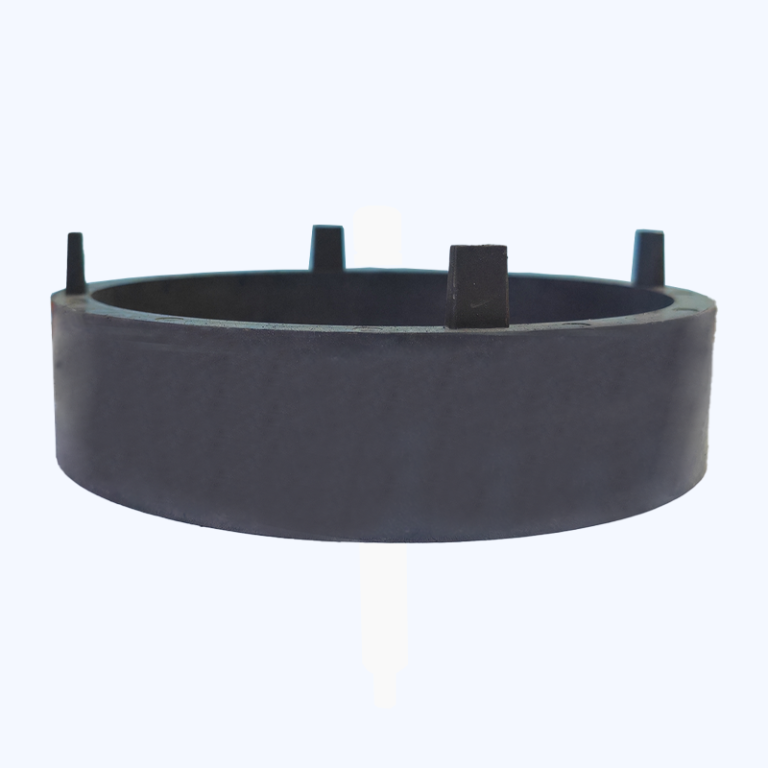
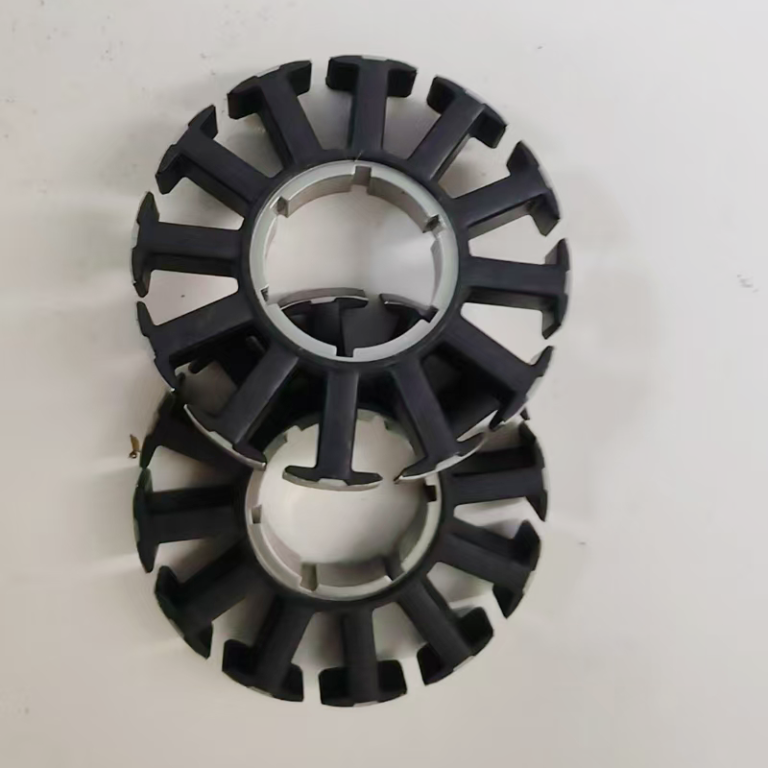
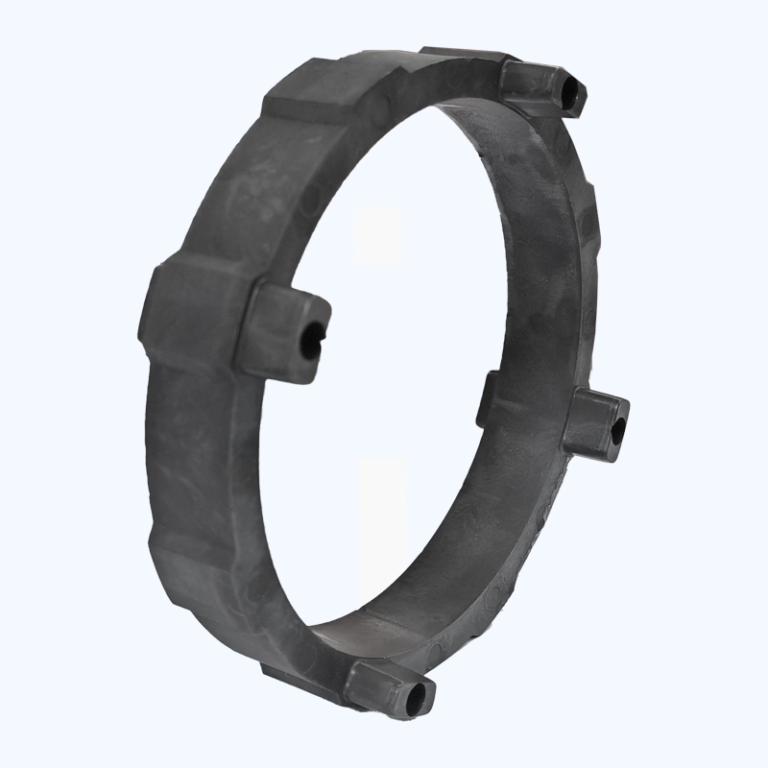
Injection Molded Magnetic Components are widely used in modern motor systems, intelligent sensing equipment, industrial controls and fluid handling applications. By combining injection molding with precision magnetization technology, these magnetic components can provide consistent dimensions, stable magnetic performance and reliable operation for precision machinery. High Kos develops injection molded magnetic rings, magnetic rotors, sensor magnetic rings and pump rotors for different equipment requirements. From standard components to customized designs, the products are developed for applications where magnetic accuracy, mechanical stability and long-term reliability are important. Injection Molded Magnetic Rings for Motor Systems Injection molded magnetic rings are widely used in compact motor applications. The integrated molding process allows the magnetic material and component structure to be produced with controlled dimensions and consistent quality. These magnetic rings can support smooth motor operation and stable magnetic output, making them suitable for: Brushless DC motors Cooling fan motors Stepper motors Smart home appliances Office equipment Automotive micro motors For high-speed applications, dimensional accuracy and dynamic balance are especially important. A properly designed magnetic ring can help reduce vibration and operating noise while maintaining stable motor performance. Injection Molded Magnetic Rotors Injection molded magnetic rotors integrate the magnetic element and rotor structure into a

Magnetization Technology for Magnetic Rings

Magnetization Technology for Magnetic Rings: Methods, Pole Patterns, and Applications

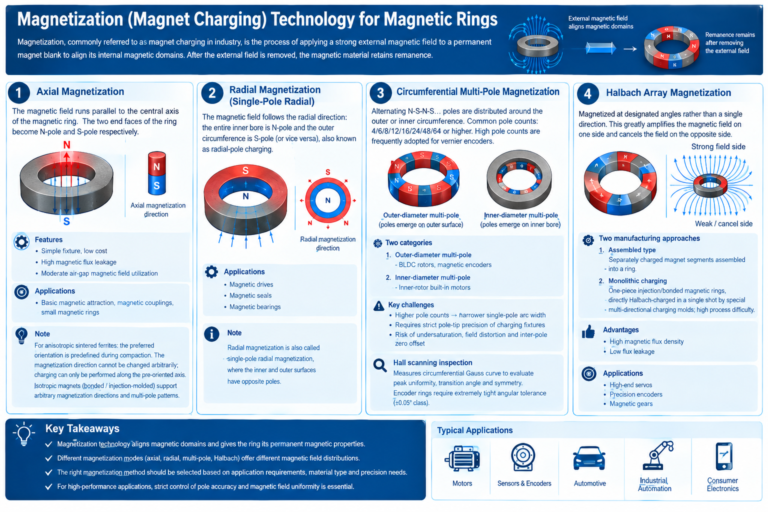
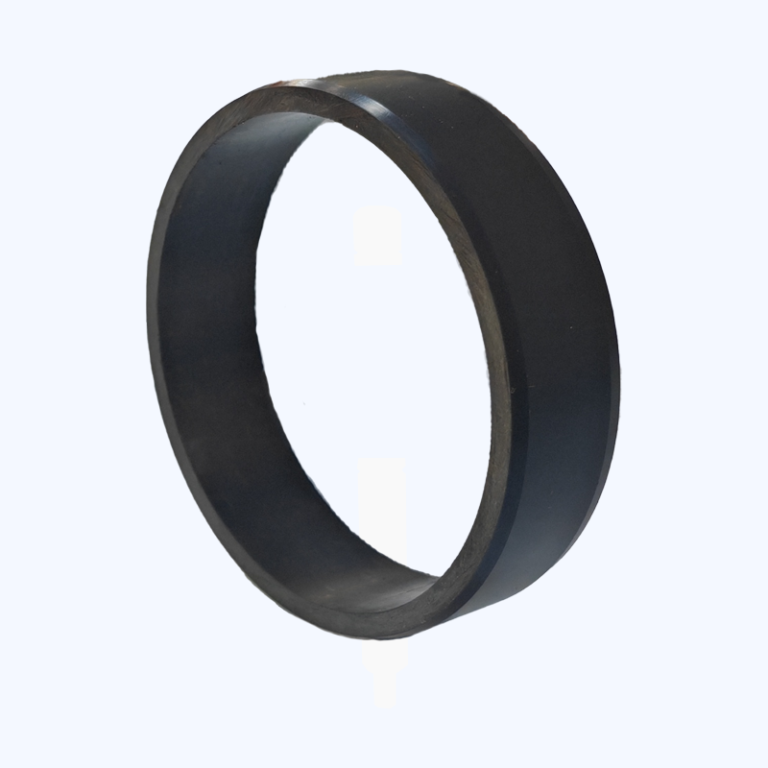
Magnetization Technology for Magnetic Rings is an important process in the manufacturing of permanent magnetic components. In industrial production, magnetization is also commonly called magnet charging. The process uses a strong external magnetic field to align the magnetic domains inside a permanent magnet blank. After the external magnetic field is removed, the magnetic material retains remanent magnetization. The final magnetic field distribution depends on the material, charging direction, fixture structure, pole arrangement, magnetic circuit, and process parameters. For motor rotors, magnetic encoders, magnetic couplings, sensors, and other precision components, selecting the appropriate Magnetization Technology for Magnetic Rings is essential for achieving the required magnetic field pattern. Understanding Magnetization Technology for Magnetic Rings The basic principle behind Magnetization Technology for Magnetic Rings is the application of a sufficiently strong external magnetic field to a permanent magnet material. Before charging, the magnetic domains inside the material are not necessarily aligned in the required direction. The external magnetic field provides the force needed to establish the desired magnetic orientation. Once the charging field is removed, the material retains part of this magnetization as remanence. The charging process therefore determines how the magnetic poles appear on the finished ring. Depending on the application, a

Diamagnetism in Ferrite Magnetic Rings

Diamagnetism in Ferrite Magnetic Rings and Ferrimagnetic Behavior

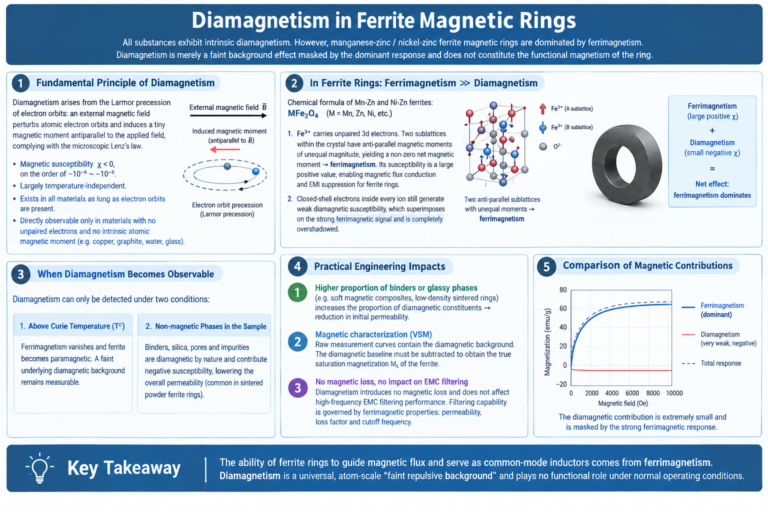
Ferrite magnetic rings are widely used in electromagnetic interference (EMI) suppression, common-mode filtering, inductors, transformers, and other electronic applications. Their magnetic performance is mainly determined by ferrimagnetism rather than diamagnetism. Understanding Diamagnetism in Ferrite Magnetic Rings is important because all materials contain some degree of diamagnetic response at the atomic level. However, in manganese-zinc (Mn-Zn) and nickel-zinc (Ni-Zn) ferrites, this weak background effect is overwhelmingly masked by the much stronger ferrimagnetic response. As a result, diamagnetism does not provide the functional magnetic behavior normally associated with ferrite rings. The ability of ferrite materials to guide magnetic flux and suppress high-frequency interference comes primarily from their ferrimagnetic properties. What Is Diamagnetism in Ferrite Magnetic Rings? Diamagnetism in Ferrite Magnetic Rings originates from the response of electron orbits to an external magnetic field. When an external magnetic field is applied to an atom, the motion of its electrons is slightly perturbed. This produces a very small induced magnetic moment that opposes the applied magnetic field. This behavior can be understood through Larmor precession and the microscopic form of Lenz’s law. The magnetic susceptibility of a diamagnetic material is negative: χ < 0 For typical diamagnetic materials, the magnitude of susceptibility is extremely

Magnetic Ring Physical Properties

Magnetic Ring Physical Properties and Electronic Applications

Magnetic rings are widely used in electronic equipment, motor systems, sensing devices, automotive components, and industrial automation. Their performance depends on material composition, magnetic structure, dimensions, frequency response, and magnetization design. Understanding Magnetic Ring Physical Properties helps engineers determine how a component will behave under different electrical and magnetic conditions. Ferrite rings used for electromagnetic interference (EMI) suppression mainly depend on frequency-related impedance, while permanently magnetized rings can be used with Hall-effect sensors for position and speed detection. Understanding Magnetic Ring Physical Properties The basic Magnetic Ring Physical Properties are closely related to the material from which the component is manufactured. Ferrite is widely used in electronic anti-interference components because of its magnetic response and frequency-dependent characteristics. Inside ferrite materials are numerous magnetic domains. When there is no external magnetic field, these domains have different orientations, and their magnetic effects largely cancel each other at the macroscopic level. When an alternating magnetic field is applied, the domains respond to the changing field. As the frequency increases, magnetic losses become more significant. This behavior contributes to the high-frequency impedance that makes ferrite components useful for noise suppression. Therefore, the Magnetic Ring Physical Properties should always be evaluated together with the operating

Magnetic Ring Physical Properties

Magnetic Ring Physical Properties and Applications in Electronic Devices

Understanding Magnetic Ring Physical Properties Magnetic rings are widely used in electronic devices, motor systems and sensing applications. Although they may have a simple ring-shaped structure, their performance is closely related to the physical characteristics of the magnetic material. The most important Magnetic Ring Physical Properties in electronic applications are related to their frequency-dependent impedance. Ferrite magnetic rings can provide relatively low impedance to low-frequency current while presenting much higher impedance to high-frequency signals. This characteristic allows magnetic rings to perform two important functions: electromagnetic interference suppression and magnetic sensing. Understanding these properties is important when selecting magnetic rings for cables, electronic circuits, motors and sensor systems. What Determines Magnetic Ring Physical Properties? Magnetic Domain Structure Ferrite materials contain numerous magnetic domains. Without an external magnetic field, these domains are generally oriented in different directions, so the material does not exhibit strong overall permanent magnetism. When an alternating magnetic field is applied, the magnetic domains respond to the changing field. At high frequencies, the domains repeatedly change their magnetic state. This process produces magnetic losses, including hysteresis-related losses and other energy dissipation mechanisms. Part of the high-frequency electrical energy is therefore converted into heat. This behavior gives ferrite magnetic rings

Magnetic Ring Pole Count

Magnetic Ring Pole Count and Gauss Value: How They Affect Performance

Introduction to Magnetic Ring Pole Count and Magnetic Field Strength Magnetic rings are widely used in motors, sensors, encoders, automotive components and industrial control systems. Their performance depends on several factors, but Magnetic Ring Pole Count and magnetic field strength are among the most important parameters. Although these two specifications are often discussed together, they perform different functions. Pole count mainly influences signal density, detection resolution and motor control characteristics. Magnetic field strength, commonly measured in Gauss, determines the intensity and effective range of the magnetic field. Understanding the relationship between Magnetic Ring Pole Count, Gauss value and magnetization direction can help engineers select the right magnetic solution for specific applications. What Is Magnetic Ring Pole Count? Understanding Magnetic Pole Configuration Magnetic Ring Pole Count refers to the number of alternating north and south magnetic poles distributed around or across a magnetic ring. For example, a 2-pole magnetic ring contains one north pole and one south pole. A 4-pole ring contains two alternating N-S pole pairs, while an 8-pole ring contains four pole pairs. Common configurations include: 2 poles 4 poles 8 poles 12 poles Multi-pole customized configurations The appropriate pole configuration depends on whether the magnetic ring is designed

Ferrite Magnetic Rings for EMI Suppression

Ferrite Magnetic Rings for EMI Suppression in Electronic Devices

Introduction to Ferrite Magnetic Rings for EMI Suppression Modern electronic devices rely heavily on switching power supplies, variable-frequency motors, digital control circuits and high-speed communication systems. While these technologies improve efficiency and functionality, they can also generate unwanted high-frequency electromagnetic noise. If electromagnetic interference is not properly controlled, the noise may travel along power lines or signal cables. This can interfere with nearby electronic equipment, affect sensitive control circuits and reduce the stability of wireless communication systems. Ferrite Magnetic Rings for EMI Suppression provide a practical and widely used solution for controlling high-frequency interference. Installed around power cables or signal lines, these magnetic components help reduce unwanted noise without significantly affecting normal low-frequency current transmission. What Are Ferrite Magnetic Rings for EMI Suppression? Ferrite Magnetic Rings for EMI Suppression are soft magnetic components designed to increase impedance against unwanted high-frequency electrical noise. They are commonly manufactured from ferrite materials and installed directly around electrical cables. When a cable passes through a ferrite ring, the magnetic component creates frequency-dependent impedance within the circuit. At normal operating frequencies, the impedance remains relatively low, allowing electrical current or useful signals to pass through. At higher interference frequencies, however, the impedance increases. Part of

Magnetic Ring Sensors

Magnetic Ring Sensors: How Magnetic Rings Enable Intelligent Detection

Introduction to Magnetic Ring Sensors As household appliances and electronic devices become increasingly intelligent, reliable sensing technology plays an essential role in improving automation, safety and operational accuracy. Magnetic Ring Sensors are widely used in modern equipment to detect movement, position, speed and other physical conditions without direct mechanical contact. In many applications, a permanent magnetic ring works together with a Hall sensor to convert physical movement into electrical signals. Because this detection method does not require direct contact between the sensing components, it offers advantages such as reduced mechanical wear, fast response and good resistance to dust and moisture. From household appliances and personal electronics to motor control and flow measurement systems, Magnetic Ring Sensors provide a practical solution for intelligent sensing applications. What Are Magnetic Ring Sensors? The term Magnetic Ring Sensors generally refers to a sensing system in which a magnetic ring works together with a Hall-effect sensor or another magnetic sensing device. The magnetic ring generates a magnetic field, while the sensor detects changes in that field. When the magnetic ring moves, rotates or changes position relative to the sensor, the detected magnetic signal also changes. The electronic control system can then process this signal to

Automotive Ferrite Magnets

Automotive Ferrite Magnets: A Reliable Solution for Vehicle Motor Applications

Introduction to Automotive Ferrite Magnets Modern vehicles rely on numerous electric motors to support functions such as windshield wiping, power windows, seat adjustment, fuel delivery, air circulation and thermal management. Behind many of these systems are Automotive Ferrite Magnets, which provide a stable magnetic field for permanent-magnet motors. Although rare-earth magnets receive considerable attention in high-power applications, ferrite remains an important material for automotive motor manufacturing. Its balanced combination of magnetic stability, corrosion resistance, temperature performance and cost efficiency makes it suitable for many high-volume vehicle applications. For manufacturers of automotive motors and magnetic components, selecting the appropriate Automotive Ferrite Magnets requires careful consideration of material grade, magnet geometry, motor structure and operating conditions. What Are Automotive Ferrite Magnets? Automotive ferrite magnets are permanent magnetic components designed for use in vehicle motors, actuators and related electrical systems. They are commonly produced from permanent ferrite materials, including strontium ferrite-based material systems. Depending on the motor design, these magnets can be manufactured in different forms, including: Ferrite magnetic arcs Ring magnets Segment magnets Rotor magnets Customized permanent magnets Injection-molded ferrite components Unlike soft ferrite cores used for EMI suppression, permanent ferrite magnets generate and maintain a magnetic field after magnetization. Automotive Ferrite

Permanent Ferrite Magnetic Rings

Permanent Ferrite Magnetic Rings for Automotive Motors

Introduction to Permanent Ferrite Magnetic Rings Permanent Ferrite Magnetic Rings are important magnetic components used in automotive motor systems. In automotive applications, the term “magnetic ring” can refer to different products, including soft ferrite rings for electromagnetic interference (EMI) suppression and permanent-magnet components used to generate the excitation field of motors. Among automotive auxiliary motor applications, permanent ferrite magnetic arcs and rings are particularly important. These components provide a stable magnetic field for various DC permanent-magnet motors used throughout a vehicle. With their combination of cost efficiency, temperature stability, corrosion resistance and demagnetization resistance, Permanent Ferrite Magnetic Rings remain a practical choice for many automotive motor applications. What Are Permanent Ferrite Magnetic Rings? Permanent Ferrite Magnetic Rings are permanent-magnet components manufactured from ferrite magnetic materials, commonly based on strontium ferrite. Depending on the motor structure, they can be produced as: Magnetic rings Arc magnets Segment magnets Customized rotor magnets Injection-molded ferrite magnetic components Unlike soft ferrite components used for EMI suppression, permanent ferrite materials retain a stable magnetic field after magnetization. In automotive motors, this magnetic field acts as the excitation source and interacts with the electromagnetic field generated by the motor windings. Permanent Ferrite Magnetic Rings in Automotive Motors

Scroll to Top