
Induction magnetic rings are important permanent magnetic components used in motor position detection, rotational speed measurement, magnetic encoders, and motion control systems. They work with Hall-effect sensors or other magnetic sensing technologies to convert changes in magnetic fields into electrical signals.
As brushless motors, automotive electrification, industrial automation, and robotics continue to develop, the demand for accurate and reliable magnetic sensing components is increasing. Manufacturers are placing greater emphasis on multipole magnetization, magnetic field uniformity, dimensional accuracy, and long-term operating stability.
For motor manufacturers and magnetic sensing system designers, understanding the structure, applications, and manufacturing requirements of induction magnetic rings is essential for selecting suitable components.
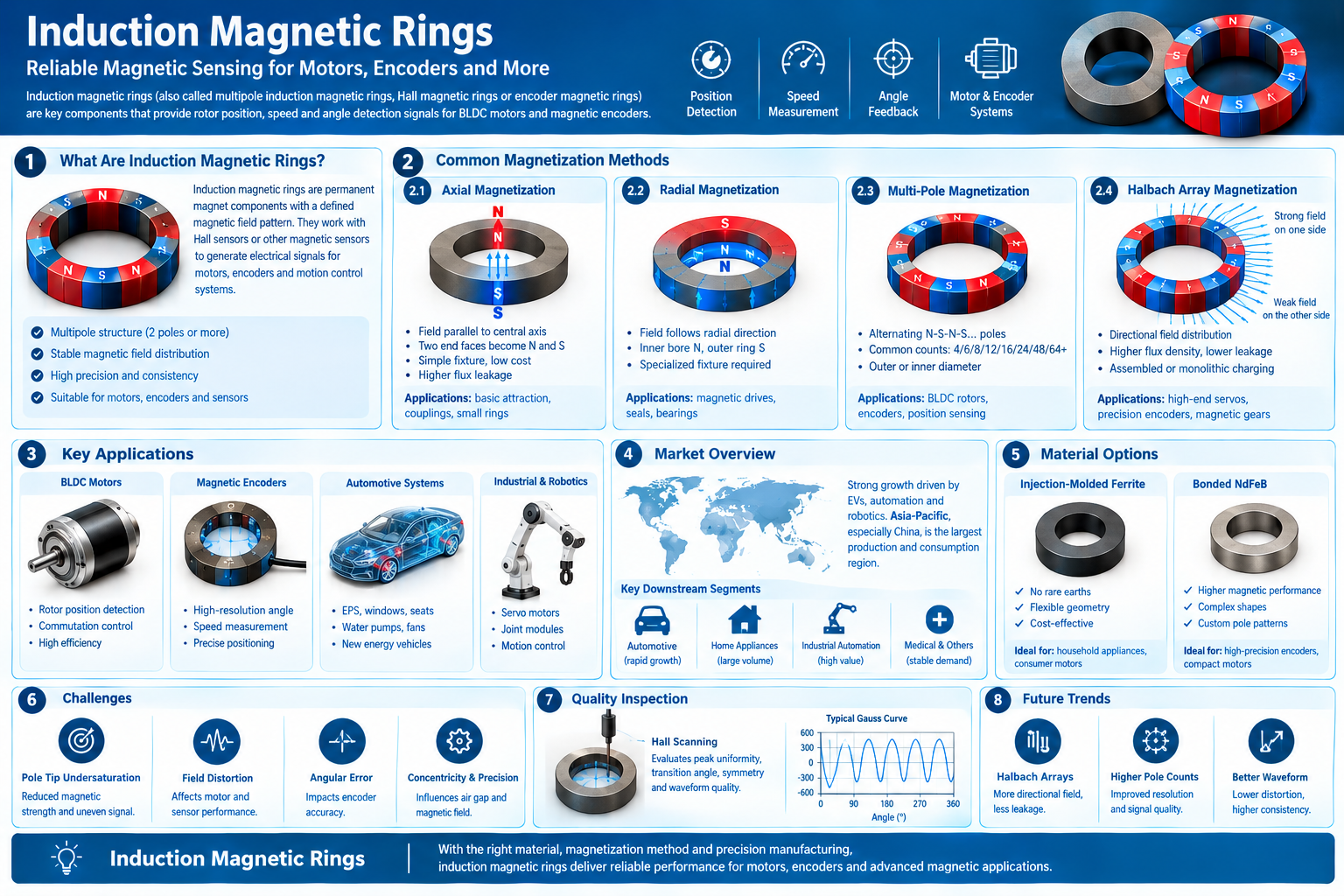
What Are Induction Magnetic Rings?
Induction magnetic rings are permanent magnetic components designed to generate a defined magnetic field pattern for non-contact sensing.
Unlike conventional magnets primarily used for attraction or holding force, these components are engineered to provide magnetic signals that can be detected by sensors during rotation or movement.
A typical assembly consists of a magnetic ring, a Hall-effect sensor or another magnetic sensing element, and an electronic control system. As the ring rotates, alternating magnetic poles pass the sensor, generating electrical signals that can be used to calculate rotational speed, position, or angular movement.
Depending on the application, a magnetic ring may use two poles or multiple alternating north and south poles around its circumference.
Main Characteristics of Induction Magnetic Rings
Important characteristics include:
-
Defined magnetic pole arrangement
-
Consistent magnetic field distribution
-
Controlled pole spacing and transition angles
-
Compatibility with magnetic sensing technologies
-
Suitable performance across the required operating temperature range
-
Dimensional consistency for reliable assembly
These characteristics make induction magnetic rings suitable for compact motors, automotive components, magnetic encoders, and industrial motion control equipment.
Main Materials Used in Induction Magnetic Rings
Material selection influences magnetic strength, manufacturing flexibility, temperature performance, and production cost.
Two common material categories are injection-molded ferrite and bonded neodymium iron boron (NdFeB).
Injection-Molded Ferrite Magnetic Rings
Injection-molded ferrite magnetic rings combine ferrite magnetic powder with a polymer binder. The mixture is processed through injection molding to produce components with complex geometries and repeatable dimensions.
Common advantages include:
-
No dependence on rare-earth elements
-
Flexible component geometry
-
Suitability for high-volume manufacturing
-
Integration with selected plastic structures
-
Cost-effective production for many consumer motor applications
These components are frequently considered for fans, water pumps, small household appliances, and other applications where production volume and cost control are important.
Their final magnetic performance depends on the ferrite formulation, powder characteristics, molding conditions, magnetization pattern, and component geometry.
Bonded NdFeB Magnetic Rings
Bonded NdFeB magnetic rings use neodymium-based magnetic powder combined with a binder. They can offer higher magnetic performance than many ferrite formulations while supporting complex shapes and multipole magnetization.
Potential applications include compact motors, precision magnetic encoders, and sensing assemblies that require stronger magnetic fields within limited installation space.
However, material selection must account for operating temperature, corrosion protection, mechanical requirements, and rare-earth material costs.
Comparing Ferrite and Bonded NdFeB Rings
| Feature | Injection-Molded Ferrite | Bonded NdFeB |
|---|---|---|
| Main material | Ferrite powder and binder | NdFeB powder and binder |
| Rare-earth dependence | Generally none | Yes |
| Magnetic performance | Suitable for many standard sensing applications | Generally higher magnetic energy potential |
| Manufacturing flexibility | Complex molded geometries | Complex molded geometries |
| Cost considerations | Often economical for high-volume products | More sensitive to rare-earth material prices |
| Typical applications | Fans, pumps, household motors | Compact motors, precision sensing and encoders |
The best material depends on the required magnetic signal, working temperature, dimensions, production volume, and total component cost.
Key Applications of Induction Magnetic Rings
The demand for induction magnetic rings is closely connected to the development of brushless motors and non-contact sensing systems.
Automotive Micro Motors
Automotive applications represent an important area for magnetic sensing components. Modern vehicles use numerous small motors for comfort, steering assistance, thermal management, and other functions.
Potential applications include:
-
Electric power steering systems
-
Power windows
-
Powered seats
-
Electric water pumps
-
Cooling fans
-
Selected wheel-speed and rotational sensing systems
The precise component requirements vary by application. Automotive designs generally place particular emphasis on temperature resistance, vibration tolerance, dimensional stability, and long-term consistency.
The growth of electric and hybrid vehicles also increases the importance of compact electric actuators and thermal management systems. This creates additional opportunities for magnetic components designed for demanding automotive environments.
BLDC Motors and Household Appliances
Brushless DC motors are widely used in household appliances because they support electronic speed control and can provide efficient operation when properly designed.
Induction magnetic rings can supply rotor-position or rotational-speed signals in systems using magnetic sensing.
Common applications include:
-
Robot vacuum cleaners
-
Electric fans
-
Water pumps
-
Small household appliances
-
Gimbal motors
-
Compact actuators
For high-volume consumer products, manufacturers typically balance magnetic performance with unit cost, molding efficiency, and batch-to-batch consistency.
Industrial Automation and Robotics
Industrial automation requires reliable position and motion feedback across motors, rotary mechanisms, and robotic joints.
Magnetic rings can be integrated into servo systems, rotary encoders, collaborative robots, and other automated equipment.
Compared with basic speed detection, precision motion control may require more demanding magnetic waveform characteristics and angular consistency.
High-pole-count magnetic rings and specialized Halbach configurations may be considered when the sensing architecture benefits from a more carefully controlled magnetic field distribution.
Flowmeters and Medical Equipment
Magnetic sensing is also used in selected fluid measurement systems and medical equipment.
In a flowmeter, a rotating or moving element can carry a magnetized component. A sensor detects changes in the magnetic field and sends signals to the measurement electronics.
For medical equipment and other precision devices, component selection must reflect the specific environmental, dimensional, reliability, and regulatory requirements of the final system.
What Drives Demand for Induction Magnetic Rings?
Several long-term developments are creating demand for magnetic sensing components.
The Shift Toward Brushless Motors
Brushless motor technology is used across automotive systems, home appliances, industrial equipment, and consumer devices.
Depending on the motor architecture, rotor-position feedback may be provided by Hall sensors, magnetic encoders, sensorless control algorithms, or other methods.
Where magnetic position sensing is used, a properly designed magnetic ring provides the field pattern required by the sensing system.
The continued adoption of brushless motors therefore supports demand for compatible magnetic sensing components.
Automotive Electrification
Electric and hybrid vehicles rely on a range of electric motors and actuators for steering, braking-related functions, thermal management, and auxiliary systems.
These applications may require magnetic components that can maintain consistent performance under temperature cycling, vibration, and extended operating periods.
As a result, automotive customers often place greater emphasis on traceability, manufacturing process control, and product validation.
Industrial Automation and Robotics
Servo motors, collaborative robots, and robotic joint modules increasingly require accurate motion feedback.
In some designs, conventional speed detection is not sufficient, and the sensing system must provide more detailed angular information.
This encourages the development of magnetic rings with higher pole counts, controlled magnetic waveforms, and tighter pole-position tolerances.
Wider Adoption of Magnetic Encoders
Magnetic encoders can offer practical advantages in environments where dust, vibration, or mechanical robustness is a concern.
Compared with optical encoders, certain magnetic designs can provide a compact structure and competitive cost. However, the choice between magnetic and optical technologies depends on the required accuracy, environmental conditions, resolution, and system architecture.
As magnetic sensing becomes more widely adopted in suitable applications, demand for compatible encoder rings can increase.
Domestic Supply Chain Development
Motor and sensor manufacturers may seek qualified local suppliers to improve delivery flexibility, reduce supply chain complexity, and support product customization.
For magnetic ring manufacturers, this creates opportunities to develop stronger capabilities in tooling, magnetization, inspection, and application engineering.
However, entering automotive and high-end industrial supply chains typically requires substantial validation and quality management rather than price competitiveness alone.
Manufacturing Challenges for Induction Magnetic Rings
Producing a magnetic ring blank is only one part of the manufacturing process. The finished component must also deliver the required magnetic field pattern and maintain dimensional consistency.
Precision Multipole Magnetization
Multipole magnetization requires a charging fixture and magnetic circuit capable of creating the intended sequence of north and south poles.
As pole count increases, individual pole regions become narrower, making fixture accuracy and field distribution more demanding.
Potential defects include uneven pole strength, incorrect transition positions, magnetic distortion, and incomplete magnetization in localized regions.
Magnetic Field Uniformity
A ring may meet its dimensional specifications but still produce an inconsistent magnetic waveform.
Differences in material properties, magnetization conditions, or fixture alignment can lead to variation between poles or between production batches.
For encoder and motor applications, these variations can affect signal consistency and system performance.
Concentricity and Dimensional Accuracy
The inner diameter, outer diameter, roundness, and concentricity of a magnetic ring influence how it fits into a motor or sensing assembly.
Dimensional errors can change the air gap between the ring and the sensor. Since magnetic field strength and waveform depend on the sensing distance and geometry, stable mechanical dimensions are important.
Manufacturers should therefore evaluate dimensional and magnetic characteristics together.
Customer Validation and Reliability
Automotive and industrial customers often require application-specific qualification, reliability testing, and production consistency.
Depending on the end use, validation may include temperature cycling, vibration, environmental exposure, dimensional checks, magnetic waveform measurement, and long-term performance assessment.
The exact requirements vary by customer and product category, making early technical communication important.
Technology Trends: Halbach Arrays and Higher Pole Counts
The development of induction magnetic rings is moving toward more precise magnetic field control and greater integration with advanced sensing systems.
Halbach Magnetic Ring Design
A Halbach array uses different magnetization directions arranged in a specific sequence to concentrate the useful magnetic field on one side while reducing it on the other.
In suitable ring designs, this can improve magnetic field utilization and reduce unwanted leakage.
Potential applications include precision encoders, advanced servo systems, and specialized robotic mechanisms.
However, Halbach structures require careful design of the magnetization pattern and magnetic circuit. Their advantages depend on the material, geometry, sensor position, and overall system configuration.
Higher Pole Counts
Magnetic rings with 32, 64, 128, or more poles may be considered for specialized sensing applications.
A higher pole count can provide more magnetic transitions per mechanical revolution. Nevertheless, it does not automatically guarantee greater system accuracy or resolution.
The final performance also depends on sensor capability, signal processing, pole-position errors, waveform quality, and calibration.
Magnetic Waveform Quality
Manufacturers increasingly need to evaluate more than the peak Gauss value.
Important characteristics include:
-
Peak magnetic field strength
-
Pole-to-pole consistency
-
Pole transition angle
-
Waveform symmetry
-
Harmonic distortion
-
Magnetic field changes across temperature
-
Batch-to-batch repeatability
These parameters help determine whether a magnetic ring can meet the actual requirements of a motor or encoder.
How to Select a Suitable Induction Magnetic Ring
When evaluating induction magnetic rings for a new project, engineers should consider the complete sensing system rather than selecting a component based on material or pole count alone.
Key questions include:
-
What is the intended application: motor commutation, speed detection, or angular position measurement?
-
Which sensor technology will be used?
-
What pole count and magnetization pattern are required?
-
What magnetic field strength is needed at the working air gap?
-
What are the operating temperature and environmental conditions?
-
Which dimensional tolerances and concentricity requirements apply?
-
What magnetic inspection and batch-consistency criteria are necessary?
Providing these details early can help manufacturers assess material options, tooling requirements, magnetization feasibility, and quality-control methods.
Conclusion
Induction magnetic rings are important components in magnetic sensing systems used for motors, encoders, automotive equipment, household appliances, and industrial automation.
Their performance depends on more than magnetic material alone. Multipole magnetization, field uniformity, pole-position accuracy, concentricity, and temperature stability all influence how the finished ring performs in its intended application.
As brushless motors, electric vehicles, and robotics continue to develop, the industry is placing greater emphasis on precision manufacturing and application-specific magnetic design.
For manufacturers and engineering teams, selecting the right material and magnetization structure—and validating the magnetic waveform under actual operating conditions—provides a practical foundation for developing reliable magnetic sensing solutions.