Multi-Pole Magnetic Ring Magnetization for Motors and Magnetic Encoders
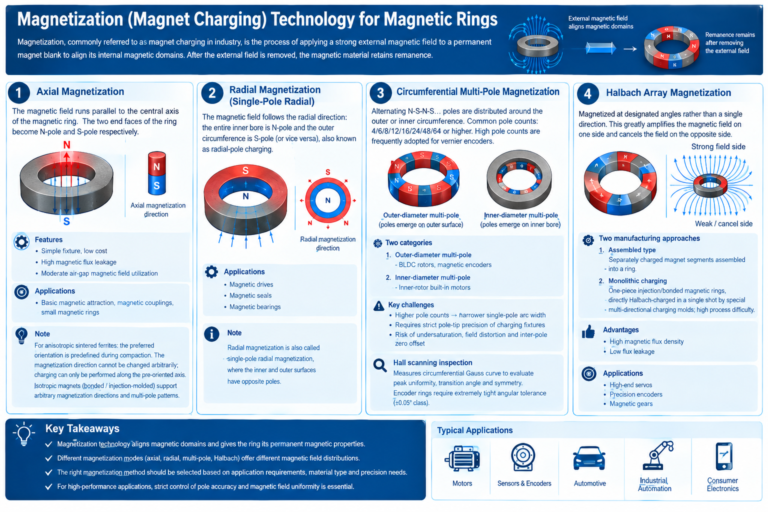
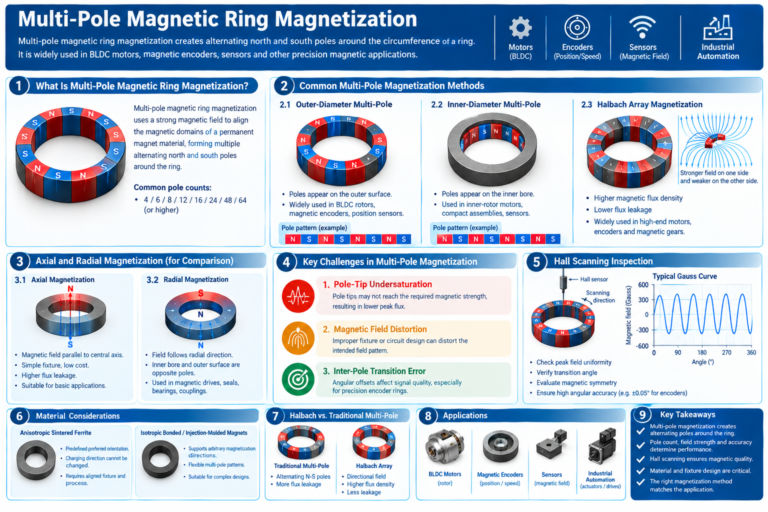
Multi-Pole Magnetic Ring Magnetization is an important manufacturing process for permanent magnetic components used in motors, magnetic encoders, sensors, and other rotary systems. Unlike simple two-pole magnetization, multi-pole charging creates alternating north and south poles around the circumference of a magnetic ring. The number of poles, magnetic field strength, pole width, transition angle, and magnetic uniformity all influence the performance of the finished component. For this reason, precise charging equipment and magnetic inspection are essential when producing high-quality multi-pole magnetic rings. What Is Multi-Pole Magnetic Ring Magnetization? Multi-Pole Magnetic Ring Magnetization creates multiple alternating magnetic poles around the circumference of a permanent magnetic ring. A typical pattern can be represented as: N-S-N-S-N-S-N-S The exact number of poles depends on the application. Common configurations include 4, 6, 8, 12, 16, 24, 48, and 64 poles, while specialized encoder applications may require even higher pole counts. During charging, a specially designed fixture generates a strong magnetic field at specific locations around the ring. The magnetic field aligns the internal magnetic domains and establishes the required pole pattern. After the charging field is removed, the magnetic material retains remanent magnetization. Why Multi-Pole Magnetic Ring Magnetization Matters The main purpose of Multi-Pole Magnetic Ring