NEWS

neodemium magnet

What Makes a Professional Sintered NdFeB Magnet Factory Stand Out:neodemium magnet

What Makes a Professional Sintered NdFeB Magnet Factory Stand Out SEO Title (50–60 characters):Neodemium Magnet Factory – Highkos Sintered NdFeB Solutions Meta Description (120 characters):Neodemium magnet solutions by Highkos deliver reliable, high-performance magnets tailored for industrial applications. What Makes a Professional Sintered NdFeB Magnet Factory Stand Out In modern industries, neodemium magnet (NdFeB magnet) is an essential component used in electric motors, robotics, renewable energy, and more. However, the performance and reliability of these magnets depend on the expertise and production quality of the factory. Selecting a professional sintered NdFeB magnet factory ensures consistent magnetic strength, durability, and long-term stability. For more information, visit Highkos Official Website. Advanced Manufacturing Capabilities of a Neodemium Magnet Factory Precision Sintering Technology for High-Performance Magnets A professional factory utilizes precision sintering technology to produce high-quality magnets. The sintering process heats powders to high temperatures and controls cooling rates, determining the magnet’s microstructure, uniformity, and stability. Temperature Control: Ensures even heating and consistent magnetic properties. Pressure Management: Reduces porosity and improves mechanical strength. Controlled Cooling: Prevents internal stress and minimizes cracks. Precision sintering allows each NdFeB magnet to achieve optimal energy product (BHmax) and long-lasting performance. Premium Raw Materials for Neodemium Magnet High-performance magnets require

neodemium magnet

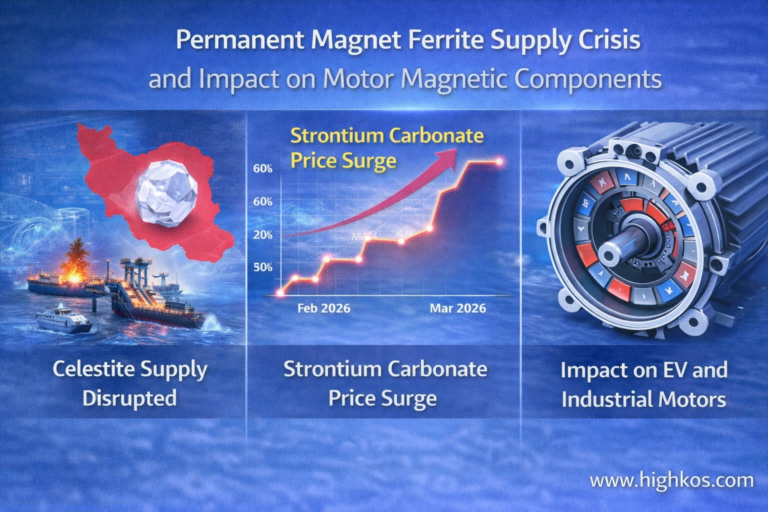
Permanent Magnet Ferrite Supply Crisis and Its Impact on Motor Magnetic Component

Permanent magnet ferrite materials are essential components in modern motors, sensors, and energy systems. However, in March 2026 the global supply chain for permanent magnet ferrite entered a serious crisis due to disruptions in the upstream celestite raw material market. This sudden supply shock is already affecting industries such as: new energy vehicle motors wind power generators energy-efficient motors industrial automation systems As companies relying on magnetic components face rising costs and unstable supply, the security of the global magnetic materials supply chain has become a major industry concern. Manufacturers of precision magnetic components, such ashttps://www.highkos.com/, are closely monitoring these changes as they directly impact the production of ferrite magnets and injection molded magnetic parts used in modern motor systems. Global Celestite Shortage Behind the Ferrite Magnet Crisis The current crisis originates from the sudden disruption of high-grade celestite supply, which is the key raw material used to produce strontium carbonate. Strontium carbonate is one of the most critical ingredients used in manufacturing permanent magnet ferrite materials. However, global celestite resources are highly concentrated. Important facts about the global supply chain include: Iran holds about 85% of the world’s high-grade celestite reserves Iran accounts for around 35% of global celestite

injection molded magnetic rings

Injection Molded Magnetic Rings: Static Magnetic Field Formation and Manufacturing Process

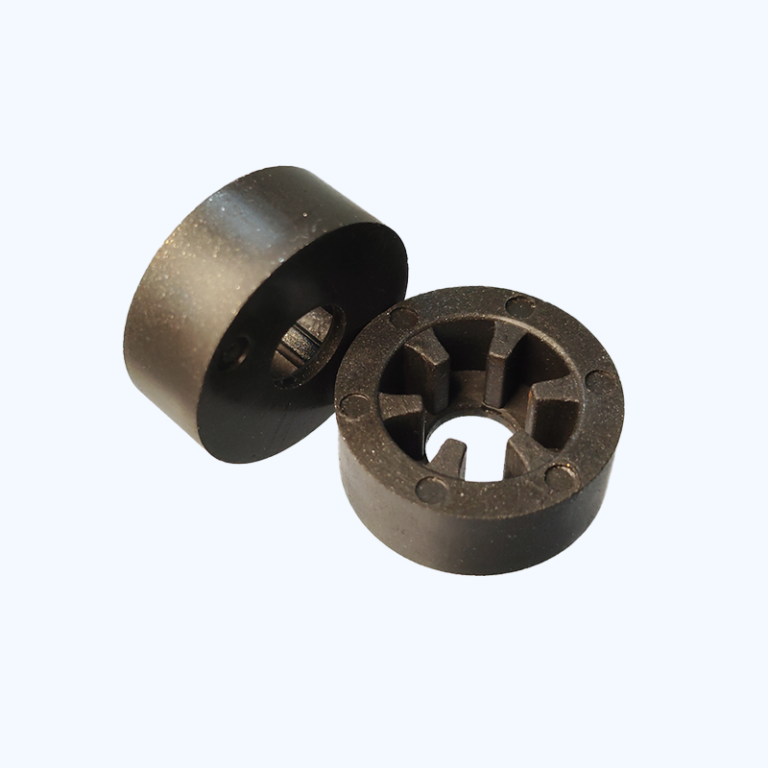
Injection molded magnetic rings are important functional components used in modern sensors, encoders, and brushless motor systems. Their magnetic performance determines the accuracy of signal transmission and the stability of motor control. Unlike traditional sintered magnets, injection molded magnetic rings are manufactured by mixing magnetic powder with a thermoplastic polymer matrix and forming the component through injection molding. This production method allows manufacturers to create complex shapes with high dimensional precision while maintaining stable magnetic properties. The static magnetic field generated by injection molded magnetic rings is the final result of complex microstructural changes during the molding and magnetization process. Understanding how this magnetic field forms is critical for improving device performance. For more information about magnetic components and customized magnetic solutions, you can explore the product resources at👉 https://www.highkos.com/ Material Structure of Injection Molded Magnetic Rings Injection molded magnetic rings belong to the category of polymer bonded magnets. These materials are composed of two major elements: Magnetic powder filler Common magnetic powders include: Ferrite magnetic powder NdFeB magnetic powder These powders provide the permanent magnetic properties required for sensors and motor systems. Thermoplastic polymer matrix Typical polymer materials include: PA12 PPS Nylon-based engineering plastics The polymer matrix allows the

static magnetic properties of injection molded magnetic rings

Static Magnetic Properties of Injection Molded Magnetic Rings and Their Engineering Significance

Static Magnetic Properties of Injection Molded Magnetic Rings Static magnetic properties are critical parameters that determine the performance of injection molded magnetic rings used in sensors, motors, and industrial automation systems. In modern engineering applications, these properties directly affect signal accuracy, magnetic stability, and device reliability. Injection molded magnetic rings are widely used in brushless motors, encoders, speed sensors, and automotive systems because they allow precise control of magnetic pole distribution and compact integrated designs. Companies specializing in magnetic components, such ashttps://www.highkos.com/, provide advanced solutions for high-precision magnetic components used in electronics and industrial equipment. Key Static Magnetic Properties in Injection Molded Magnetic Rings In engineering applications, several indicators are used to evaluate the static magnetic properties of injection molded magnetic rings. Remanence Remanence refers to the magnetic induction that remains in the magnetic ring after the external magnetizing field is removed. Typical remanence values include: Ferrite injection molded magnets: 0.21 – 0.31 T NdFeB injection molded magnets: 0.35 – 0.78 T Higher remanence allows the magnetic ring to produce stronger and more stable magnetic fields, which is essential for motor rotors and sensor systems. Injection molded magnets offered by manufacturers likehttps://www.highkos.com/ can be customized to achieve specific magnetic field

Highkos – Magnet Solutions for Fan & Motor Applications”

Highkos Supports Fan & Motor Manufacturers During FanTech Expo India 2026

Highkos Supports Fan & Motor Manufacturers During FanTech Expo India 2026 With the upcoming FanTech Expo India 2026 (Feb 12–14) drawing attention from fan and motor manufacturers worldwide, now is the perfect time to explore innovative magnet solutions that can enhance your products. At Highkos, we specialize in the design and production of high-performance permanent magnets for a wide range of fan and motor applications. Our products are engineered to deliver consistent magnetic performance, high efficiency, and long service life, helping manufacturers meet increasing demands for energy-efficient, high-quality motors. Magnet Solutions Tailored for Fan Motors Our experience covers a variety of applications, including: Ceiling fan motors – reliable performance for residential and commercial fans BLDC fan motors – optimized for energy efficiency and durability Other motor systems – customized solutions for specific design requirements By partnering with Highkos, manufacturers can achieve:✔ Improved torque and rotational stability✔ Reduced energy consumption✔ Enhanced product lifespan and reliability Why Choose Highkos Advanced materials & precise magnetization – ensuring stable and reliable performance Custom solutions for production needs – scalable for both small batches and mass production Global supply experience – trusted by international clients in the fan and motor industries Connect With Us The

Multipole Magnetization for Injection Molded Magnets

Multipole Magnetization for Injection Molded Magnets in Industrial Applications

Multipole Magnetization for Injection Molded Magnets in Industrial Applications Multipole Magnetization for Injection Molded Magnets has become a key technology in modern industrial design, especially in applications that require compact structures, precise magnetic fields, and high efficiency. Compared with traditional single-pole or two-pole magnetization, multipole magnetization allows engineers to tailor magnetic performance to meet increasingly complex system requirements. Injection molded magnets, combined with advanced multipole magnetization techniques, are now widely used in motors, sensors, solenoid systems, and thermal management equipment. What Is Multipole Magnetization for Injection Molded Magnets? Multipole magnetization refers to a process in which multiple north and south poles are distributed across a magnetic component in a predefined pattern. When applied to injection molded magnets, this technique enables: Higher magnetic field resolution Improved torque smoothness Better signal accuracy for sensors Reduced vibration and noise Because injection molded magnets can be produced in complex shapes, multipole magnetization for injection molded magnets offers greater design flexibility than traditional sintered magnets. Why Multipole Magnetization Matters in Industrial Design Industrial systems today demand: Smaller and lighter components Higher energy efficiency Lower noise and vibration Stable performance over long lifecycles Multipole magnetization directly supports these goals by optimizing magnetic flux distribution. This is

Injection Molded Magnet Magnetization

The main magnetization methods for injection molded magnets are as follows

Injection Molded Magnet Magnetization: Key Techniques and Applications Injection Molded Magnet Magnetization plays a critical role in producing high-performance magnetic components for a wide range of industrial applications. From electric motors and sensors to automotive thermal systems and renewable energy devices, proper magnetization ensures consistent magnetic strength, efficiency, and long-term reliability. In this article, we explore the main methods of magnetizing injection molded magnets, their applications, and why B2B manufacturers rely on these techniques for scalable and reliable production. What Is Injection Molded Magnet Magnetization? Injection molded magnets are made by combining magnetic powders with polymer binders through precise injection molding processes. After molding, these magnets require magnetization to align magnetic domains in a specific orientation. Proper magnetization improves: Motor torque and efficiency Sensor accuracy System durability Energy efficiency and performance consistency B2B manufacturers rely on proper injection molded magnet magnetization to meet the high standards of industrial motors, EV components, and advanced sensors. Main Magnetization Methods 1. External Magnetic Field Magnetization This method uses strong external magnetic fields, generated by permanent magnets or electromagnets, to magnetize the molded part. Key features include: Full penetration of the magnetic field for uniform magnetization Suitable for simple geometries or single-pole designs Commonly

Integrated magnetic assemblies

Integrated Magnetic Assemblies for Advanced Thermal Control Systems

Integrated Magnetic Assemblies for Advanced Thermal Control Systems As automotive electrification and industrial automation continue to advance, thermal control systems have become one of the most critical subsystems affecting safety, efficiency, and reliability. From battery packs and power electronics to fluid circulation and sensing modules, every component must work together under increasingly demanding conditions. In this context, integrated magnetic assemblies are emerging as a key enabling technology. By combining magnetic functionality, mechanical structure, and environmental protection into a single compact unit, these assemblies help manufacturers meet strict performance, space, and durability requirements—especially in automotive and industrial thermal control systems. Understanding Integrated Magnetic Assemblies Integrated magnetic assemblies are multi-functional magnetic components designed to perform more than just magnetic tasks. Unlike traditional magnet solutions that rely on multiple discrete parts, these assemblies integrate: Magnetic elements Structural support Functional interfaces Protective encapsulation This design philosophy reduces system complexity while improving dimensional accuracy, repeatability, and long-term stability. For B2B manufacturers, integrated magnetic assemblies offer a practical way to simplify system architecture without compromising performance. Why Thermal Control Systems Demand Integrated Magnetic Solutions Thermal control systems operate in some of the harshest environments within modern equipment. Components must withstand: Wide temperature ranges Continuous vibration Coolant

Injection molded ferrite magnet

Injection Molded Ferrite Magnetic Components for Thermal Management Systems

Injection Molded Ferrite Magnetic Components for Thermal Management Systems In modern automotive and industrial thermal management systems, reliability, precision, and integration are no longer optional — they are essential. From electronic water pumps to solenoid valves and temperature sensors, magnetic components play a key role in controlling coolant flow, heat exchange, and system stability. Thanks to injection molded ferrite technology, manufacturers can now achieve higher precision, lower noise, stronger corrosion resistance, and fully integrated designs that traditional sintered magnets struggle to match. Why Injection Molded Ferrite Magnets Are Widely Used in Thermal Systems Injection molded ferrite magnetic components are especially suitable for magnetic drive components, sensors, and heat exchange control units due to several core advantages: High dimensional accuracy Excellent corrosion resistance Integrated molding of multiple functional parts Stable magnetic performance across wide temperature ranges Cost-effective mass production for B2B applications These characteristics make injection molded ferrite a critical material in both automotive and industrial thermal control systems. 1. Electronic Water Pump Rotor Magnet Application Function The electronic water pump rotor magnet is responsible for driving coolant circulation to regulate the temperature of: Battery packs Electric motors Power electronics and control units Stable coolant flow directly affects system efficiency, safety,

motor control magnetic ring

Injection Molded Magnetic Drive Motors for Industrial Fans & Motors | Highkos

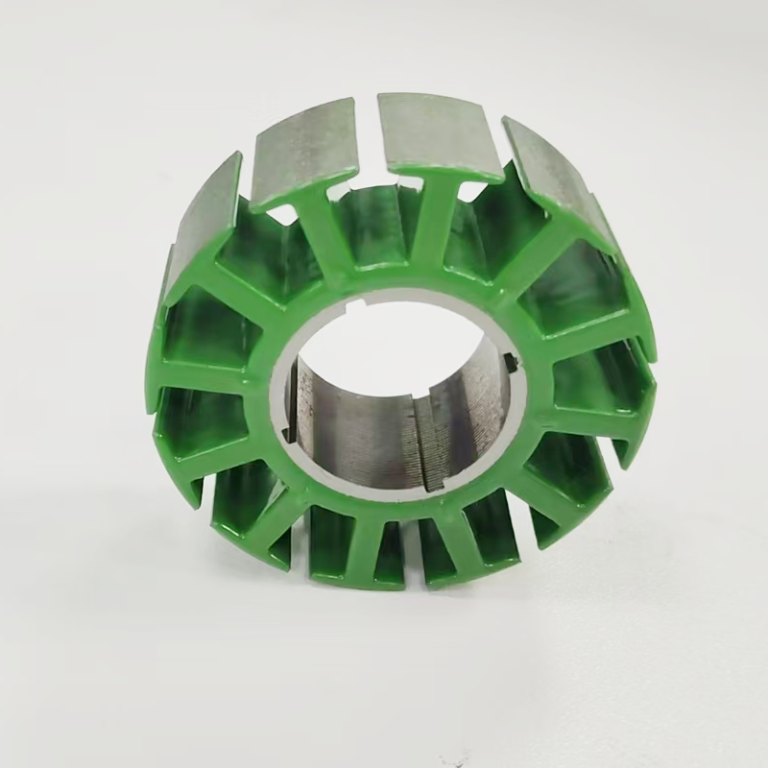
Injection Molded Magnetic Drive Motors for Industrial Fans & Motors In today’s industrial world, reliable, energy-efficient, and durable motors are essential. Whether you’re designing industrial ventilation systems, HVAC units, water pumps, or custom machinery, the right motor can make a huge difference in efficiency, performance, and maintenance costs. Injection molded magnetic drive motors have quickly become a preferred choice for engineers and OEMs because they combine high precision, lightweight design, and cost-effective production. At Highkos, we provide a complete range of custom magnetic motor components, including injection molded ferrite, bonded NdFeB magnets, rotors, and stators. Our solutions help manufacturers improve efficiency, reduce downtime, and deliver reliable products. Explore our offerings here: Highkos Products. Why Injection Molded Magnetic Drive Motors Are Essential for Industrial Applications 1. High Precision and Repeatable Performance Injection molded magnetic components allow engineers to achieve tight tolerances and precise rotor geometries. This ensures: Stable magnetic flux, which improves torque consistency Reduced vibration and noise for smoother motor operation Long-term reliability, even in continuous-duty industrial fans and pumps High precision is especially important in industrial ventilation systems, where consistent airflow and minimal vibration are critical for both efficiency and workplace comfort. 2. Energy Efficiency That Reduces Operational Costs

Advantages of Injection Molded Magnetic Drive Motors

Advantages of Injection Molded Magnetic Drive Motors in Convection Fan Applications With the growing demand for high-efficiency, lightweight, and cost-effective convection fans, motor technology has become a critical factor in product performance and market competitiveness. Among the latest innovations, injection molded magnetic drive motors are increasingly adopted in convection fan systems due to their superior manufacturing flexibility, magnetic performance, and system integration advantages. Manufacturers such as Highkos, a professional supplier of precision magnetic motor components and magnetic drive solutions, are leveraging injection molded magnetic materials to deliver high-performance, energy-efficient motor solutions for HVAC, ventilation, and convection fan applications.👉 Learn more about magnetic motor solutions at:https://www.highkos.com/ What Are Injection Molded Magnetic Drive Motors? Injection molded magnetic drive motors utilize bonded magnetic materials, typically composed of rare-earth magnetic powders combined with polymer binders, shaped through high-precision injection molding processes. Unlike traditional sintered magnets, injection molded magnets allow complex geometries, tighter tolerances, and integrated rotor designs, making them ideal for modern convection fan motors. These motors are widely used in: Convection fans Ventilation systems HVAC equipment Cooling fans for electronics Energy-efficient household appliances Key Advantages of Injection Molded Magnetic Drive Motors 1. High Dimensional Accuracy for Optimized Fan Performance Injection molding enables precise

Magnetic Ring for Motors

High Kos Magnet: Premium Neodymium & Ferrite Magnetic Solutions for Global Industrial Applications

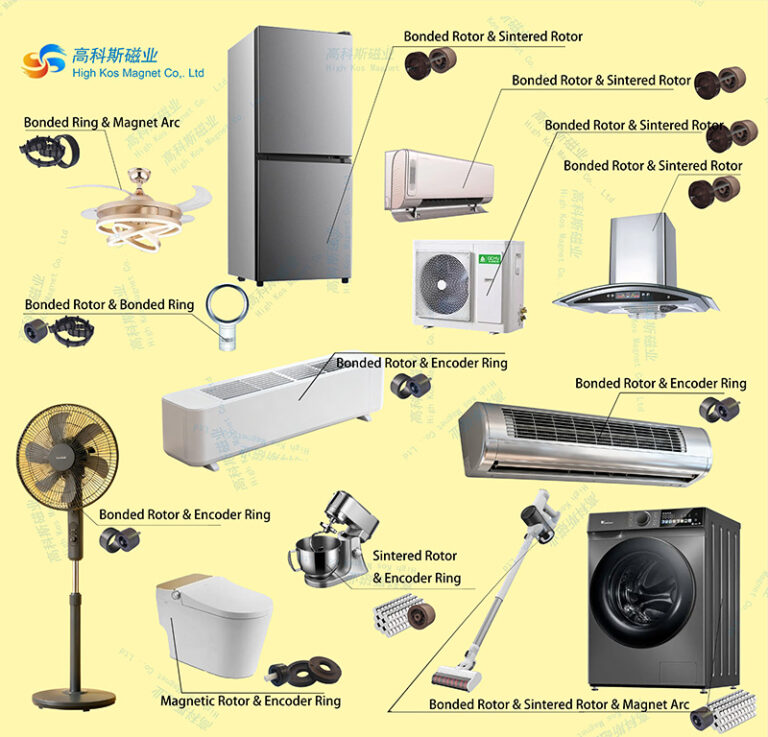
High Kos Magnet: Premium Magnetic Solutions to Power Next-Gen Industrial & Motor Applications In today’s competitive industrial landscape, high-performance magnetic components are pivotal to product reliability, energy efficiency, and overall system performance. High Kos Magnet Co., Ltd., with over 18 years of experience in magnet technology, is a trusted global supplier of both neodymium (NdFeB) and ferrite magnetic solutions tailored for diverse industrial applications. Comprehensive Magnetic Product Portfolio for OEMs & Engineers High Kos offers an extensive range of magnetic components designed to support mission-critical applications in automotive, consumer electronics, industrial automation, home appliances, pumps, and more. Key product categories include: Injection Molded Ferrite Magnets – precision-engineered magnetic rings and rotors for motors in ceiling fans, industrial blowers, and water pumps. Injection Molded NdFeB Magnets – high-energy rare-earth magnets with superior magnetic properties for electric motors and precision sensors. Sintered NdFeB & Bonded NdFeB Magnets – powerful permanent magnets optimized for stability and performance in demanding environments. Induction Magnetic Rings & Motor Rotors – custom shapes and magnetic circuits to deliver precise magnetic flux for efficient motor design. These products are engineered to meet strict industry tolerances and customer-specific performance requirements, helping partners improve motor efficiency, torque output, and system

Scroll to Top