NEWS

Integrated magnetic assemblies

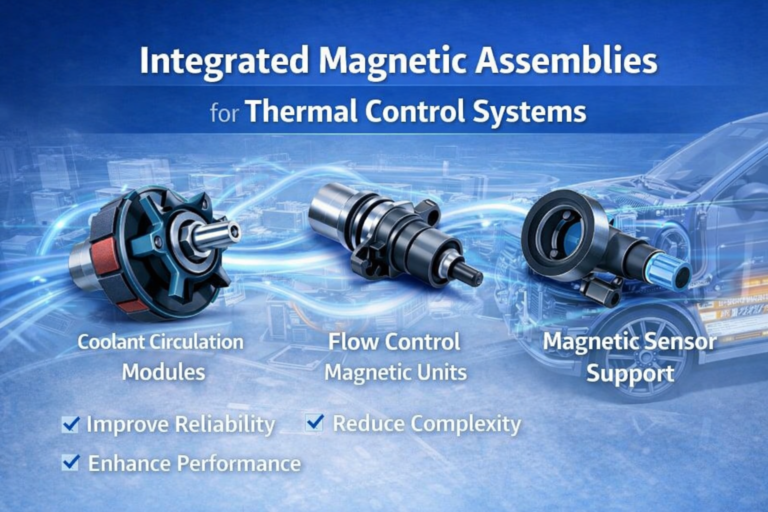
Integrated Magnetic Assemblies for Advanced Thermal Control Systems

Integrated Magnetic Assemblies for Advanced Thermal Control Systems As automotive electrification and industrial automation continue to advance, thermal control systems have become one of the most critical subsystems affecting safety, efficiency, and reliability. From battery packs and power electronics to fluid circulation and sensing modules, every component must work together under increasingly demanding conditions. In this context, integrated magnetic assemblies are emerging as a key enabling technology. By combining magnetic functionality, mechanical structure, and environmental protection into a single compact unit, these assemblies help manufacturers meet strict performance, space, and durability requirements—especially in automotive and industrial thermal control systems. Understanding Integrated Magnetic Assemblies Integrated magnetic assemblies are multi-functional magnetic components designed to perform more than just magnetic tasks. Unlike traditional magnet solutions that rely on multiple discrete parts, these assemblies integrate: Magnetic elements Structural support Functional interfaces Protective encapsulation This design philosophy reduces system complexity while improving dimensional accuracy, repeatability, and long-term stability. For B2B manufacturers, integrated magnetic assemblies offer a practical way to simplify system architecture without compromising performance. Why Thermal Control Systems Demand Integrated Magnetic Solutions Thermal control systems operate in some of the harshest environments within modern equipment. Components must withstand: Wide temperature ranges Continuous vibration Coolant
Injection molded ferrite magnet

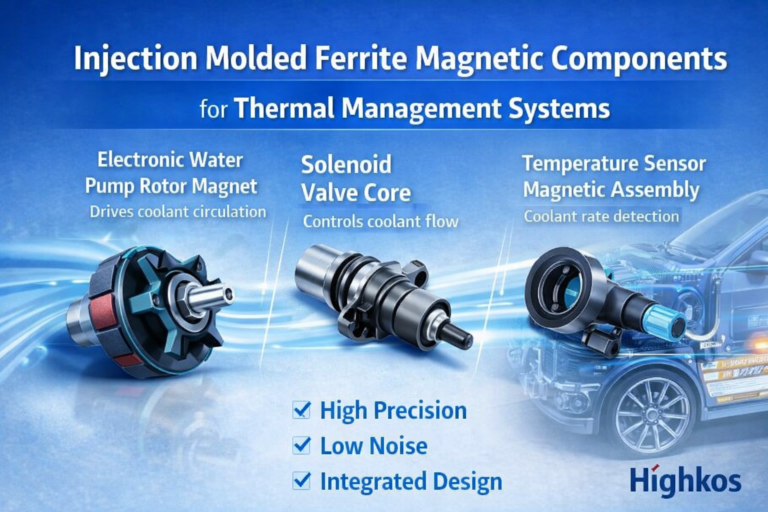
Injection Molded Ferrite Magnetic Components for Thermal Management Systems

Injection Molded Ferrite Magnetic Components for Thermal Management Systems In modern automotive and industrial thermal management systems, reliability, precision, and integration are no longer optional — they are essential. From electronic water pumps to solenoid valves and temperature sensors, magnetic components play a key role in controlling coolant flow, heat exchange, and system stability. Thanks to injection molded ferrite technology, manufacturers can now achieve higher precision, lower noise, stronger corrosion resistance, and fully integrated designs that traditional sintered magnets struggle to match. Why Injection Molded Ferrite Magnets Are Widely Used in Thermal Systems Injection molded ferrite magnetic components are especially suitable for magnetic drive components, sensors, and heat exchange control units due to several core advantages: High dimensional accuracy Excellent corrosion resistance Integrated molding of multiple functional parts Stable magnetic performance across wide temperature ranges Cost-effective mass production for B2B applications These characteristics make injection molded ferrite a critical material in both automotive and industrial thermal control systems. 1. Electronic Water Pump Rotor Magnet Application Function The electronic water pump rotor magnet is responsible for driving coolant circulation to regulate the temperature of: Battery packs Electric motors Power electronics and control units Stable coolant flow directly affects system efficiency, safety,

motor control magnetic ring

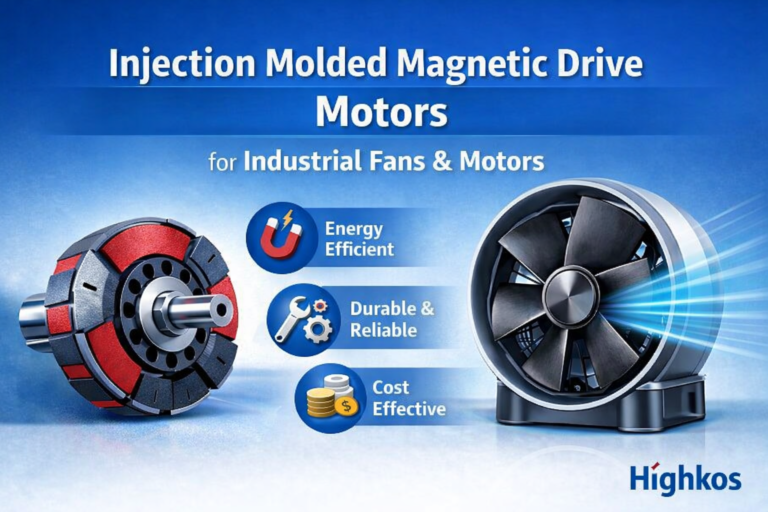
Injection Molded Magnetic Drive Motors for Industrial Fans & Motors | Highkos

Injection Molded Magnetic Drive Motors for Industrial Fans & Motors In today’s industrial world, reliable, energy-efficient, and durable motors are essential. Whether you’re designing industrial ventilation systems, HVAC units, water pumps, or custom machinery, the right motor can make a huge difference in efficiency, performance, and maintenance costs. Injection molded magnetic drive motors have quickly become a preferred choice for engineers and OEMs because they combine high precision, lightweight design, and cost-effective production. At Highkos, we provide a complete range of custom magnetic motor components, including injection molded ferrite, bonded NdFeB magnets, rotors, and stators. Our solutions help manufacturers improve efficiency, reduce downtime, and deliver reliable products. Explore our offerings here: Highkos Products. Why Injection Molded Magnetic Drive Motors Are Essential for Industrial Applications 1. High Precision and Repeatable Performance Injection molded magnetic components allow engineers to achieve tight tolerances and precise rotor geometries. This ensures: Stable magnetic flux, which improves torque consistency Reduced vibration and noise for smoother motor operation Long-term reliability, even in continuous-duty industrial fans and pumps High precision is especially important in industrial ventilation systems, where consistent airflow and minimal vibration are critical for both efficiency and workplace comfort. 2. Energy Efficiency That Reduces Operational Costs

Advantages of Injection Molded Magnetic Drive Motors

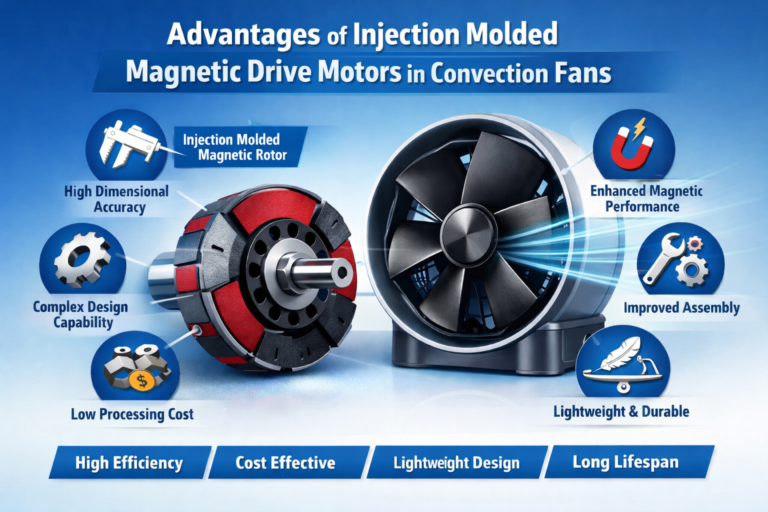
Advantages of Injection Molded Magnetic Drive Motors in Convection Fan Applications With the growing demand for high-efficiency, lightweight, and cost-effective convection fans, motor technology has become a critical factor in product performance and market competitiveness. Among the latest innovations, injection molded magnetic drive motors are increasingly adopted in convection fan systems due to their superior manufacturing flexibility, magnetic performance, and system integration advantages. Manufacturers such as Highkos, a professional supplier of precision magnetic motor components and magnetic drive solutions, are leveraging injection molded magnetic materials to deliver high-performance, energy-efficient motor solutions for HVAC, ventilation, and convection fan applications.👉 Learn more about magnetic motor solutions at:https://www.highkos.com/ What Are Injection Molded Magnetic Drive Motors? Injection molded magnetic drive motors utilize bonded magnetic materials, typically composed of rare-earth magnetic powders combined with polymer binders, shaped through high-precision injection molding processes. Unlike traditional sintered magnets, injection molded magnets allow complex geometries, tighter tolerances, and integrated rotor designs, making them ideal for modern convection fan motors. These motors are widely used in: Convection fans Ventilation systems HVAC equipment Cooling fans for electronics Energy-efficient household appliances Key Advantages of Injection Molded Magnetic Drive Motors 1. High Dimensional Accuracy for Optimized Fan Performance Injection molding enables precise

High Kos Magnet: Premium Neodymium & Ferrite Magnetic Solutions for Global Industrial Applications

High Kos Magnet: Premium Magnetic Solutions to Power Next-Gen Industrial & Motor Applications In today’s competitive industrial landscape, high-performance magnetic components are pivotal to product reliability, energy efficiency, and overall system performance. High Kos Magnet Co., Ltd., with over 18 years of experience in magnet technology, is a trusted global supplier of both neodymium (NdFeB) and ferrite magnetic solutions tailored for diverse industrial applications. Comprehensive Magnetic Product Portfolio for OEMs & Engineers High Kos offers an extensive range of magnetic components designed to support mission-critical applications in automotive, consumer electronics, industrial automation, home appliances, pumps, and more. Key product categories include: Injection Molded Ferrite Magnets – precision-engineered magnetic rings and rotors for motors in ceiling fans, industrial blowers, and water pumps. Injection Molded NdFeB Magnets – high-energy rare-earth magnets with superior magnetic properties for electric motors and precision sensors. Sintered NdFeB & Bonded NdFeB Magnets – powerful permanent magnets optimized for stability and performance in demanding environments. Induction Magnetic Rings & Motor Rotors – custom shapes and magnetic circuits to deliver precise magnetic flux for efficient motor design. These products are engineered to meet strict industry tolerances and customer-specific performance requirements, helping partners improve motor efficiency, torque output, and system

How to Choose the Right Rotor Magnet for Electric Motors in 2025: A Complete Buyer & Engineer Guide

Author | High Kos Magnet Updated | December 2025 Introduction: Why Choosing the Right Rotor Magnet Matters More Than Ever As electric motors continue to evolve in 2025, manufacturers are facing a dual challenge: achieving higher efficiency and performance while simultaneously controlling cost and ensuring long-term reliability. Against this background, the importance of selecting the right rotor magnet has never been greater. The magnetic rotor element is not just a functional component—it is a core performance driver. Its magnetic strength, thermal stability, mechanical integrity, and dimensional accuracy directly influence motor torque, speed control, energy consumption, noise level, and overall lifespan. In many cases, motor failures or performance issues can be traced back to an unsuitable rotor magnet choice rather than motor design itself. With growing demand in industries such as electric vehicles, industrial automation, household appliances, and energy-efficient fan motors, engineers and procurement teams must rethink how they evaluate magnetic rotor element solutions. This article provides a practical, future-oriented guide on how to choose the right rotor magnet for electric motors in 2025, helping decision-makers balance performance, reliability, and cost with confidence. What Is a Rotor Magnet and Its Role in Electric Motors A magnetic rotor element is a permanent magnet

rotor water pump

How to Choose the Right Rotor Water Pump for Your System in 2025 Introduction: Why Choosing the Right Rotor Water Pump is Crucial for 2025 Systems

Author | High Kos Magnet Updated | December 2025 As industries continue to prioritize the enhancement of operational efficiency, environmental sustainability, and reducing overall energy consumption, the importance of selecting the right Rotary pump cannot be overstated. In 2025, these pumps play a critical role in ensuring that systems operate efficiently across a wide range of industries, from HVAC systems and industrial cooling to water treatment and agricultural irrigation. These sectors depend heavily on the consistent and reliable flow of water, making the right choice of pump a key factor in minimizing downtime and optimizing performance. Rotor water pumps have evolved significantly over the years, with advancements in technology making them more efficient, compact, and durable than ever before. In today’s fast-paced industrial landscape, choosing the appropriate pump is not just about cost; it’s about understanding how the pump will perform under various operating conditions, its long-term impact on energy usage, and how it fits into a broader sustainability strategy. In 2025, selecting a rotor pump goes beyond simply picking a functional unit—it’s about making a strategic choice that will lead to long-term savings, greater system reliability, and a more sustainable operation. This guide will provide insights into the key factors

rotor magnet

How to Choose the Right BLDC Motor Rotor for Your Application in 2025 Introduction: Why Choosing the Right BLDC Motor Rotor Matters More Than Ever

Author | High Kos Magnet Updated | December 2025 As global industries accelerate toward electrification, automation, and higher energy efficiency, the BLDC magnetic rotor has become one of the most critical components in modern motor systems. In 2025, engineers and manufacturers are under increasing pressure to develop motors that deliver higher performance, longer service life, lower acoustic noise, and reduced energy consumption—while simultaneously controlling costs and ensuring supply chain stability. Regulatory requirements, sustainability goals, and rising customer expectations further intensify these challenges, making correct BLDC magnetic rotor selection more important than ever before. The rotor is no longer just a mechanical part; it is a strategic design element that directly influences the competitiveness of the final product. In many projects, however, the BLDC magnetic rotor is still treated as a secondary component and is often selected late in the design phase. This approach frequently leads to compromises in efficiency, torque consistency, thermal stability, or manufacturability. A mismatched BLDC motor rotor may introduce issues such as excessive vibration, uneven magnetic forces, magnet demagnetization, reduced efficiency, or even premature motor failure. These problems not only degrade product performance but also increase warranty claims, maintenance requirements, and long-term operating costs for end users. By

rotor water pump

How to Source High-Quality Neodymium NdFeB Magnets from Manufacturers

Author | High Kos Magnet Updated | December 2025 Sourcing neodymium NdFeB magnets is a critical decision for manufacturers, engineers, and procurement managers across industries such as motors, electronics, automotive, medical devices, and industrial automation. While neodymium NdFeB magnets are known for their exceptional magnetic strength, not all suppliers deliver the same level of quality, consistency, and technical support. Choosing the wrong manufacturer can lead to unstable performance, premature demagnetization, dimensional inconsistencies, or even supply chain risks. This guide explains how to source high-quality neodymium NdFeB magnets from manufacturers, what criteria truly matter, and how to avoid common procurement pitfalls. What Is Neodymium NdFeB and Why Quality Matters Neodymium NdFeB (Neodymium-Iron-Boron) magnets are the strongest commercially available permanent magnets. Their superior magnetic energy density allows designers to reduce size and weight while maintaining high performance. However, the quality of neodymium NdFeB magnets depends heavily on: Raw material purity Manufacturing process control Magnet grade consistency Coating and corrosion protection Engineering and quality assurance systems High-quality neodymium NdFeB magnets ensure stable magnetic properties, long service life, and predictable performance under real working conditions. Key Challenges When Sourcing Neodymium NdFeB Magnets Many buyers assume all neodymium NdFeB magnets with the same grade perform equally.

rotor water pump

Ferrite Magnet Grades Explained: Y30, Y35, Y40 and More

Author | High Kos Magnet Updated | December 2025 Ferrite magnets remain one of the most important and widely used permanent magnetic materials in modern manufacturing. Despite the rapid development of rare-earth magnets, ferrite magnets continue to dominate many industrial and commercial applications because they offer an outstanding balance of cost efficiency, mechanical durability, and long-term magnetic stability. From automotive components and industrial motors to consumer electronics and household appliances, ceramic magnets provide reliable and consistent magnetic performance at scale, making them especially suitable for high-volume production and long-term use. One of the most significant advantages of ceramic magnets is their predictability throughout the entire product lifecycle. The raw materials used in ferrite magnets are abundant and widely available, which helps manufacturers avoid supply chain disruptions and sharp price fluctuations. In addition, ferrite magnet manufacturing processes are well established and highly mature, ensuring stable quality and repeatable performance. Their magnetic properties remain reliable over long operating lifetimes, even under continuous use or varying environmental conditions. This makes ferrite magnets an ideal choice for manufacturers who prioritize supply chain security, consistent pricing, and dependable product performance. As application requirements become more demanding, understanding ferrite magnet grades—such as Y30, Y35, and Y40—becomes increasingly

Single-Pole Absolute Encoder

How to Choose the Right NdFeB Magnets for Your Project in 2025

Author | High Kos Magnet Updated | December 2025 In 2025, global manufacturing and product innovation are being reshaped by rising expectations for energy efficiency, compact system design, and long-term operational reliability. As industries continue to evolve toward smarter, lighter, and more sustainable solutions, the role of high-performance magnetic materials has become increasingly critical. Across key sectors such as electric vehicles, renewable energy systems, industrial automation, medical equipment, and consumer electronics, ndfeb magnets have emerged as one of the most indispensable functional materials. Their outstanding magnetic strength enables engineers to deliver powerful and stable performance while significantly reducing component size, overall weight, and energy consumption. This combination of strength and efficiency supports modern design trends, including miniaturization, system integration, and improved energy utilization. At the same time, selecting the right ndfeb magnets has become far more complex than in the past. Fluctuations in rare-earth raw material prices, stricter global environmental regulations, and growing customer expectations for longer product lifespans mean that magnet selection can no longer rely on a single factor such as grade or unit price. Instead, engineers and procurement teams must take a holistic approach, carefully evaluating the operating environment, thermal conditions, mechanical stress, manufacturing processes, and long-term performance

rotor water pump

Neodymium Iron Boron Density vs Magnetic Strength: Engineering Trade-Offs Explained

Author | High Kos Magnet Updated | December 2025 Understanding NdFeB magnet density in Modern Magnet Engineering NdFeB magnet density is a fundamental physical parameter that directly influences the performance, weight, and reliability of high-performance permanent magnets. In modern engineering applications—especially motors, automation equipment, consumer electronics, and automotive systems—understanding neodymium iron boron density is essential for making informed design and sourcing decisions. Neodymium iron boron (NdFeB) magnets are known for their exceptional magnetic strength, but density plays a critical role in how that strength is utilized. Engineers must carefully balance NdFeB magnet density against magnetic strength, mechanical integrity, and cost. A higher density often indicates better magnetic particle packing, but it may also increase weight and affect thermal behavior. In this article, we explore the engineering trade-offs between neodymium iron boron density and magnetic strength, helping OEMs, designers, and procurement teams choose the most suitable magnet solution for their applications. What Is NdFeB magnet density? Definition of NdFeB magnet density NdFeB magnet density refers to the mass per unit volume of NdFeB magnetic material, typically measured in g/cm³. For most sintered NdFeB magnets, the NdFeB magnet density ranges from 7.4 to 7.6 g/cm³, while bonded or injection-molded NdFeB magnets have a

Scroll to Top