
Water pumps are essential components in household appliances, automotive systems, industrial equipment, water treatment devices and many other fluid-handling applications. As pump designs become more compact and energy-conscious, the performance of the motor rotor becomes increasingly important. A well-designed rotor helps the motor generate stable rotational movement, maintain reliable operation and work effectively with the pump’s hydraulic structure.
For pump manufacturers and OEM/ODM buyers, selecting a reliable Water Pump Rotor Manufacturer is an important part of product development and supply chain planning. The right manufacturing partner should understand magnetic materials, rotor geometry, magnetization, dimensional tolerances and the operating environment of the finished pump. These factors influence not only the component itself but also the assembly process and the performance of the final equipment.
High Kos Magnet focuses on magnetic materials and customized magnetic components, including injection-molded and sintered magnet solutions. Its product portfolio covers motor-related magnetic components and water pump rotor products for different application requirements.
This guide explains how water pump rotors work, what buyers should consider when selecting a manufacturing partner, and how to evaluate customized rotor solutions for long-term production.
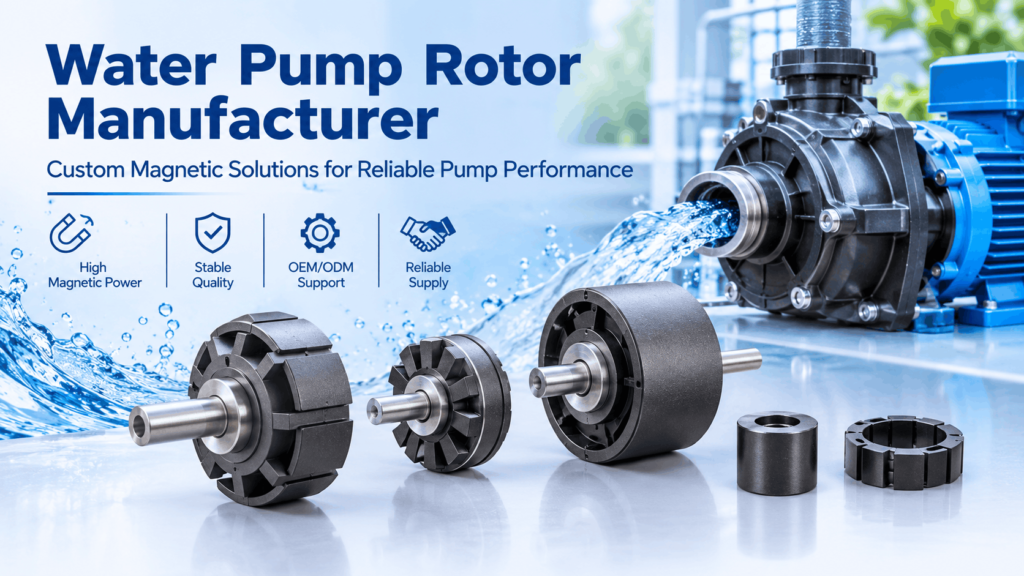
1. What Does a Water Pump Rotor Manufacturer Produce?
A Water Pump Rotor Manufacturer produces the rotating magnetic component used in a pump’s motor assembly. Depending on the motor architecture, the rotor may contain a permanent magnet, a shaft, a supporting structure, a molded housing or other integrated components.
In a brushless DC water pump, the rotor interacts with the magnetic field generated by the stator windings. This interaction creates rotational torque, which drives the impeller or connected pumping mechanism. The resulting movement transfers energy to the fluid and produces the required flow.
The exact rotor structure varies according to the pump design. A small circulation pump for household equipment may require a compact magnetic assembly, while an automotive coolant pump may need to meet different operating temperature, vibration and service-life requirements.
A qualified manufacturer should therefore evaluate the complete application instead of treating every pump rotor as a standard magnetic part.
Water Pump Rotor Components and Their Functions
A typical rotor assembly may include several functional elements:
- Permanent magnet: Generates the magnetic field required for motor operation.
- Shaft or supporting structure: Provides mechanical support and transfers rotational movement where the design requires it.
- Molded or encapsulating structure: Helps integrate components and may provide protection against the operating environment.
- Bearing or related interfaces: Support rotation and help maintain the intended mechanical alignment.
- Magnetization pattern: Determines the arrangement of magnetic poles and affects how the rotor interacts with the stator.
Not every design uses the same combination of components. Buyers should confirm the actual structure required by their motor design before requesting a quotation.
2. Why Water Pump Rotor Design Matters
A water pump rotor is more than a rotating magnet. Its material, geometry, magnetic properties and mechanical structure all contribute to the operation of the pump.
Magnetic Performance and Motor Operation
The magnetic properties of a rotor influence its interaction with the stator. Magnetic strength, pole arrangement and magnetization consistency should match the motor’s electromagnetic design.
If the rotor’s magnetic characteristics do not meet the design requirements, the motor may not deliver the expected operating performance. For this reason, engineering teams should define the required magnetic parameters and pole configuration during the development stage.
An experienced Water Pump Rotor Manufacturer should be able to discuss material and magnetization options according to the drawings and technical requirements supplied by the customer.
Dimensional Accuracy and Assembly Compatibility
Rotor dimensions directly affect how the component fits into the motor and pump assembly. Outer diameter, inner diameter, length, shaft position and interface dimensions may all be critical.
Dimensional deviations can create assembly difficulties or affect the alignment of rotating parts. Buyers should identify critical dimensions on engineering drawings and establish appropriate inspection requirements before mass production.
Dynamic Balance, Noise and Vibration
A rotating component must maintain suitable mechanical balance for its intended operating conditions. Poor balance can contribute to vibration, noise and additional mechanical loading.
These concerns are particularly relevant to compact pumps used in household appliances, vehicle thermal management systems and precision fluid equipment. Rotor design and manufacturing controls should be evaluated together rather than as separate issues.
3. Magnetic Materials Used by a Water Pump Rotor Manufacturer
Material selection is one of the most important decisions in a customized rotor project. The appropriate material depends on magnetic requirements, operating temperature, component geometry, production volume and cost targets.
Injection-Molded Ferrite Magnets
Injection-molded ferrite combines ferrite magnetic powder with a suitable polymer binder. The material can be processed into different shapes, making it useful for magnetic components with customized geometries.
For pump rotor applications, injection molding may support integrated component structures and repeatable production. It can be considered when the design requires particular shapes, assembly features or a combination of magnetic and mechanical functions.
High Kos provides an injection-molded ferrite product range for magnetic component applications. The suitability of a particular material and structure should be confirmed against the customer’s motor design and operating conditions.
Sintered Ferrite Magnets
Sintered ferrite is another option for permanent magnet applications. It is widely used in motors and other magnetic assemblies where the required magnetic properties and component geometry are compatible with the material.
When evaluating sintered ferrite, buyers should consider the required magnetic performance, mechanical design, dimensions and assembly method. The material should be selected according to the actual application rather than by price alone.
You can review High Kos’s sintered ferrite products to understand the company’s available magnetic product categories.
Bonded Magnetic Materials
Bonded magnets use magnetic powder combined with a binder and can be manufactured through different forming processes. Depending on the formulation and production method, they may offer flexibility in component geometry and magnetic design.
For some pump applications, bonded magnetic components can be considered when the design requires integrated structures or particular dimensional characteristics. Material selection should take into account magnetic performance, mechanical strength, temperature and fluid exposure.
High Kos also provides information about injection-bonded magnets and their applications.
How to Choose the Right Material
There is no single magnetic material that is ideal for every water pump. A practical comparison should consider:
- Required magnetic properties and pole configuration.
- Operating temperature and expected thermal variation.
- Rotor geometry and dimensional requirements.
- Fluid exposure and protection or encapsulation needs.
- Mechanical loading and operating speed.
- Production volume and overall manufacturing cost.
A Water Pump Rotor Manufacturer should assess these factors together with the customer’s engineering team before confirming a proposed solution.
4. Applications of Customized Water Pump Rotors
Water pump rotors are used in many industries. Although the basic operating principle may be similar, the technical requirements can vary considerably between applications.
Household Appliances
Household appliances such as water dispensers, washing machines, dishwashers and circulation equipment may use compact pumps to move water through internal systems.
The rotor must fit the available installation space and work with the motor and pump structure. Low noise, stable rotation and consistent assembly quality may be important considerations for appliance manufacturers.
Automotive and New Energy Vehicles
Automotive applications include coolant circulation, auxiliary fluid systems and thermal management equipment. In new energy vehicles, electric pumps may support the circulation of coolant in systems associated with batteries, motors and power electronics.
These applications can involve temperature changes, vibration and demanding operating cycles. Buyers should provide the manufacturer’s engineering team with the relevant environmental and mechanical requirements.
High Kos also discusses magnetic components in vehicle applications in its article on automotive ferrite magnets.
Industrial Pumps and Fluid Equipment
Industrial water pumps and fluid-handling equipment may operate for extended periods or under specific pressure, temperature and environmental conditions.
For these projects, the rotor should be designed around the pump’s operating requirements, including the fluid environment, mechanical interfaces and expected duty cycle. The manufacturer should also understand the customer’s inspection and production consistency requirements.
Medical and Precision Equipment
Certain medical devices and precision instruments use compact pumps for fluid circulation or controlled fluid movement. In these applications, component dimensions, assembly compatibility and consistent operation may be particularly important.
The rotor supplier should follow the technical documentation and validation requirements defined by the equipment manufacturer. Any industry-specific compliance requirements must be confirmed for the actual finished product and application.
5. What to Look for in a Water Pump Rotor Manufacturer
Choosing a manufacturing partner involves more than comparing quotations. Buyers should assess whether the supplier can understand the project, develop a suitable component and maintain consistent production.
Magnetic Material and Product Knowledge
A supplier should understand the characteristics of different magnetic materials and how they relate to rotor design. This includes the differences between injection-molded ferrite, sintered ferrite and bonded magnetic materials.
A manufacturer with experience in magnetic components may be better positioned to discuss material selection, magnetization and structural integration with the customer’s engineering team.
Customization and Engineering Communication
Many pump manufacturers require components designed around their own motor platforms. A suitable supplier should be able to review technical drawings, samples and application requirements.
Before development begins, buyers should clarify:
- Whether the supplier can work from drawings or physical samples.
- Which magnetic material options can be evaluated.
- Whether the required pole configuration can be supported.
- Which dimensions and tolerances are critical.
- What information is needed for prototype evaluation.
- How design changes will be communicated and documented.
Clear communication helps reduce misunderstandings during development and production.
Manufacturing and Quality Control
Production consistency is essential for components used in repeated motor assemblies. Buyers should ask how the manufacturer controls material batches, dimensions, magnetization and finished-component inspection.
Quality requirements should be defined according to the product’s function and customer specifications. Depending on the project, inspection may include dimensional checks, magnetic testing, visual inspection and relevant assembly verification.
A reliable Water Pump Rotor Manufacturer should be willing to discuss the inspection plan and the acceptance criteria before mass production.
Production Capacity and Supply Stability
For OEM projects, a supplier must consider both initial development and ongoing production. Buyers should evaluate manufacturing capacity, communication efficiency, production planning and the ability to manage changes in demand.
The supplier should also explain how it handles sample approval, production scheduling, packaging requirements and delivery coordination. These factors can influence the reliability of the wider supply chain.
6. Why Consider High Kos Magnet for Water Pump Rotor Projects?
High Kos Magnet focuses on the research, development and production of magnetic materials and customized magnetic components. Its website lists water pump rotors among its product categories, alongside motor inner rotors, outer rotors, magnetic rings and other motor-related components.
The company’s product and manufacturing information covers injection-molded ferrite and other magnetic solutions. This provides a starting point for pump manufacturers evaluating magnetic component options for customized projects.
For OEM and ODM customers, the development process should begin with the actual application requirements. High Kos can review the information provided by customers to discuss potential material and component solutions.
You can also learn more about the company’s motor rotor manufacturing solutions and inner rotor design considerations.
The final component specification should always be confirmed through technical review and appropriate product validation. Buyers should avoid selecting a rotor based only on a general product description or an assumed material advantage.
7. How to Start a Custom Water Pump Rotor Project
A clear technical brief can make communication with a manufacturer more efficient. Before contacting a supplier, prepare as much of the following information as possible:
1. Application information
Explain the pump type, intended equipment, operating environment and main function of the rotor.
2. Drawings or samples
Provide a 2D drawing, 3D model or existing sample. Identify critical dimensions and mechanical interfaces.
3. Magnetic requirements
If available, include the preferred magnetic material, pole number, magnetization direction and relevant magnetic performance requirements.
4. Operating conditions
Share the expected operating temperature, speed, fluid exposure, duty cycle and other environmental conditions.
5. Production requirements
Provide estimated annual demand, order quantity, prototype requirements and expected project schedule.
6. Quality and packaging requirements
Specify inspection standards, documentation, traceability and packaging needs where applicable.
With this information, a Water Pump Rotor Manufacturer can better understand the project and determine which technical details need further discussion.
Conclusion: Choose the Right Water Pump Rotor Manufacturer
The quality of a water pump rotor depends on more than its magnetic material. Rotor geometry, magnetization, dimensional accuracy, mechanical balance, environmental compatibility and production consistency all influence whether the component is suitable for the finished pump.
For household appliance factories, automotive parts manufacturers, industrial pump producers and OEM/ODM brands, selecting the right Water Pump Rotor Manufacturer can support smoother product development and more reliable sourcing.
High Kos Magnet offers magnetic component solutions that include water pump rotors, injection-molded ferrite products and other motor-related magnetic components. If you are developing a new pump or looking for a customized rotor supplier, share your drawings, samples and application requirements with the High Kos team.
Contact High Kos Magnet today to discuss your water pump rotor project and explore a magnetic component solution aligned with your design and production needs.
FAQ About Water Pump Rotor Manufacturers
1. What does a Water Pump Rotor Manufacturer do?
A Water Pump Rotor Manufacturer produces magnetic rotating components for pump motor assemblies. Depending on the design, these components may include permanent magnets, shafts, molded structures and other integrated features.
2. What materials are commonly used in water pump rotors?
Material options may include injection-molded ferrite, sintered ferrite and bonded magnetic materials. The appropriate choice depends on magnetic requirements, geometry, temperature, fluid exposure and production considerations.
3. Can water pump rotors be customized according to drawings?
Customization depends on the manufacturer’s equipment, material options and engineering capabilities. Buyers should provide drawings or samples, critical dimensions and application details for an initial technical review.
4. Why is magnetization important for a pump rotor?
Magnetization determines the arrangement and orientation of magnetic poles. The rotor’s magnetic configuration must be compatible with the stator and motor design to support the intended operation.
5. What information should I provide when requesting a quotation?
Provide the application, drawings or samples, material preference if known, pole configuration, operating conditions, critical tolerances, estimated order quantity and quality requirements.
6. How can I evaluate a water pump rotor supplier?
Review the supplier’s magnetic material knowledge, customization experience, manufacturing process, quality controls, engineering communication and ability to support repeat production. Confirm all technical and commercial requirements before placing a mass-production order.