
Static Magnetic Properties of Injection Molded Magnetic Rings
Static magnetic properties are critical parameters that determine the performance of injection molded magnetic rings used in sensors, motors, and industrial automation systems. In modern engineering applications, these properties directly affect signal accuracy, magnetic stability, and device reliability.
Injection molded magnetic rings are widely used in brushless motors, encoders, speed sensors, and automotive systems because they allow precise control of magnetic pole distribution and compact integrated designs.
Companies specializing in magnetic components, such as
https://www.highkos.com/, provide advanced solutions for high-precision magnetic components used in electronics and industrial equipment.
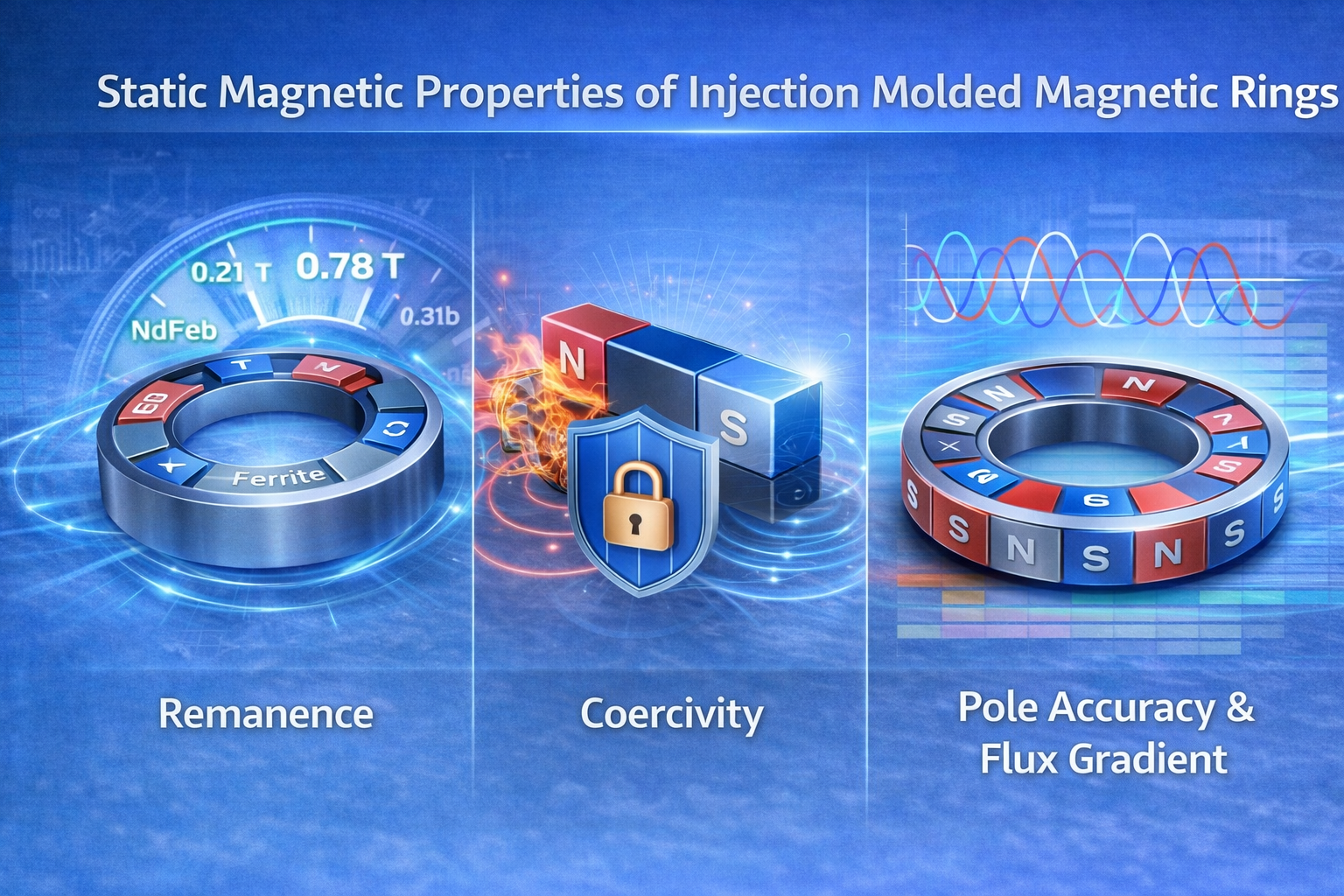
Key Static Magnetic Properties in Injection Molded Magnetic Rings
In engineering applications, several indicators are used to evaluate the static magnetic properties of injection molded magnetic rings.
Remanence
Remanence refers to the magnetic induction that remains in the magnetic ring after the external magnetizing field is removed.
Typical remanence values include:
-
Ferrite injection molded magnets: 0.21 – 0.31 T
-
NdFeB injection molded magnets: 0.35 – 0.78 T
Higher remanence allows the magnetic ring to produce stronger and more stable magnetic fields, which is essential for motor rotors and sensor systems.
Injection molded magnets offered by manufacturers like
https://www.highkos.com/ can be customized to achieve specific magnetic field strengths for different industrial applications.
Coercivity
Coercivity describes the material’s ability to resist demagnetization.
For multipole magnetic rings used in motors or sensors, high intrinsic coercivity ensures that the magnetic structure remains stable even when exposed to:
-
High temperatures
-
Reverse magnetic fields
-
Mechanical vibration
This stability is particularly important in demanding environments such as automotive cooling systems or industrial automation equipment.
Pole-Length Accuracy and Magnetic Flux Gradient
Pole-length accuracy and magnetic flux density gradient are essential parameters when injection molded magnetic rings are used as signal transmission components.
In devices such as:
-
rotary encoders
-
speed sensors
-
brushless motor controllers
the magnetic ring must generate alternating N and S poles along the circumference.
Two key factors determine sensor performance:
Pole-length accuracy
Deviation in pole spacing can directly affect the phase accuracy of sensor output signals.
Magnetic flux density gradient
The slope of magnetic flux change influences the sensitivity of Hall sensors and other detection elements.
High-precision magnetic ring production therefore requires advanced process control and magnetic circuit design.
More information about precision magnetic solutions can be found at
https://www.highkos.com/.
Microscopic Mechanism Behind Static Magnetic Properties
The static magnetic properties of injection molded magnetic rings originate from stable magnetic domain structures within magnetic powder particles.
During magnetization, a strong external magnetic field causes:
-
domain wall movement
-
alignment of magnetic moments
-
orientation of magnetic particles
After the external magnetic field is removed, the magnetic moments remain locked along the easy magnetization axis, forming a stable remanent magnetic state.
This microscopic mechanism is the fundamental reason injection molded magnets can maintain stable magnetic fields for long periods.
Influence of Polymer Matrix on Magnetic Performance
Injection molded magnetic rings differ from traditional sintered magnets because they contain a polymer resin matrix.
This matrix creates small non-magnetic gaps between magnetic powder particles.
As a result:
Advantages
-
improved impact resistance
-
better vibration resistance
-
reduced eddy current losses
-
flexible and lightweight structures
Limitation
-
lower maximum magnetic energy product compared with sintered magnets
Despite this limitation, injection molded magnets remain ideal for applications requiring complex shapes, integrated structures, and lightweight components.
These advantages make them widely used in products developed by magnetic component manufacturers such as
https://www.highkos.com/.
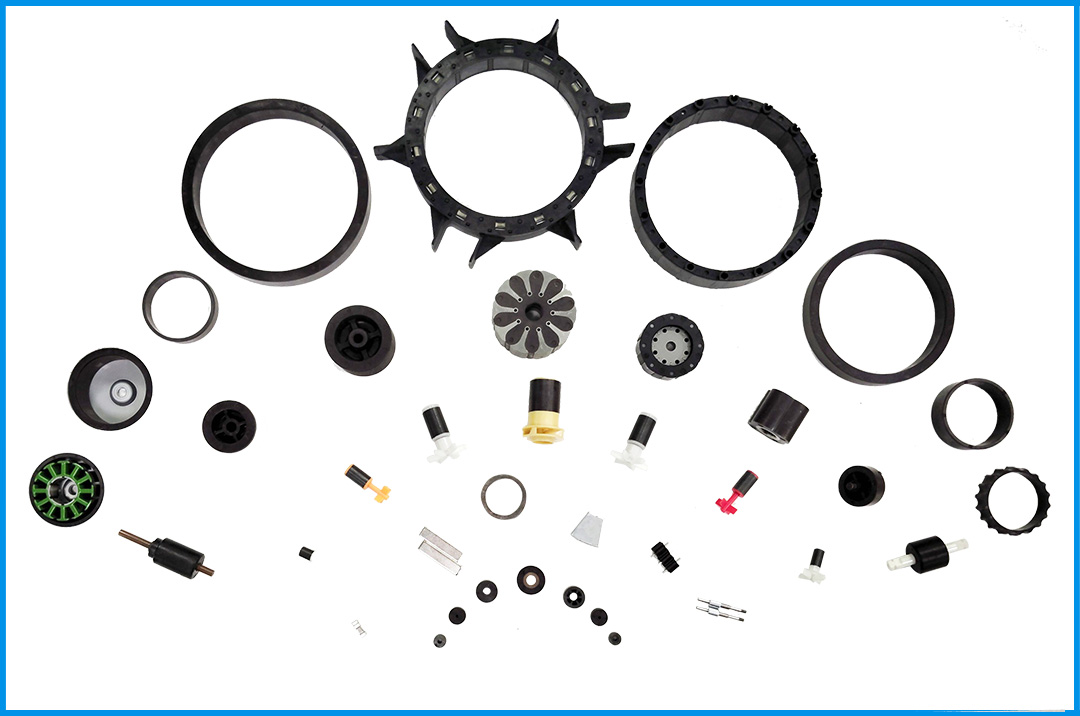
Applications of Injection Molded Magnetic Rings
Injection molded magnetic rings with optimized static magnetic properties are widely used in:
-
brushless DC motors
-
automotive sensors
-
rotary encoders
-
speed detection systems
-
smart appliances
-
industrial automation equipment
The increasing demand for precision sensing technologies in electric vehicles and smart manufacturing continues to drive innovation in magnetic component design.
Impact Resistance and Magnetic Stability
The resin matrix provides a damping effect that suppresses violent domain wall motion under vibration or shock, reducing:
-
Eddy current losses
-
Magnetic noise
-
Risk of partial demagnetization
As a result, injection molded magnetic rings supplied by
👉 Highkos perform reliably in harsh automotive and industrial environments.
Conclusion
Static magnetic properties play a decisive role in the performance of injection molded magnetic rings. Parameters such as remanence, coercivity, pole accuracy, and magnetic flux gradient determine how effectively these components function in sensors, motors, and electronic systems.
With advances in magnetic materials, molding technologies, and process optimization, injection molded magnetic rings are becoming increasingly important in high-precision industrial applications.
For customized magnetic solutions and advanced injection molded magnetic components, visit
https://www.highkos.com/.