
Introduction
As variable frequency motors become more efficient and compact, rotor design has become one of the most important factors affecting motor performance. Among modern rotor technologies, Permanent Magnet Rotor Components play a critical role in improving efficiency, reducing mechanical complexity and increasing long-term reliability.
Instead of assembling multiple individual magnets onto the rotor core, many manufacturers now use integrated magnetic rings to create a more stable and efficient rotor structure. This design is widely used in permanent magnet synchronous motors (PMSMs), brushless DC (BLDC) motors and other high-performance motor systems.
This article explains how permanent magnet rotor components work, their advantages and why integrated magnetic rings have become a preferred solution for modern motor manufacturers.
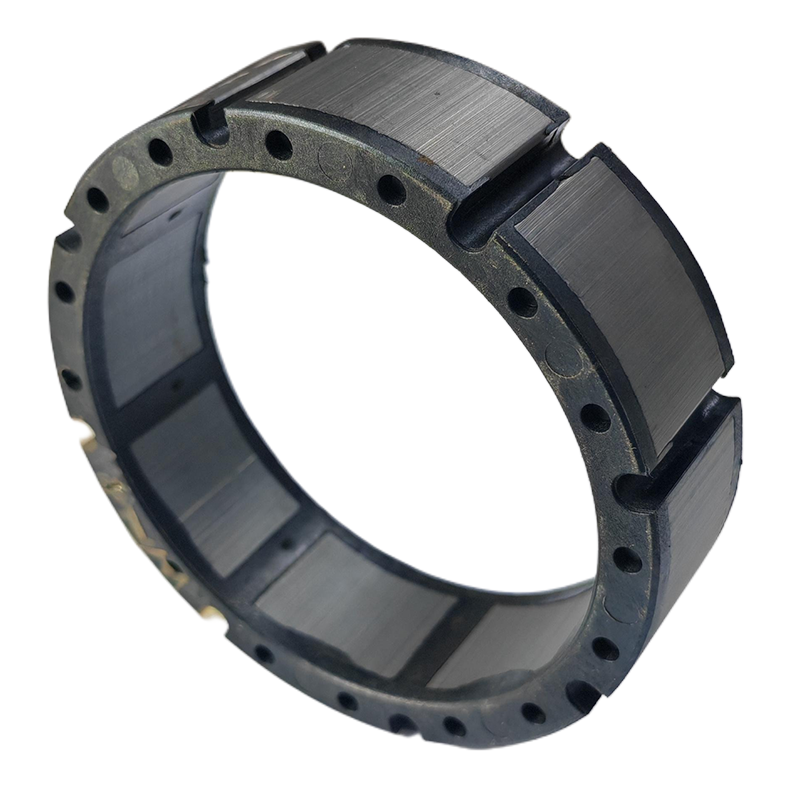
What Are Permanent Magnet Rotor Components?
Permanent Magnet Rotor Components are magnetic assemblies installed on the rotating shaft of a motor to generate the rotor magnetic field. In permanent magnet synchronous motors, these components are responsible for producing the constant magnetic field that interacts with the rotating magnetic field generated by the stator.
Modern rotor components are commonly manufactured using permanent ferrite magnetic rings or other multi-pole permanent magnetic materials. The magnetic ring features alternating north and south poles distributed evenly around its circumference, allowing the motor to produce smooth and efficient rotational torque.
How Permanent Magnet Rotor Components Work
The operating principle of permanent magnet synchronous motors is based on the interaction between two magnetic fields.
Rotor Magnetic Field
The permanent magnetic ring mounted on the rotor continuously generates a stable magnetic field without requiring external electrical excitation.
Stator Rotating Magnetic Field
When powered by a variable frequency drive, the stator windings create a rotating magnetic field whose speed changes according to the supplied frequency.
Electromagnetic Interaction
The rotating stator field interacts with the permanent magnetic field produced by the rotor component. This synchronized interaction generates torque and drives the motor shaft to rotate efficiently.
Because the rotor magnetic field remains constant, permanent magnet motors achieve higher efficiency and lower energy consumption than many conventional motor designs.
Why Integrated Magnetic Rings Are Replacing Individual Magnet Blocks
Traditional permanent magnet rotors are often manufactured by attaching multiple individual magnet blocks to the surface of the rotor core using adhesives or mechanical fixtures.
Today, integrated magnetic rings are becoming increasingly popular because they simplify rotor construction while improving reliability.
More Uniform Air-Gap Magnetic Field
A one-piece magnetic ring creates a continuous and smooth rotor surface.
Compared with multiple separate magnets, this integrated design provides a more uniform magnetic field distribution across the air gap between the rotor and stator.
Benefits include:
- Smoother motor operation
- Reduced torque ripple
- Lower vibration
- Improved operating efficiency
- Better noise performance
Fewer Rotor Components
Integrated magnetic rings eliminate many of the additional parts required by traditional rotor assemblies.
Manufacturers no longer need:
- Individual magnet blocks
- Magnet retaining sleeves
- Complex fixing structures
- Multiple adhesive bonding processes
Reducing the number of components simplifies manufacturing while improving production consistency.
Excellent Mechanical Reliability
Variable frequency motors frequently operate under rapid acceleration, deceleration and continuous speed regulation.
Integrated permanent magnet rotor components provide excellent structural stability because the magnetic ring forms a complete circular assembly directly mounted onto the rotor.
Compared with segmented magnets, integrated magnetic rings offer:
- Higher mechanical strength
- Better rotor balance
- Lower risk of magnet displacement
- Improved long-term durability
These advantages are especially important for motors operating at high rotational speeds.
Advantages of Permanent Magnet Rotor Components
Modern motor manufacturers choose integrated magnetic rings because they provide several engineering advantages.
Higher Rotor Stability
The continuous magnetic ring improves rotor balance and reduces vibration during operation.
This contributes to quieter motors and longer bearing life.
Improved Manufacturing Efficiency
Integrated rotor assemblies reduce production complexity by eliminating multiple magnet installation processes.
Manufacturers benefit from:
- Faster assembly
- Improved dimensional consistency
- Reduced labor costs
- Higher production efficiency
Better Performance in High-Speed Motors
High-speed motors require rotor structures capable of maintaining stability under significant centrifugal force.
Integrated permanent magnet rotor components provide excellent mechanical integrity, making them suitable for demanding applications.
Applications of Permanent Magnet Rotor Components
Integrated magnetic rings are widely used across industries requiring efficient and reliable motor systems.
Permanent Magnet Synchronous Motors
PMSMs are commonly used in industrial automation, HVAC equipment and energy-efficient drive systems.
Integrated rotor components improve operating efficiency while reducing maintenance requirements.
Brushless DC Motors
BLDC motors benefit from compact rotor structures, accurate magnetic positioning and reliable long-term performance.
These motors are widely used in household appliances, robotics and automotive applications.
Variable Frequency Motors
Variable frequency motors require stable rotor performance across a wide speed range.
Integrated magnetic rings improve rotor balance and ensure reliable operation during continuous speed adjustment.
Industrial Automation Equipment
Servo motors, precision machinery and automated production equipment require accurate magnetic field distribution and reliable rotor performance.
Integrated magnetic rings help achieve these requirements while supporting efficient manufacturing.
Why Choose Highkos for Permanent Magnet Rotor Components?
Highkos specializes in manufacturing customized magnetic components for motors, industrial equipment and automotive applications.
Our capabilities include:
- Permanent ferrite magnetic rings
- Multi-pole magnetic rings
- Injection molded magnetic components
- Custom rotor assemblies
- OEM and ODM manufacturing
With advanced production technology and experienced engineering support, Highkos provides reliable magnetic solutions that meet the demanding requirements of modern motor manufacturers.
Frequently Asked Questions
What are permanent magnet rotor components?
Permanent magnet rotor components are magnetic assemblies installed on the motor rotor to generate a constant magnetic field that interacts with the stator and produces motor torque.
Why are integrated magnetic rings better than separate magnet blocks?
Integrated magnetic rings provide a more uniform magnetic field, improve rotor balance, reduce the number of components and increase mechanical reliability.
Which motors commonly use permanent magnet rotor components?
They are widely used in permanent magnet synchronous motors, brushless DC motors, variable frequency motors and many industrial automation systems.
Can permanent magnet rotor components be customized?
Yes. Magnetic material, pole number, dimensions and magnetic properties can all be customized according to motor design requirements.