
Introduction
Permanent-magnet motors are widely used in modern automotive systems, household appliances, industrial equipment and precision motion systems. Among the magnetic components used in these motors, Permanent Magnet Magnetic Rings can serve as an important part of the rotor and provide the magnetic field required to generate electromagnetic torque.
Brushless DC motors (BLDC), permanent-magnet synchronous motors (PMSM) and stepper motors can all use permanent magnetic structures to create rotor excitation. Depending on the motor’s power density, operating temperature, dimensional requirements and production volume, manufacturers can select different magnetic materials and forming processes.
The main options include sintered, injection-molded and bonded magnetic rings. Each manufacturing method provides a different balance between magnetic performance, mechanical properties, integration capability and cost.
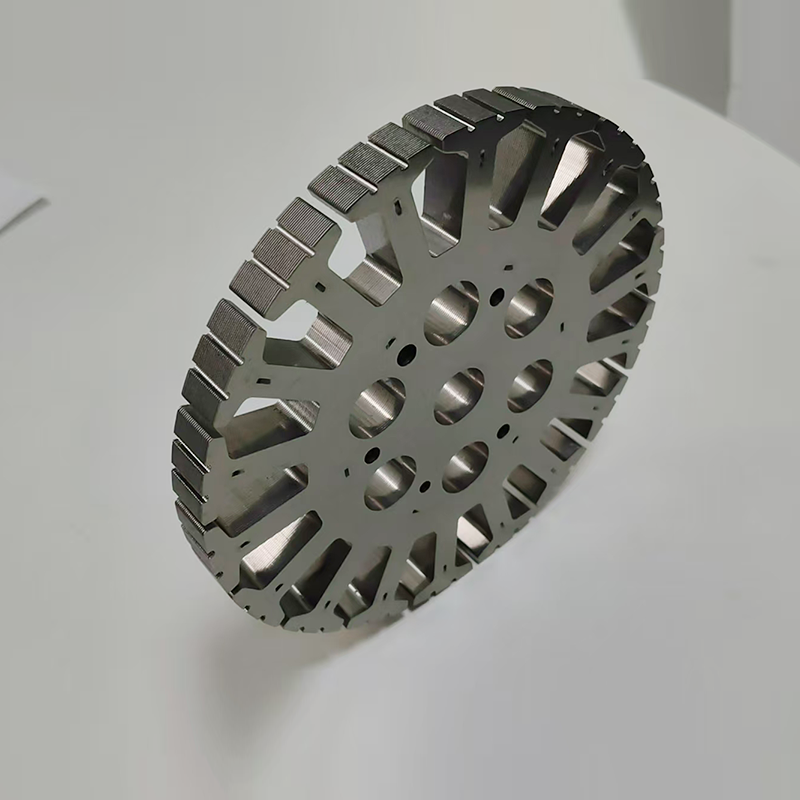
What Are Permanent Magnet Magnetic Rings?
Permanent Magnet Magnetic Rings are annular permanent-magnet components designed to generate a stable magnetic field within a motor.
During manufacturing, multiple alternating N and S poles can be magnetized around the circumference of the ring. When the ring is installed as part of the rotor, these magnetic poles interact with the rotating magnetic field generated by the energized stator windings.
The interaction produces electromagnetic torque and causes the rotor to rotate.
This basic structure can be found in different types of permanent-magnet motors, including:
- BLDC motors
- PMSM motors
- Stepper motors
- Automotive motors
- Appliance motors
- Industrial drive motors
- Precision motion systems
How Do Permanent Magnet Magnetic Rings Work in Motors?
The operating principle is based on the interaction between the rotor’s permanent magnetic field and the stator’s electromagnetic field.
The magnetic ring is magnetized with multiple N/S poles around its circumference. When current is supplied to the stator windings, the stator produces a rotating magnetic field.
The rotor magnetic field attempts to align with this rotating field, generating torque.
This process converts electrical energy into mechanical rotation.
Multi-Pole Magnetization
The number and arrangement of magnetic poles are important design parameters.
Different motors may require different pole-pair configurations depending on:
- Motor speed
- Torque requirements
- Rotor dimensions
- Control strategy
- Operating frequency
- Magnetic circuit design
Accurate multi-pole magnetization is particularly important when the magnetic ring must provide a uniform air-gap magnetic field.
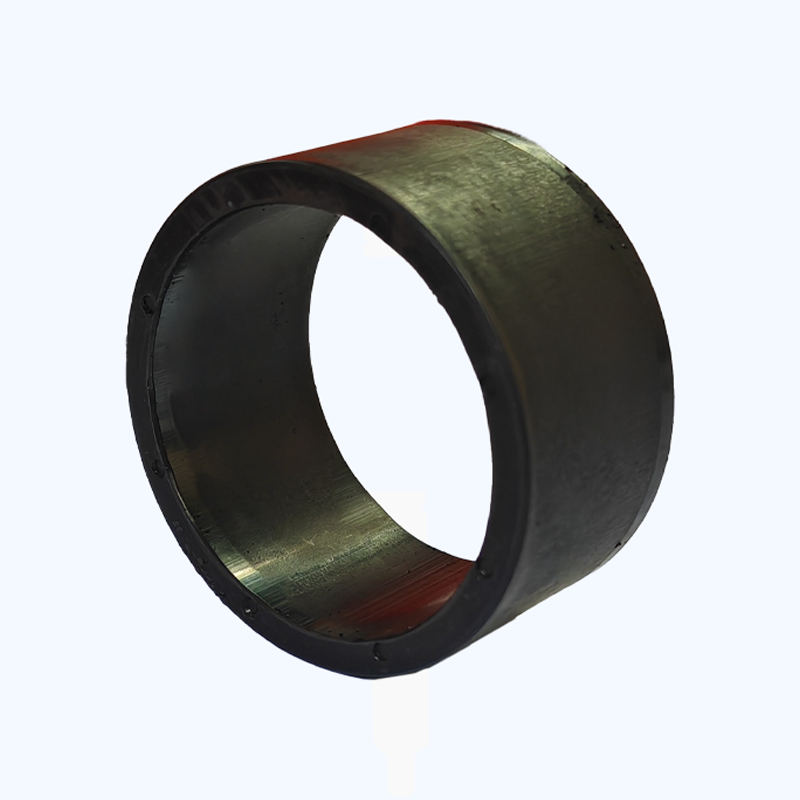
Key Magnetic Properties for Motor Applications
When selecting Permanent Magnet Magnetic Rings, motor manufacturers need to consider more than simply the magnet’s size.
Three important magnetic parameters are remanence, intrinsic coercivity and maximum magnetic energy product.
Remanence (Br)
Remanence, or Br, represents the magnetic flux density retained by a permanent magnet after the external magnetizing field is removed.
In a motor, Br has a direct influence on the magnetic flux available across the air gap.
A higher suitable Br can contribute to:
- Higher torque
- Greater torque constant
- Improved power density
- More compact motor design
However, Br should always be evaluated together with temperature characteristics and the complete magnetic circuit.
Intrinsic Coercivity (Hcj)
Intrinsic coercivity indicates a magnet’s resistance to irreversible demagnetization.
This property becomes particularly important in motors operating at elevated temperatures.
If the selected magnetic material does not have sufficient coercivity for the actual operating conditions, exposure to high temperature and opposing magnetic fields can cause irreversible demagnetization.
Once this occurs, the motor may experience permanent degradation in:
- Torque output
- Efficiency
- Power density
- Operating stability
Therefore, Hcj should be selected according to the motor’s maximum operating temperature and demagnetization conditions.
Maximum Magnetic Energy Product (BH)max
The maximum magnetic energy product, commonly expressed as (BH)max, is an important indicator of the energy density of a permanent magnet.
A higher energy product can allow a magnetic ring to generate stronger magnetic performance within a limited volume.
This is particularly valuable for applications where designers are trying to achieve high torque or power density while keeping the motor compact.
Sintered Permanent Magnet Magnetic Rings
Sintered magnets are manufactured through powder-based processes that produce a relatively dense magnetic material.
They generally offer strong magnetic performance and are widely used where high magnetic output is a priority.
Advantages of Sintered Rings
Sintered magnetic rings can provide:
- High magnetic energy density
- Strong magnetic performance
- Good high-performance motor capability
- Suitable characteristics for demanding rotor applications
However, the material is relatively hard and brittle.
As a result, complex mechanical integration can be more difficult, and additional rotor assembly processes may be required.
In many motor designs, individual sintered magnetic components are assembled onto the rotor shaft or rotor core.
Injection-Molded Permanent Magnet Magnetic Rings
Injection molding combines magnetic powder with a thermoplastic polymer binder and forms the material through an injection molding process.
Materials such as nylon-based polymer systems can be used as the matrix.
One of the most important advantages is the ability to integrate the magnetic component with other rotor structures.
Integral Rotor Molding
The magnetic ring can potentially be molded directly around a rotor shaft or other insert.
This can reduce the number of secondary assembly operations and improve dimensional consistency.
For high-volume production, this characteristic is particularly valuable because it can support automated manufacturing processes.
Typical Advantages
Injection-molded magnetic rings can offer:
- Complex shape capability
- Good dimensional consistency
- Integrated molding
- Reduced assembly steps
- Good mechanical toughness
- Suitability for high-volume production
The main trade-off is that the polymer binder reduces the proportion of magnetic material compared with some compression-bonded or sintered materials.
Therefore, magnetic performance may be lower than that of sintered alternatives.
Bonded Permanent Magnet Magnetic Rings
Bonded magnetic rings are produced by combining magnetic powder with a binder, such as epoxy resin, and forming the mixture under pressure.
Compared with injection molding, compression bonding can generally achieve a higher magnetic powder loading ratio.
This can provide stronger magnetic performance within the same component volume.
Advantages and Limitations
Bonded magnetic rings can provide:
- Higher magnetic powder content
- Good magnetic performance
- Flexible magnetic material options
- Suitable performance for compact motor designs
However, mechanical strength and structural integration must be carefully considered.
The appropriate design therefore depends on whether the motor prioritizes magnetic output, mechanical integration, production efficiency or cost.
Injection-Molded vs Bonded vs Sintered Magnetic Rings
The three forming technologies have different strengths.
| Magnetic Ring Type | Magnetic Performance | Shape Flexibility | Integration | Typical Advantage |
|---|---|---|---|---|
| Sintered | High | Moderate | Limited | High magnetic performance |
| Injection Molded | Moderate | High | Excellent | Complex shapes and mass production |
| Bonded | Moderate to High | Good | Good | Balance of magnetic output and manufacturing flexibility |
The actual performance depends on the selected magnetic material, powder loading, geometry, magnetization method and application requirements.
Therefore, there is no single forming process that is optimal for every motor.
How to Select the Right Magnetic Ring
Motor manufacturers can use a simple application-based decision process.
Step 1: Identify the Function
First determine whether the magnetic ring is being used for:
- Motor excitation
- Rotor magnetic field generation
- Position sensing
- EMI suppression
These are fundamentally different applications and require different magnetic materials.
Step 2: Confirm the Operating Temperature
Temperature is one of the most important parameters for permanent-magnet selection.
The magnetic material must maintain adequate magnetic performance and demagnetization resistance throughout the motor’s operating temperature range.
Step 3: Define Power Density Requirements
For motors requiring high torque and compact dimensions, stronger magnetic materials may be necessary.
Applications with moderate torque requirements may provide more flexibility in material and manufacturing selection.
Step 4: Consider Rotor Integration
If the rotor requires complex geometry or direct integration with a shaft, injection molding may provide important manufacturing advantages.
For relatively simple rotor structures where magnetic output has a higher priority, bonded or sintered solutions may be more appropriate.
Step 5: Evaluate Production Volume and Cost
High-volume motor production requires consistent dimensions and efficient assembly.
Injection molding can be attractive for applications where automated production and integrated forming are important.
Permanent Magnet Magnetic Rings vs EMI Suppression Rings
It is important not to confuse permanent-magnet rotor rings with soft-magnetic rings used for electromagnetic interference suppression.
Although both may be called “magnetic rings,” their functions are completely different.
Permanent Magnet Rings
Permanent magnetic rings generate a stable magnetic field and serve as part of the motor excitation system.
They are used in:
- BLDC motors
- PMSM motors
- Stepper motors
- Permanent-magnet rotor assemblies
EMI Suppression Magnetic Rings
EMI suppression rings are generally made from soft magnetic materials such as ferrite or nanocrystalline materials.
They are installed around cables or within filtering structures to suppress high-frequency interference.
Their purpose is not to generate motor torque.
Understanding this distinction is essential when selecting magnetic materials for a motor project.
Applications of Permanent Magnet Magnetic Rings
Permanent Magnet Magnetic Rings can be used across a wide range of motor applications.
BLDC Motors
BLDC motors use permanent magnetic rotor structures to interact with electronically controlled stator fields.
Magnetic rings can help create compact and efficient rotor designs.
PMSM Motors
Permanent-magnet synchronous motors require stable rotor magnetic fields for synchronous operation.
The magnetic properties and temperature stability of the selected ring are therefore important design considerations.
Stepper Motors
Stepper motors use magnetic interaction to create discrete angular movement.
Multi-pole magnetic structures can be incorporated into different rotor configurations depending on the motor architecture.
Automotive Motors
Automotive applications often require a combination of compact size, durability, temperature resistance and reliable magnetic performance.
The appropriate magnetic material should therefore be selected according to the specific motor environment.
Household Appliances
Fans, pumps, air-conditioning systems and other appliances commonly use permanent-magnet motor technologies.
For high-volume appliance production, manufacturing efficiency and dimensional consistency can be just as important as magnetic performance.
Why Choose Highkos for Permanent Magnet Magnetic Rings?
Highkos focuses on customized magnetic components and magnetic ring solutions for motor applications.
Its capabilities cover different magnetic materials and manufacturing processes, including:
- Permanent magnet magnetic rings
- Injection-molded magnetic rings
- Bonded magnetic rings
- Ferrite magnetic components
- Multi-pole magnetization
- Customized rotor magnetic components
- OEM and ODM manufacturing
For motor manufacturers, the right solution depends on the complete application rather than magnetic performance alone. Material selection, forming technology, operating temperature, rotor structure, production volume and target cost should all be evaluated together.
Frequently Asked Questions
What motors use Permanent Magnet Magnetic Rings?
They can be used in BLDC motors, PMSM motors, stepper motors and various automotive, industrial and household appliance motors.
What is the most important magnetic property?
Br, Hcj and (BH)max are all important. Br influences available magnetic flux, Hcj indicates resistance to demagnetization, while (BH)max represents magnetic energy density.
Are injection-molded magnetic rings suitable for mass production?
Yes. Their ability to form complex geometries and integrate with rotor shafts makes them particularly suitable for automated, high-volume motor manufacturing.
Are bonded magnetic rings stronger than injection-molded rings?
Bonded magnetic rings can achieve higher magnetic powder loading and therefore stronger magnetic performance in some designs. However, mechanical properties and structural requirements must also be considered.
What is the difference between permanent magnet rings and EMI suppression rings?
Permanent magnet rings generate the magnetic field used for motor excitation. EMI suppression rings use soft magnetic materials to reduce electromagnetic interference and do not directly generate motor torque.
Conclusion
Permanent Magnet Magnetic Rings play an important role in the rotor structures of BLDC, PMSM and stepper motors. Their magnetic properties directly influence the motor’s flux, torque and power density, while their forming process affects rotor integration, dimensional accuracy and manufacturing efficiency.
Sintered, injection-molded and bonded magnetic rings each offer different advantages. Sintered solutions emphasize magnetic performance, injection molding provides strong integration and mass-production benefits, while bonded magnets offer a useful balance between magnetic output and manufacturing flexibility.
For motor manufacturers, the best solution should be selected according to operating temperature, magnetic requirements, rotor structure, production volume and cost objectives rather than relying on a single performance parameter.