The pole pair count of a motor determines its base efficiency—this is an electromagnetic relationship that no feedback component can override. An induction magnetic ring does not contribute to the motor’s power output and cannot directly set efficiency. Yet the selection of its pole count, and more importantly the magnetic ring pole pair alignment with the motor, modulates losses at the control level in ways that directly affect the overall efficiency of the machine.
Highkos has been producing injection-molded and sintered magnetic components for BLDC and PMSM applications, including encoder rings with customizable pole configurations . The company’s product range covers injection molded magnetic rings with standard 8P/16P configurations as well as custom pole counts for position sensing applications . Understanding how magnetic ring pole pair matching influences commutation accuracy is essential for engineers specifying a new drive platform or troubleshooting an existing design that underperforms its efficiency targets.
Why Magnetic Ring Pole Pair Matching Is the Primary Efficiency Factor
For sensored or sensorless FOC drive schemes, the ideal requirement is that the pole pairs of the magnetic ring match those of the motor, or satisfy an integer multiple relationship. When magnetic ring pole pair matching is correct, rotor position detection is accurate and commutation angles are precise. The output current retains high sinusoidal quality, torque remains smooth, current harmonics stay low, and copper loss is effectively suppressed. Under these conditions, the motor can meet its design efficiency targets.
Incorrect pole count selection or mismatching introduces deviations in the rotor angle detected by the driver. The consequences cascade through the control loop: commutation becomes advanced or delayed, current waveforms distort, torque ripple increases, motor temperature rise climbs significantly, and efficiency drops. Operational jitter and abnormal noise may occur concurrently. Consider a simple example: a 4-pole (2 pole-pair) motor is normally fitted with a 4-pole induction ring. If a 6-pole ring is used by mistake, the driver’s angle calculation develops a systematic error, and motor efficiency can fall by several percentage points directly.
This is why Highkos emphasizes application-specific pole configuration rather than catalog defaults. The company’s multi-pole magnetization capabilities allow pole patterns to be tailored to the specific commutation scheme of each motor, reducing torque ripple without requiring controller-side compensation.
How Magnetic Ring Pole Pair Matching Governs Low-Speed Efficiency
Beyond the matching relationship itself, the pole count of the ring governs position resolution, with a particularly pronounced impact on efficiency under low-speed operating conditions. A higher pole count means more position feedback signal points per full rotor revolution, finer angle sampling, and smoother FOC vector control. The result is lower low-speed torque ripple and better efficiency in the low-speed range—a critical advantage for applications such as robotics joints, medical infusion pumps, and precision automation axes where the motor spends significant time at low RPM.
However, higher pole count is not universally beneficial. As pole count increases, the individual pole width becomes smaller, and the requirements for magnetization fixture accuracy and magnetic circuit design become more demanding . Consistency of Gauss readings across all points on the ring becomes difficult to guarantee, which readily introduces angular errors and additional harmonic losses. At that point, the pursuit of resolution produces a net performance loss rather than a gain.
Conversely, a ring with too few poles delivers insufficient position resolution, resulting in coarse control performance and heavy current fluctuation at low speed, degrading low-speed efficiency. At high rotational speeds, however, the adverse effects of a low pole count are relatively limited—which is why high-speed applications such as drone propulsion or vacuum cleaner fans can tolerate simpler feedback configurations.
Magnetic Ring Pole Pair Matching Across Appliances, Automotive and Industrial Drives
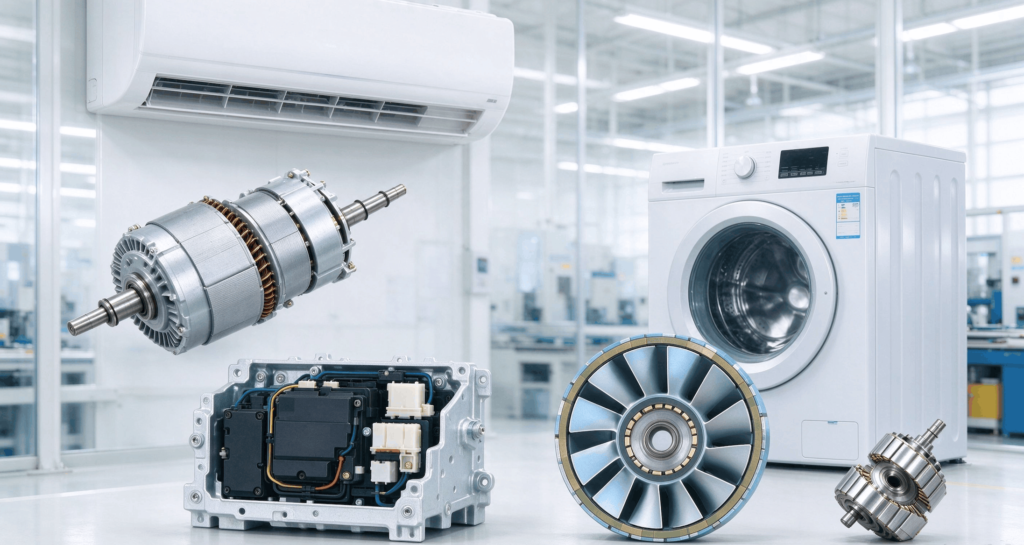
The practical consequences of magnetic ring pole pair matching vary by application. In home appliance BLDC motors—refrigerator fans, washing machine drives, range hood blowers—the motor typically operates across a wide speed range but prioritizes quiet operation and energy-label compliance. A ring whose pole count matches the motor pole pairs and provides adequate resolution at the appliance’s most-used speeds helps the controller maintain sinusoidal current and minimize acoustic noise.
In automotive electronic pumps and thermal management actuators, the matching requirement is compounded by temperature and vibration. A mismatched ring produces commutation error that manifests as excess heat—a particularly unwelcome outcome in an under-hood environment already stressed by ambient temperature. Highkos supplies automotive-grade injection NdFeB radial multipole rings for electronic throttle pumps and new energy vehicle battery cooling pumps, with pole configurations matched to the motor design and IATF16949 quality documentation.
For industrial automation and robotics, the stakes are position repeatability and settling time. A direct-drive joint without a gearbox exposes every imperfection in the feedback signal. Matching the ring pole pairs to the motor and selecting a pole count that supports the required resolution at the application’s operating speed is the starting point for stable control. Where a single-track ring’s resolution proves insufficient, Highkos’s multi-track Vernier encoder technology offers an alternative approach for absolute position sensing by combining tracks with different pole-pair counts .
Balancing Magnetic Ring Pole Pair Matching Against Manufacturing Realities
Specifying the theoretically ideal pole count is only useful if the production process can hold the tolerances required. A high-pole ring with narrow pole arcs demands tight concentricity, uniform magnetization, and precise sensor placement. Minor eccentricity that would be invisible in a 16-pole ring becomes a measurable angular error in a 64-pole ring. For OEMs sourcing from multiple suppliers, this creates a hidden risk: a ring that passes incoming inspection may still perform differently in the finished motor if magnetization consistency varies between batches.
Highkos addresses this by controlling magnet production in-house, from powder formulation through molding and magnetization. The company’s injection molded magnetic rings are specified with surface magnetic field ranges such as 1750–1850 GS for consistent flux output . Multi-pole magnetization processes are controlled for pole count, magnetic strength, transition angle, and field uniformity, with pole counts ranging from 4 to 64 poles and beyond for specialized applications . For customers evaluating a magnetic ring pole pair change or a new supplier, samples produced on production tooling allow validation testing to reflect volume performance rather than prototype conditions.
The cost trade-off also deserves attention. A higher pole count may require a more capable sensor or encoder IC, tighter assembly fixtures, and more expensive magnetization tooling. In cost-sensitive appliance or power tool programs, the lowest pole count that satisfies the resolution requirement at the operating speed is often the economically optimal choice—not the highest count available.
Conclusion: Matching Is the Minimum, Resolution Is the Optimization
The efficiency impact of a feedback magnetic ring is indirect but real. Correct magnetic ring pole pair alignment prevents the commutation errors that waste copper and generate excess heat. Appropriate resolution selection supports smooth low-speed control without imposing manufacturing complexity that the production line cannot sustain. The ring does not produce torque, but it determines how efficiently the motor’s torque is delivered.
Highkos brings magnetic material expertise and encoder ring manufacturing together for appliance, automotive, pump, robotics, and power tool customers. If you are specifying a feedback magnet for a new motor platform, troubleshooting an efficiency shortfall, or evaluating a supplier change, contact Highkos to discuss pole pair matching options, request samples, or review your ring specification against your drive architecture.
FAQ
Does the magnetic ring pole count directly determine motor efficiency?
No. The motor’s pole pair count determines base efficiency. The magnetic ring is a position feedback component and does not contribute to power output. However, correct magnetic ring pole pair matching prevents commutation errors that would otherwise increase losses and reduce efficiency.
What happens if the magnetic ring pole count does not match the motor pole pairs?
Mismatching introduces systematic rotor angle errors in the driver’s calculation. This causes advanced or delayed commutation, distorted current waveforms, increased torque ripple, higher temperature rise, and reduced efficiency. In severe cases, operational jitter and abnormal noise occur.
Is a higher pole count always better for low-speed efficiency?
Higher pole count improves resolution and low-speed smoothness up to a point. Beyond that, narrower pole arcs make magnetization uniformity and concentricity harder to control, introducing angular errors and harmonic losses that can offset the resolution gain .
What pole count options does Highkos offer for encoder rings?
Highkos produces injection-molded and sintered magnetic rings with custom pole configurations. Standard products include 8P/16P rings, and custom multi-pole magnetization supports pole counts from 4 to 64 poles and beyond depending on the application .
Can Highkos help verify that a ring specification matches my motor?
Yes. Highkos works with customers at the application definition stage to align ring pole count, magnetization pattern, and resolution with the motor pole pairs and drive architecture. Sample rings produced on production tooling support validation testing.