
Magnetic rings are important components in modern motors, sensing systems, automotive electronics, household appliances and industrial equipment. Their geometry, magnetic material, pole configuration and dimensional consistency can directly influence the performance of the final product. For manufacturers developing compact motors or precision sensing devices, choosing the right Magnetic Ring Manufacturer is an important part of product development and supply chain management.
A reliable manufacturing partner should do more than supply standard magnetic components. It should understand the application, evaluate material options, coordinate magnetization requirements and maintain consistent production quality. These factors become particularly important for OEM and ODM projects, where a magnetic ring must fit a specific mechanical structure and meet defined performance requirements.
High Kos Magnet focuses on magnetic materials and customized magnetic components, including injection-molded and sintered magnet solutions. Its product range includes magnetic rings and motor-related components for applications such as home appliances, automotive systems and water pumps. Buyers can explore the High Kos Magnet website to learn more about its products and manufacturing focus.
This guide explains the main magnetic ring types, material considerations, industrial applications and supplier evaluation criteria to help engineering teams and purchasing managers make informed decisions.
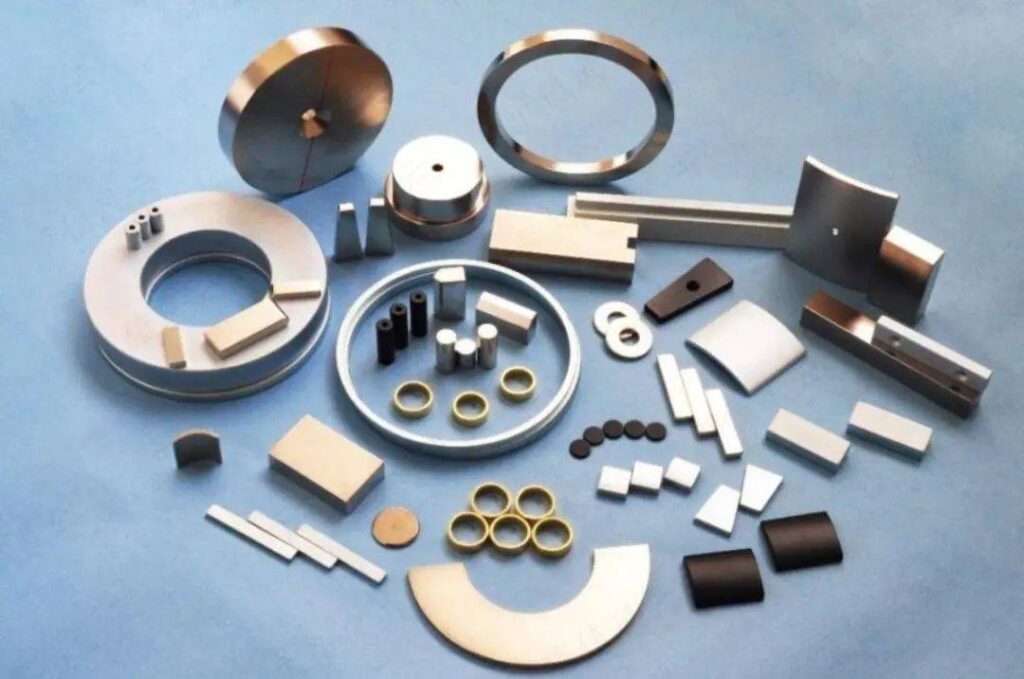
What Does a Magnetic Ring Manufacturer Produce?
A Magnetic Ring Manufacturer produces ring-shaped magnetic components designed for different mechanical, electrical and sensing functions. Although magnetic rings share a general shape, their purposes can differ significantly according to material composition, magnetization pattern and operating environment.
Some rings generate the magnetic field needed for motor rotation. Others provide signals for speed or position detection. Soft ferrite rings used in electronic circuits may serve an entirely different purpose, such as electromagnetic interference suppression.
Before selecting a supplier, buyers should identify the component’s actual function instead of relying on the general term “magnetic ring.”
Permanent Magnet Rings for Motors
Permanent magnet rings generate a magnetic field that interacts with the stator field in a permanent-magnet motor. Depending on the design, they may be used in brushless DC motors (BLDC), permanent-magnet synchronous motors (PMSM), fan motors, pump motors and other compact drive systems.
The number and arrangement of magnetic poles must match the motor’s electromagnetic design. Incorrect pole configuration or inconsistent magnetic properties may affect torque, speed control, vibration and overall operating stability.
Magnetic Rings for Sensors and Encoders
Magnetic rings can also serve as targets for magnetic sensing systems. As a ring rotates, its magnetic field changes relative to a sensor, allowing an electronic control system to detect movement, rotational speed or position.
These applications require attention to pole spacing, magnetic field consistency, dimensional accuracy and the relationship between the ring and the sensor.
For additional technical background, see High Kos Magnet’s article on multi-pole magnetic ring magnetization.
Injection-Molded Magnetic Rings
Injection-molded magnetic rings combine magnetic powder with a polymer binder and are formed through an injection molding process. This approach can support complex geometries and integrated component structures.
For projects involving high-volume motor production, compact assemblies or specialized rotor designs, injection molding may help simplify manufacturing and assembly. The suitability of this process depends on the required magnetic performance, material selection and mechanical design.
High Kos Magnet’s injection-molded ferrite product range provides a useful starting point for buyers evaluating this type of magnetic component.
How a Magnetic Ring Manufacturer Selects Materials
Material selection is one of the most important steps in magnetic ring development. A suitable material must satisfy the magnetic requirements while remaining compatible with the component’s geometry, operating temperature, mechanical structure and target production cost.
An experienced Magnetic Ring Manufacturer evaluates these factors together rather than selecting a material based on magnetic strength alone.
Ferrite Magnetic Rings
Ferrite is widely used in cost-sensitive permanent magnet applications. Depending on the design, ferrite magnetic rings can be suitable for fan motors, household appliances, pump systems and other motor-related components.
Potential advantages include material cost considerations and suitability for applications where the required magnetic performance can be achieved within the available design space. However, engineers must assess the actual magnetic characteristics, dimensions and operating conditions before confirming a ferrite solution.
Ferrite permanent magnet rings should also be distinguished from soft ferrite rings used for EMI suppression. Although both are called ferrite rings, their magnetic behavior and intended functions are different.
NdFeB Magnetic Rings
Neodymium-iron-boron (NdFeB) magnets are selected for applications that require strong magnetic performance within a limited volume. They may be considered for compact motors, high-performance drive systems and precision magnetic assemblies.
However, NdFeB selection requires attention to operating temperature, resistance to demagnetization, corrosion protection where relevant, and the mechanical requirements of the finished component. The appropriate grade and manufacturing process depend on the application rather than on a universal recommendation.
Buyers comparing material options can review the company’s ferrite and NdFeB magnet manufacturing information.
Injection-Molded and Bonded Magnetic Materials
Injection-molded and bonded magnets combine magnetic powder with a binder. Their manufacturing characteristics differ from those of conventional sintered magnets.
Injection molding can support complex shapes and integration with other components, while bonded magnet processes may offer a different balance of magnetic powder content, shape flexibility and mechanical properties. Actual results depend on the material system and production method.
When working with a Magnetic Ring Manufacturer, buyers should compare candidate processes against the complete product specification, including magnetic output, geometry, assembly requirements and expected production volume.
Why Multi-Pole Magnetization Matters
Magnetic material alone does not determine how a finished ring performs. The magnetization pattern is equally important for motors, encoders and sensing devices.
A multi-pole magnetic ring contains multiple north and south poles arranged according to the design. As the ring rotates, this pattern interacts with the motor’s magnetic circuit or produces signals that can be detected by sensors.
Matching Pole Configuration to the Application
The required pole count depends on the motor architecture, sensing method, control system and mechanical dimensions. A design intended for a motor rotor may require a different pole arrangement from a magnetic ring used for rotational sensing.
Engineering teams should confirm the following information before production:
-
Required number of magnetic poles and pole arrangement.
-
Magnetization direction and pattern.
-
Ring dimensions and installation position.
-
Magnetic field requirements at the relevant measurement location.
-
Compatibility with the motor or sensor design.
These details help the manufacturer assess whether the proposed magnetic ring can support the intended function.
Maintaining Consistency in Production
For OEM projects, consistency between batches is critical. Even when individual components meet dimensional requirements, variations in magnetization or material properties can create challenges during motor assembly or sensor calibration.
A qualified Magnetic Ring Manufacturer should establish appropriate inspection procedures for the characteristics that matter to the application. Depending on the project, these may include dimensional checks, magnetic testing, visual inspection and verification of the magnetization pattern.
The specific acceptance criteria should be agreed upon by the customer and supplier before mass production.
Key Applications of a Magnetic Ring Manufacturer’s Products
A capable Magnetic Ring Manufacturer should understand how magnetic components function within the customer’s finished equipment. The right solution depends on the operating environment, mechanical structure, magnetic requirements and expected production volume.
Household Appliances and Fan Motors
Household appliances often use compact motors to drive fans, pumps, compressors and other moving parts. Magnetic rings can form part of the rotor assembly or support speed and position sensing.
For appliance manufacturers, key considerations include noise and vibration, assembly consistency, production efficiency and cost management. A magnetic component that fits the motor design and manufacturing process can help simplify assembly and improve production repeatability.
Automotive and New Energy Vehicle Components
Automotive systems use magnetic components in auxiliary motors, actuators, sensing devices and other electromechanical assemblies. Depending on the application, a magnetic ring may need to operate under temperature changes, vibration and repeated operating cycles.
For new energy vehicle projects, buyers should define the component’s operating temperature, mechanical loading, magnetic performance and relevant validation requirements early in the development process. Suppliers should evaluate the actual application rather than assume that one magnetic material is suitable for every automotive system.
High Kos Magnet’s article on permanent ferrite magnetic rings for automotive motors provides additional information about magnetic ring applications in automotive auxiliary motors.
Water Pumps and Fluid Equipment
Water pumps and fluid-handling equipment may use magnetic rings or integrated magnetic rotor components in brushless motor assemblies. Component geometry and material selection must suit the pump’s mechanical arrangement and operating environment.
Depending on the design, buyers may need to consider moisture exposure, temperature, sealing arrangements, dimensional stability and the relationship between the rotor and surrounding components. These requirements should be reviewed together with the pump’s engineering team.
Industrial Automation and Robotics
Automated equipment, robotic systems and precision motion-control devices rely on predictable movement and accurate feedback. Magnetic rings can support motor operation or work with sensors to detect rotational position and speed.
For these applications, engineers should pay particular attention to pole configuration, magnetic field consistency and the alignment between the magnetic ring and sensing element. A Magnetic Ring Manufacturer that understands the complete assembly can help identify manufacturing considerations before tooling and mass production begin.
Medical Devices, Drones and Power Tools
Medical equipment, drones, model aircraft and power tools may contain compact motors or magnetic sensing systems. Their magnetic components must be designed around the specific product requirements, including size, weight, operating speed and environmental conditions.
The validation requirements for medical equipment may differ significantly from those for consumer power tools or drones. Buyers should communicate the intended use and applicable product requirements clearly when requesting a quotation.
How to Choose a Reliable Magnetic Ring Manufacturer
Supplier evaluation should cover engineering communication, process suitability, quality control and long-term supply—not just the unit price. The following steps can help procurement teams and engineers compare potential suppliers.
1. Review Relevant Product and Process Experience
Ask whether the supplier manufactures the type of magnetic ring required for your project. Experience with injection-molded ferrite, NdFeB components, multipole magnetization or integrated rotor structures may be relevant, depending on the application.
Review the manufacturer’s actual product range and ask for examples of similar components where appropriate. High Kos Magnet’s magnetic ring and permanent magnet resources can help buyers understand available component approaches.
2. Confirm Customization and Engineering Communication
A custom magnetic ring project often begins with a drawing, sample or preliminary specification. The supplier should clarify any missing details before confirming feasibility.
Useful information to provide includes:
-
Outer diameter, inner diameter and ring thickness.
-
Magnetic material or preferred manufacturing process, if known.
-
Required pole count and magnetization pattern.
-
Operating temperature and application environment.
-
Mechanical interface and assembly method.
-
Annual demand, prototype quantity and expected production schedule.
If some parameters have not yet been finalized, share the intended application and current design information. The manufacturer can then discuss which details need engineering confirmation.
3. Evaluate Quality Control and Traceability
Quality requirements should be agreed upon before production starts. Depending on the project, inspection may cover component dimensions, appearance, magnetic properties, pole pattern and fit with the mating parts.
For repeat orders, ask how the supplier maintains consistency between production batches and handles nonconforming components. If the project requires material records, inspection reports or traceability, define those expectations in the purchase specification.
Avoid relying on broad quality claims alone. Clear acceptance criteria and documented communication provide a more useful foundation for a stable supplier relationship.
4. Compare Total Cost Rather Than Unit Price Alone
The lowest quotation does not always provide the best commercial result. Buyers should consider tooling, secondary machining, assembly steps, inspection, packaging, lead time and the cost of rejected parts.
For high-volume applications, an injection-molded magnetic ring may offer manufacturing or integration benefits, depending on the design. In other projects, a different material or forming method may be more suitable.
A practical comparison should evaluate the complete component and production process rather than compare unit prices without considering specifications.
5. Assess Long-Term Supply Suitability
OEM and ODM buyers need suppliers that can support product development and repeat orders. Discuss forecast volumes, sample approval, order scheduling, engineering changes and communication procedures before placing a production order.
A clear process for handling specification changes is especially important when a magnetic ring is part of a larger motor or sensing assembly. Changes to dimensions, material or pole configuration should be reviewed for their effect on the finished product.
Why Work with High Kos Magnet?
High Kos Magnet focuses on the research, development, production and sales of magnetic products, including injection-molded and sintered magnetic components. Its product range includes magnetic rings and motor-related parts for applications in household appliances, automotive systems, water pumps and other equipment.
For buyers seeking a Magnetic Ring Manufacturer, the key is to match the component design with the intended application. Material, geometry, magnetization and assembly requirements should be considered together, with project specifications established before mass production.
You can explore the injection-molded ferrite product range or review the company’s magnetic materials and manufacturing information to identify a suitable starting point for your project.
Frequently Asked Questions About Magnetic Ring Manufacturers
What does a magnetic ring manufacturer do?
A magnetic ring manufacturer produces ring-shaped magnetic components for applications such as motor rotors, magnetic sensors and encoders. Depending on its production capabilities, it may offer different materials, forming processes, magnetization patterns and customized geometries.
Which material is best for a custom magnetic ring?
There is no single best material for every application. Ferrite may suit cost-sensitive designs, while NdFeB may be considered where strong magnetic performance within a limited space is important. Injection-molded and bonded options offer different balances of shape flexibility, magnetic properties and integration.
Can magnetic rings be customized for OEM and ODM projects?
Customization may cover dimensions, material selection, pole count, magnetization pattern and mechanical interfaces. The available options depend on the manufacturer’s processes and the specific project requirements. Buyers should submit drawings or application details for technical review.
Why is multipole magnetization important?
Multipole magnetization creates a defined arrangement of alternating magnetic poles around a ring. This pattern is important for many motor rotor and magnetic sensing applications. The pole count and arrangement must match the design of the motor or sensor system.
What information should I send when requesting a quotation?
Provide a drawing or sample, component dimensions, intended application, required material if known, magnetization requirements, operating environment, estimated order quantity and target delivery schedule. The more complete the information, the easier it is to assess feasibility and prepare a meaningful quotation.
How can I evaluate a magnetic ring supplier’s quality?
Review the supplier’s relevant manufacturing experience, inspection procedures, ability to meet agreed specifications, communication practices and approach to batch consistency. For demanding projects, define acceptance criteria and documentation requirements before ordering.
Conclusion: Find the Right Magnetic Ring Manufacturer for Your Project
Selecting a suitable Magnetic Ring Manufacturer requires a clear understanding of the component’s function, material, magnetization pattern, mechanical dimensions and production requirements. A well-matched magnetic ring can support reliable motor operation, accurate sensing and efficient assembly across household appliances, automotive systems, pumps, industrial automation and other equipment.
Before placing an order, define the critical specifications, compare suitable manufacturing processes and confirm quality expectations with your supplier. These steps can reduce development uncertainty and create a stronger foundation for long-term procurement.
Developing a custom magnetic ring for a motor, sensor or OEM product? Contact High Kos Magnet to discuss your application, drawings and production requirements. Share your project details to start evaluating a suitable magnetic component solution.