
Choosing the right Ferrite Magnet Manufacturer is an important decision for businesses producing electric motors, household appliances, automotive components, water pumps, industrial automation equipment and other magnetic assemblies. Ferrite magnets remain widely used in industrial manufacturing because they offer a practical balance of material cost, magnetic performance and suitability for high-volume production.
However, not every ferrite magnet is suitable for every application. Component geometry, manufacturing process, magnetization direction, operating temperature and installation requirements all influence the final result. For OEM and ODM buyers, selecting a manufacturer that understands these factors can help reduce development risks and improve consistency across production batches.
High Kos Magnet focuses on magnetic materials and customized magnetic components, including injection-molded and sintered magnets. Its product portfolio includes ferrite motor rotors, magnetic rings and water pump rotor components for different industrial applications. Buyers can explore the High Kos Magnet official website to review its product range and manufacturing information.
This guide explains ferrite magnet types, manufacturing processes, industrial applications and supplier evaluation criteria to help purchasing managers and engineers identify a suitable manufacturing partner.
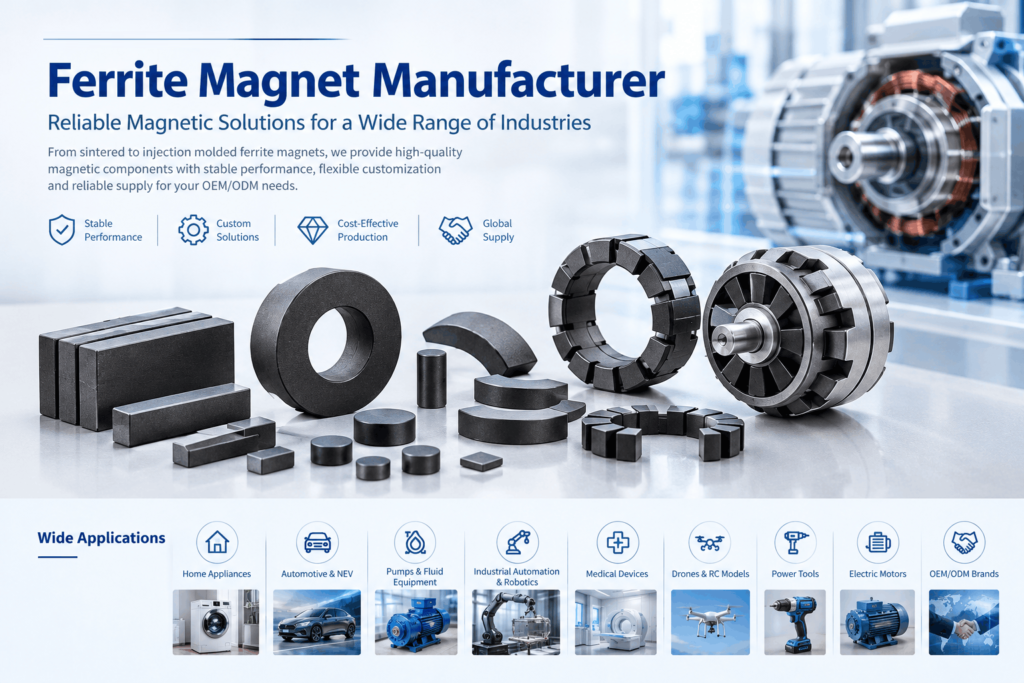
What Does a Ferrite Magnet Manufacturer Produce?
A Ferrite Magnet Manufacturer produces permanent magnetic components made primarily from ferrite-based magnetic materials. Often called ceramic magnets, permanent ferrite magnets are commonly used in applications where cost management, stable magnetic behavior and scalable production are important.
Ferrite magnets should not be confused with soft ferrite components used for electromagnetic interference suppression. Permanent ferrite magnets are designed to retain magnetization, while soft ferrites are generally used for their behavior in changing magnetic fields.
Depending on the manufacturing process and product design, a ferrite magnet manufacturer may produce rings, arcs, blocks, custom shapes and integrated motor components. The right format depends on the magnetic circuit, available installation space and the mechanical requirements of the finished product.
Sintered Ferrite Magnets
Sintered ferrite magnets are produced by forming ferrite material and processing it at high temperatures to create a rigid magnetic component. The process is suitable for many conventional permanent magnet shapes and motor-related applications.
For equipment manufacturers, sintered ferrite can be a practical choice when the design requires a rigid magnet with suitable magnetic performance and a cost-conscious material system. Engineers must still account for the component’s dimensions, mechanical support and application-specific operating conditions.
Explore High Kos Magnet’s sintered ferrite magnet products to review available motor-related component examples.
Injection-Molded Ferrite Magnets
Injection-molded ferrite magnets combine ferrite magnetic powder with a polymer binder and form the material through injection molding. This process can support more complex shapes and integration with other component features than some conventional magnet-forming approaches.
Injection-molded ferrite is worth evaluating for selected motor rotors, magnetic rings, water pump components and customized assemblies. Its suitability depends on the required magnetic properties, geometry, material formulation and mechanical conditions.
High Kos Magnet offers an injection-molded ferrite product range that includes motor outer rotors, inner rotors, induction magnetic rings and water pump rotors.
How to Choose the Right Ferrite Magnet Manufacturer for Your Application
Material selection should begin with the function of the finished component, not simply the magnet’s shape or price. A capable Ferrite Magnet Manufacturer should understand how the magnet will operate inside the customer’s product and which specifications are critical to its performance.
Define Magnetic Performance Requirements
The required magnetic performance depends on the design of the magnetic circuit, the space available for the magnet and the output expected from the finished equipment. For motor applications, engineers may need to consider torque, speed, pole configuration and the interaction between the rotor and stator.
A magnet that performs well in one design may not produce the same results in another. Buyers should therefore provide the manufacturer’s engineering team with application details and relevant drawings rather than selecting a product based on a general material description alone.
Consider Temperature and Operating Conditions
Ferrite magnet selection should account for the application’s operating temperature and the conditions the component will experience during use. Temperature changes can affect magnetic performance, while mechanical loading and assembly methods may influence the reliability of the complete component.
For automotive parts, pump systems and industrial equipment, buyers should communicate the actual operating environment and any relevant validation requirements. The manufacturer can then assess whether the proposed material and component structure are suitable for further development.
Match the Manufacturing Process to the Design
Sintered and injection-molded ferrite magnets offer different manufacturing characteristics. Sintered ferrite is commonly used for rigid permanent magnet components, while injection molding can support complex geometries and selected integrated structures.
Neither process is universally better. The appropriate choice depends on magnetic requirements, part geometry, production volume, assembly method and total manufacturing cost. A supplier should explain the relevant trade-offs before the buyer commits to tooling or mass production.
Key Applications of Ferrite Magnets in B2B Manufacturing
A professional Ferrite Magnet Manufacturer should understand the operating requirements of different industries. Although ferrite magnets are used across many sectors, the correct component design depends on the motor architecture, mechanical load, magnetic circuit and production environment.
Ferrite Magnets for Household Appliances
Household appliances use magnetic components in fan motors, ventilation equipment, refrigeration systems, washing machines and other motor-driven products. In these applications, ferrite magnets can provide a cost-conscious solution when the required magnetic performance can be achieved within the available design space.
For appliance manufacturers, component consistency is especially important in high-volume production. Buyers should evaluate dimensions, magnetic properties, pole configuration and assembly compatibility to reduce production variation and simplify quality management.
Ferrite Magnets for Automotive and New Energy Vehicles
Automotive systems contain numerous auxiliary motors, actuators and sensing components. Ferrite magnets can be suitable for selected applications where cost control, environmental stability and sufficient magnetic performance are important.
In new energy vehicles, potential applications include auxiliary pumps, thermal management equipment and other electromechanical systems. The magnet requirements depend on the specific function, operating temperature, mechanical structure and validation criteria. High-power-density traction motors may require different materials, so ferrite should be assessed on an application-by-application basis.
Read more about automotive ferrite magnets and vehicle applications.
Ferrite Magnets for Water Pumps and Fluid Equipment
Water pump manufacturers may use ferrite magnetic components in rotor assemblies and other magnetic drive structures. Injection-molded designs can be worth evaluating when the application calls for a particular geometry or integration with surrounding components.
For fluid equipment, engineers should consider the operating medium, temperature, sealing structure, rotor dimensions and compatibility with adjacent components. The complete assembly must meet the pump’s operating requirements; choosing a magnet based only on its material category is not sufficient.
High Kos Magnet’s injection-molded ferrite components for thermal management systems provide further context for applications involving electronic water pumps and related equipment.
Ferrite Magnets for Industrial Automation and Precision Equipment
Industrial automation systems use magnetic components in motors, actuators, positioning systems and sensing assemblies. Ferrite may be appropriate where the design can accommodate its magnetic characteristics and where stable, repeatable production is important.
Robotics and precision equipment manufacturers should evaluate magnetic output together with dimensional tolerances, alignment, pole configuration and sensor compatibility. These factors help determine whether a ferrite component can meet the finished product’s requirements.
Ferrite Magnets for Medical Devices, Drones and Power Tools
Medical devices, drones, model aircraft and power tools use different motor architectures and have distinct performance requirements. Ferrite magnets may be suitable for selected designs, but the decision should be based on actual size, weight, speed, temperature and magnetic performance requirements.
For medical applications, buyers should communicate any applicable regulatory, material documentation and validation requirements directly to the supplier. Drone and power tool manufacturers may place greater emphasis on weight, mechanical loading and operating speed. The manufacturer should evaluate each project against its own specifications.
How to Choose a Reliable Ferrite Magnet Manufacturer
Finding a suitable Ferrite Magnet Manufacturer involves more than comparing prices. Engineering support, process suitability, inspection methods and supply planning all affect the long-term value of a supplier relationship.
Review Product Range and Manufacturing Processes
Begin by checking whether the supplier produces the ferrite component your application requires. Some projects need conventional sintered magnets, while others may benefit from injection-molded ferrite rings, inner rotors, outer rotors or water pump rotors.
Review the manufacturer’s actual product pages and ask for relevant examples. High Kos Magnet’s ferrite magnet product categories provide a starting point for identifying components that may fit your application.
Confirm Customization and Engineering Communication
OEM and ODM projects frequently require customized dimensions, pole arrangements or mechanical interfaces. Before requesting a quotation, prepare as much technical information as possible, including:
-
Drawings or reference samples.
-
Outer diameter, inner diameter, thickness and other critical dimensions.
-
Required magnetic properties and magnetization direction.
-
Operating temperature and environmental conditions.
-
Assembly structure and connection requirements.
-
Prototype quantity, expected annual volume and delivery schedule.
If the design is not finalized, share the intended application and preliminary drawings. This helps the manufacturer identify missing specifications and discuss process feasibility before tooling decisions are made.
Evaluate Quality Control and Batch Consistency
For industrial buyers, consistent quality across repeat orders is just as important as the performance of the initial sample. Ask how the supplier checks critical dimensions, magnetic properties, pole configuration and appearance.
Where the application requires it, agree on inspection records, traceability, sample approval and procedures for handling nonconforming products. The relevant inspection methods and acceptance limits should be defined according to the component’s function rather than assumed to be identical for all ferrite magnets.
Compare Total Cost and Long-Term Supply Value
Ferrite magnets are often considered for cost-sensitive applications, but the lowest unit price does not always produce the lowest total cost. Tooling, secondary processing, assembly, inspection, packaging and rejected components can all affect the final purchasing decision.
Compare quotations using the same specifications and order assumptions. Discuss lead times, minimum order quantities, forecast changes and engineering-change procedures before placing a production order. A transparent supplier relationship helps buyers balance quality, cost and delivery expectations.
Why Choose High Kos Magnet as Your Ferrite Magnet Manufacturer?
High Kos Magnet focuses on magnetic materials and customized magnetic components, including injection-molded and sintered magnets. Its published product portfolio includes ferrite motor rotors, magnetic rings and water pump rotors for different equipment applications.
highkos.com+2
For B2B buyers, the value of a manufacturing partner lies in understanding how material selection, geometry, magnetization and assembly requirements work together. These factors are particularly important when a ferrite magnet forms part of a motor or a customized electromechanical component.
You can review High Kos Magnet’s injection-molded ferrite products, sintered ferrite products and magnetic materials manufacturing information to explore potential solutions.
When discussing a project with a Ferrite Magnet Manufacturer, provide the intended application, drawings, operating conditions and expected order volume. This makes it easier to assess material suitability and identify the technical details that must be confirmed before production.
FAQ: Ferrite Magnet Manufacturer
What is a ferrite magnet manufacturer?
A ferrite magnet manufacturer produces permanent magnetic components using ferrite-based materials. Products may include rings, arcs, custom shapes and motor components made through processes such as sintering or injection molding.
What is the difference between sintered and injection-molded ferrite magnets?
Sintered ferrite magnets are formed and processed at high temperatures to create rigid magnetic components. Injection-molded ferrite combines magnetic powder with a polymer binder, allowing greater flexibility for selected complex shapes and integrated structures. The appropriate process depends on the application’s magnetic, mechanical and dimensional requirements.
Are ferrite magnets suitable for electric motors?
Yes. Ferrite magnets are used in many motor applications, including selected fan motors, household appliances, automotive auxiliary systems and pump equipment. Suitability depends on the required magnetic output, available space, temperature and motor design.
Can a ferrite magnet manufacturer produce custom shapes?
Customization may be possible for dimensions, geometry, pole configuration and magnetization direction. The available options depend on the manufacturing process and product design. Buyers should submit drawings or samples for technical evaluation.
How do I choose between ferrite and NdFeB magnets?
Ferrite may be attractive when cost and adequate magnetic performance are priorities. NdFeB may be preferred when stronger magnetic performance within a limited space is required. Engineers should compare the magnetic circuit, temperature requirements, dimensions and total component cost before deciding.
What information should I provide when requesting a quotation?
Provide drawings or samples, dimensions, application details, material preferences, magnetization requirements, operating conditions, order quantity and expected delivery schedule. Clear specifications help the manufacturer assess feasibility and prepare a relevant quotation.
Conclusion: Partner with the Right Ferrite Magnet Manufacturer
Choosing the right Ferrite Magnet Manufacturer requires a careful evaluation of material properties, manufacturing processes, application requirements and production consistency. Sintered and injection-molded ferrite magnets offer different design possibilities, making it important to select a component that fits the finished product rather than relying on material name alone.
For household appliance factories, automotive suppliers, pump manufacturers, industrial automation businesses and overseas OEM/ODM brands, clear technical communication can help reduce development uncertainty and support more predictable sourcing. Confirm specifications, inspection criteria and delivery expectations before moving from samples to mass production.
Looking for a reliable ferrite magnet solution for your next project? Contact High Kos Magnet to discuss your drawings, application requirements and production needs. Share your project details to start evaluating a suitable customized magnetic component.