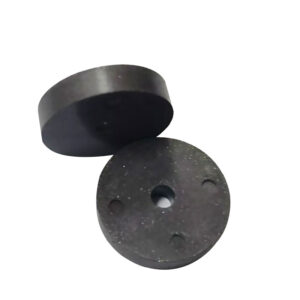
 A single-pole absolute encoder is a high-reliability magnetic angle sensing device designed for rotational position monitoring. Equipped with a single north-south magnetic pole pair and
high-precision Hall sensor ICs, this encoder delivers real-time absolute angle positioning without pre-operation homing. It perfectly integrates the anti-interference durability of magnetic encoders and the instant positioning advantage of absolute encoders, becoming a cost-effective sensing solution for industrial automation, intelligent equipment and automotive electronic systems. Compared with incremental encoders and high-end optical encoders, it balances structural simplicity, operational efficiency and environmental adaptability, covering most medium-precision industrial positioning scenarios.
Working Principle of Single-Pole Absolute Encoder
The single-pole absolute encoder adopts an ultra-simple two-component structural design, eliminating complex mechanical coding discs and optical lens groups used in traditional optical encoders. Its core configuration includes a radially magnetized single-pole magnet and a dedicated magnetic sensor IC, achieving non-contact angle detection with long service life and low wear. You can learn more about magnetic encoder basic principles from
TI official magnetic sensing technical documentation.
1. Core Structural Components

The first key component is the single-pole pair magnet, which is manufactured in ring or disc shape with uniform radial magnetization. It only generates one complete north-south magnetic field cycle, ensuring stable and regular magnetic field changes during 360° rotation. The second component is the fixed magnetic sensor IC, built with multiple high-sensitivity Hall elements, analog-to-digital converters (ADC) and embedded operation algorithms, responsible for real-time collection and analysis of magnetic field signals.
2. Complete Operating Workflow
When the rotating shaft drives the single-pole magnet to operate, the spatial orientation of the magnetic field changes synchronously with the rotation angle. The internal Hall array of the sensor IC continuously captures analog magnetic field signals, and the high-precision ADC module converts analog signals into digital data. The embedded calibration algorithm instantly calculates and outputs the absolute mechanical angle position, realizing real-time positioning without delay.
3. Built-in Calibration Mechanism
Due to the physical characteristics of magnetic field diffusion, raw magnetic detection data will produce slight non-linear errors, leading to deviation between sensor output angle and actual mechanical angle. Modern single-pole absolute encoder ICs are equipped with automatic non-linear calibration functions, which dynamically correct detection errors through built-in programs during operation, effectively improving positioning accuracy and solving the inherent defect of magnetic field detection.
5 Core Advantages of Single-Pole Absolute Encoder
Different from incremental encoders that require homing and optical encoders with strict environmental requirements, single-pole absolute encoders have unique competitive advantages in industrial application scenarios, covering durability, efficiency, cost and installation flexibility.
1. Instant Power-On Positioning, No Homing Required
As a typical absolute encoder product, it can feed back the real-time absolute rotation angle immediately after power-on. It completely abandons the tedious zero-point homing procedure of incremental encoders, greatly shortening equipment startup time, improving industrial operation efficiency, and avoiding positioning errors caused by homing failures. For more professional industrial positioning solutions, check our
industrial sensor precision positioning solution page.
2. Excellent Environmental Durability
Adopting non-contact magnetic induction detection technology, the internal structure has no vulnerable optical components. It is completely insensitive to industrial dust, oil pollution, moisture and other harsh environmental factors, and has strong resistance to mechanical vibration and impact. It can work stably for a long time in complex industrial environments such as factory workshops and automotive operating conditions.
3. Compact Structure & Easy Installation
The overall structure is miniaturized and lightweight, with no complex transmission and coding structures. It features flexible installation methods, strong adaptability to equipment assembly space, and can be embedded in small servo motors, medical equipment and miniature robotic equipment without occupying excess space.
4. Cost-Effective Industrial Sensing Option
Compared with high-precision optical absolute encoders, it has lower manufacturing and maintenance costs while meeting medium-precision positioning needs. It avoids the high failure rate and frequent maintenance problems of optical encoders in harsh environments, reducing the long-term operating cost of equipment.
5. Stable Dynamic Response Performance
Supported by high-speed ADC sampling and lightweight operation algorithms, the sensor IC can quickly capture magnetic field changes during high-speed rotation, realizing high-frequency angle signal output. It adapts to high-speed dynamic operation scenarios of servo motors and automated robotic arms, ensuring stable and continuous positioning feedback.
Key Limitations & Optimization Solutions
Although single-pole absolute encoders have prominent comprehensive performance, they still have scenario limitations compared with high-end optical encoders, with targeted optimization methods in practical applications:
Precision Ceiling: Restricted by single-pole magnetic field detection principle, it cannot achieve arcsecond-level ultra-high precision of professional optical encoders, so it is not suitable for ultra-precision processing and aerospace high-precision positioning scenarios. It is only applicable to conventional medium-precision industrial positioning.
External Magnetic Interference Risk: The magnetic detection mechanism is vulnerable to strong external magnetic field interference, which may cause detection deviation. The optimal solution is to add electromagnetic shielding structure in system design and keep away from strong magnetic equipment such as electromagnets and transformers.
Main Industrial Application Scenarios
Relying on high reliability, instant positioning and strong environmental adaptability, single-pole absolute encoders are widely used in industries that require stable dynamic positioning and high equipment continuity:
-
Robotics: Applied to joint rotation positioning of industrial robots and service robots, ensuring accurate angle control of robotic arms.
-
Servo Motor System: Matched with small and medium-power servo motors for industrial automation transmission and positioning control.
-
Automotive Electronics: Used for automobile throttle, steering angle and body attitude monitoring, adapting to complex vehicle operating environments.
-
Medical Equipment: Applied to miniature medical detection and rehabilitation equipment, meeting the requirements of stable operation and compact structure.
Conclusion
The single-pole absolute encoder fills the market gap between low-precision incremental encoders and high-cost ultra-precision optical encoders with its 5 core strengths. Its simple structure, instant power-on positioning, strong environmental resistance and low maintenance cost make it a mainstream magnetic positioning device in medium-precision industrial scenarios. With the continuous upgrading of magnetic sensing calibration technology, its positioning accuracy and anti-interference ability will be further improved, with broader application prospects in intelligent manufacturing and automotive intelligence fields. For more magnetic encoder industry standards, refer to
IEC official industrial sensing standard.