
Choosing the right Motor Rotor Manufacturer is an important decision for companies developing electric motors, household appliances, automotive components, water pumps and industrial equipment. The rotor is a core part of a motor’s electromagnetic and mechanical system. Its structure, magnetic properties, dimensional accuracy and balance can all influence operating efficiency, vibration, noise and long-term reliability.
For OEM and ODM buyers, sourcing a motor rotor is not simply a matter of finding a component with the right dimensions. The supplier must understand how the rotor works within the complete motor assembly, what magnetic material suits the application, how the component will be manufactured and which quality requirements must be maintained during mass production.
High Kos Magnet focuses on magnetic materials and customized magnetic components, including injection-molded and sintered magnet solutions. Its product range includes motor inner rotors, outer rotors, magnetic rings and water pump rotors for different equipment applications. Buyers can explore the High Kos Magnet official website to learn more about its magnetic products and manufacturing focus.
This article explains motor rotor types, material selection, manufacturing considerations, application requirements and supplier evaluation criteria to help engineering teams and purchasing managers make informed sourcing decisions.
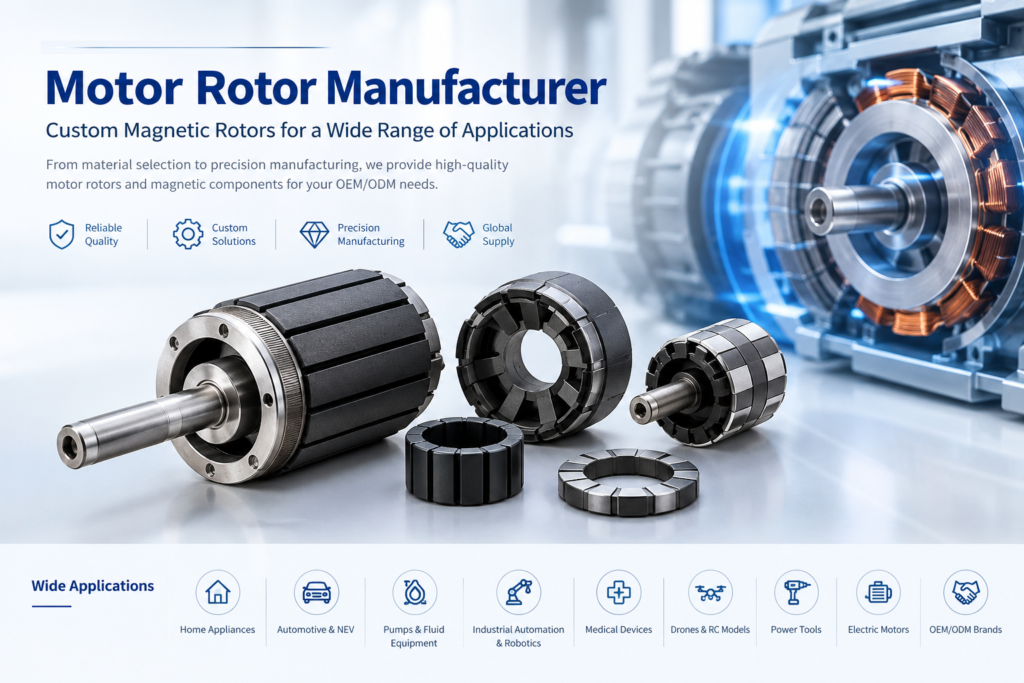
What Does a Motor Rotor Manufacturer Do?
A Motor Rotor Manufacturer produces the rotating component inside an electric motor. Depending on the motor design, the rotor may contain permanent magnets, a magnetic core, a shaft, a housing or other integrated parts. Its structure must work with the stator and the motor’s control system to produce the required rotational movement.
Motor rotors are not interchangeable across all applications. A compact fan motor, an electronic water pump and an industrial drive may have very different requirements for magnetic output, operating speed, temperature resistance, mechanical strength and assembly.
Motor Inner Rotor and Outer Rotor Designs
An inner rotor typically rotates inside the stator, while an outer rotor surrounds the stator. Both configurations are used in different motor architectures, and each offers a different mechanical arrangement.
Inner rotor designs are common in many compact drives and applications that require a relatively small rotating assembly. Outer rotor designs can be useful in applications such as fans, where the rotor’s surrounding structure supports the intended motor layout.
The best configuration depends on the product’s dimensions, torque requirements, speed range, cooling method and installation constraints. Buyers should provide the complete application context when asking a manufacturer to recommend or produce a rotor.
High Kos Magnet provides information on injection-molded motor outer rotors and injection-molded ferrite components.
Magnetic Motor Rotors and Integrated Components
A permanent-magnet rotor uses magnetic material to create the field required by the motor design. Depending on the process, the magnetic element may be manufactured separately and assembled into a rotor, or integrated with other structural features through a molding process.
An integrated design may reduce the number of separate components or simplify assembly in suitable applications. However, feasibility depends on the motor structure, material, manufacturing process and required mechanical properties.
A qualified supplier should help buyers assess these factors before tooling, sampling and mass production begin.
How a Motor Rotor Manufacturer Selects Magnetic Materials
Material selection directly affects the design possibilities and operating characteristics of a magnetic rotor. An experienced Motor Rotor Manufacturer evaluates magnetic performance alongside geometry, temperature, mechanical loading, cost and production requirements.
Ferrite Motor Rotors
Ferrite magnets are commonly considered for applications where cost, magnetic performance and operating conditions must be balanced. Depending on the design, ferrite rotor components may be suitable for fan motors, household appliances, selected pump systems and other motor applications.
The final suitability depends on the required magnetic output, available space, rotor configuration and operating environment. Engineers should also consider the mechanical design and assembly process rather than evaluating the magnet material in isolation.
High Kos Magnet’s sintered ferrite product range provides examples of ferrite rotor components for buyers reviewing different design options.
NdFeB Motor Rotors
Neodymium-iron-boron (NdFeB) magnets are considered when a design requires strong magnetic performance within a limited volume. They may be relevant to compact motors, precision equipment and applications with demanding output requirements.
However, selecting NdFeB requires careful evaluation of operating temperature, demagnetization resistance, corrosion protection where necessary and the mechanical demands of the assembly. A stronger magnet is not automatically the best choice if the application does not require its characteristics or if other design constraints dominate.
For material comparisons, review High Kos Magnet’s ferrite and NdFeB magnet manufacturing information.
Injection-Molded Magnetic Rotors
Injection-molded magnetic components combine magnetic powder with a binder and form the material into a designed shape. This manufacturing approach can support complex geometries and repeatable production for selected motor applications.
For suitable designs, injection molding may allow magnetic and structural features to be integrated into a compact component. It can also support specialized pole arrangements when the material and magnetization process are properly matched to the application.
The choice between injection-molded, bonded and sintered magnets should be based on the required magnetic properties, dimensions, structural design, production volume and total cost. High Kos Magnet discusses these considerations in its article on injection-molded magnetic components for precision motor and sensing applications.
Motor Rotor Manufacturing: Key Processes and Quality Factors
The manufacturing process influences whether a rotor can meet the customer’s design requirements consistently. A Motor Rotor Manufacturer should understand not only how to produce the component, but also which process characteristics are critical to the finished motor.
Molding, Machining and Assembly
Depending on the product design, rotor manufacturing may involve mold development, magnetic material forming, machining, assembly and magnetization. The exact process route varies according to material selection and component structure.
Dimensions such as the inner diameter, outer diameter, overall height and mounting interfaces must match the associated motor components. If a rotor is difficult to install or does not maintain the required fit, assembly efficiency and finished-motor performance may be affected.
For OEM projects, provide drawings and assembly requirements early. This allows the supplier to review critical dimensions and identify potential manufacturing challenges before production tooling is finalized.
Magnetization and Pole Configuration
Permanent-magnet rotors require a magnetic field arrangement suited to the motor’s electromagnetic design. The number of poles, magnetization direction and pole distribution should be confirmed with the motor engineering team.
Incorrect magnetization can prevent a component from meeting the intended motor requirements, even if its external dimensions are correct. Buyers should therefore include magnetic specifications in the drawing or technical agreement wherever applicable.
For further reading, see High Kos Magnet’s article on multi-pole magnetic ring magnetization, which explains an important process used for magnetic components in motor and sensing applications.
Dimensional Accuracy, Balance and Consistency
Rotor quality involves both magnetic and mechanical characteristics. Depending on the application, important inspection points may include dimensional measurements, visual condition, magnetic properties, pole configuration, concentricity and dynamic balance.
Balance becomes especially important in rotating equipment, where excessive imbalance may contribute to vibration, noise and additional loading on bearings or other parts. The appropriate inspection method and acceptance limits depend on the motor’s operating conditions.
For repeat production, buyers should establish clear acceptance criteria, inspection records and change-control procedures. These measures help both parties maintain consistency between samples and production batches.
Applications Served by a Motor Rotor Manufacturer
Different industries place different demands on rotating components. Understanding the application helps a manufacturer evaluate material, design and production choices more accurately.
Household Appliances and Fan Motors
Household appliances use motors in fans, ventilation systems, refrigeration equipment, washing machines and other products. Rotor requirements vary with motor architecture, operating speed, noise expectations and installation space.
For appliance manufacturers, a suitable rotor should fit the motor assembly and support stable operation throughout the intended duty cycle. Repeatable dimensions and magnetic properties are also important for high-volume production.
Automotive and New Energy Vehicle Components
Automotive systems use electric motors in auxiliary drives, actuators, pumps and other subsystems. Depending on the application, rotor components may need to withstand vibration, temperature variation and repeated operating cycles.
For new energy vehicle components, buyers should define the actual application and relevant validation requirements rather than assume every motor rotor has the same performance or environmental needs. Material selection, mechanical retention and magnetization should be assessed as part of the complete motor design.
High Kos Magnet also provides background on automotive ferrite magnets and their applications.
Water Pumps and Fluid Equipment
Brushless motor rotors are used in different water pump and fluid equipment designs. In some applications, the rotor is part of a compact assembly in which magnetic, mechanical and fluid-handling requirements must work together.
Depending on the design, important considerations may include resistance to the operating environment, dimensional stability, bearing interfaces and compatibility with surrounding components. Buyers should clarify whether the project requires a standalone rotor, a magnetic rotor component or a more integrated assembly.
Industrial Automation, Robotics and Precision Equipment
Industrial automation and robotics use motors for movement, positioning and repetitive operations. Rotor consistency can influence motor assembly and the performance of the wider drive system.
For precision applications, buyers should pay particular attention to the relationship between the rotor’s magnetic characteristics, mechanical dimensions and the control system. Requirements should be established during development so that the supplier can evaluate the appropriate production and inspection approach.
Medical Devices, Drones and Power Tools
Medical devices, drones, model aircraft and power tools may require compact motors with application-specific limits on size, weight, vibration or operating speed. Their rotor designs can differ substantially, so the supplier needs clear information about the intended use.
Medical equipment buyers should communicate any applicable industry, safety, documentation or validation requirements directly. For drones and power tools, mechanical loading, speed and product-specific operating conditions may be central to the design review.
How to Choose the Right Motor Rotor Manufacturer
Selecting a supplier involves more than comparing quotations. Engineering capability, manufacturing suitability, quality management and communication can all affect project timelines and long-term supply reliability.
Evaluate Relevant Manufacturing Experience
Start by reviewing the supplier’s actual product portfolio. Does it manufacture inner rotors, outer rotors, magnetic rings or water pump rotors? Does its material range match the needs of your project?
Ask for relevant product examples and clarify whether the supplier can manufacture to drawings or samples. A supplier with experience in a similar component may be better positioned to identify potential issues involving dimensions, magnetization or assembly.
Confirm Customization and Engineering Support
For OEM and ODM projects, customized manufacturing is often necessary because rotor geometry and magnetic requirements are closely connected to the complete motor design.
Prepare a technical package containing the following information:
-
Rotor drawings, dimensions or reference samples.
-
Preferred magnetic material, if already determined.
-
Required pole count and magnetization pattern.
-
Operating speed, temperature and environmental conditions.
-
Shaft, bearing, housing and other assembly interfaces.
-
Prototype quantity, estimated annual demand and target schedule.
If some specifications remain undecided, share the motor application and preliminary design. The manufacturer can then identify the information needed to assess feasibility and prepare a quotation.
Review Quality Control and Production Consistency
A reliable Motor Rotor Manufacturer should understand the difference between producing an acceptable prototype and maintaining consistent quality in repeat orders.
Discuss how the supplier inspects critical dimensions, magnetic properties and other agreed characteristics. For applications involving high rotational speeds or precise positioning, clarify whether balance, concentricity or additional functional checks are required.
Acceptance criteria should be agreed upon before mass production. Where necessary, define sample approval, inspection documentation, traceability and procedures for managing engineering changes.
Compare Total Cost and Supply Capability
Unit price is only one part of the purchasing decision. Tooling, machining, assembly, inspection, packaging, delivery schedules and potential rejection costs can influence the total cost of ownership.
Ask suppliers to explain the assumptions behind their quotations, including tooling charges, minimum order quantities and any secondary processing. Also discuss forecast updates, repeat-order arrangements and how specification changes will be handled.
A well-defined sourcing process helps buyers balance cost, quality and delivery expectations without compromising essential motor requirements.
Why Consider High Kos Magnet as Your Motor Rotor Manufacturer?
High Kos Magnet focuses on magnetic materials and customized magnetic components, including injection-molded and sintered magnets. Its website lists motor inner rotors, outer rotors, induction magnetic rings, water pump rotors and related motor parts.
For equipment manufacturers, the value of a magnetic component supplier lies in its ability to connect material selection, component structure, magnetization and production requirements. These considerations are particularly relevant when a rotor must fit a customized motor assembly or support repeat manufacturing.
You can review the company’s injection-molded ferrite products, sintered ferrite products and magnetic component manufacturing information to assess possible options for your application.
The most suitable solution will depend on your drawings, operating conditions, magnetic requirements and production volume. Providing this information early helps establish a more productive technical discussion.
FAQ: Motor Rotor Manufacturer and Custom Rotor Sourcing
What does a motor rotor manufacturer produce?
A motor rotor manufacturer produces the rotating component used in an electric motor. Depending on the motor design, the product may contain permanent magnets, a magnetic core, a shaft or integrated structural features. Common product types include inner rotors, outer rotors and customized magnetic rotor assemblies.
Which magnetic material is suitable for a motor rotor?
Ferrite and NdFeB are two options for permanent-magnet rotor designs. Ferrite may suit applications with cost-sensitive requirements, while NdFeB may be considered when stronger magnetic performance within a limited space is important. The appropriate material depends on the motor design, temperature, magnetic output and overall cost target.
Can a motor rotor manufacturer produce customized components?
Customization may include rotor dimensions, magnetic material, pole configuration and mechanical interfaces. Feasibility depends on the supplier’s manufacturing processes and the application requirements. Buyers should submit drawings or samples for technical review before confirming a design.
What information is needed for a motor rotor quotation?
Provide component drawings, dimensions, application details, material preferences, magnetization requirements, operating conditions, order quantities and expected delivery schedules. If the design is still in development, preliminary specifications can help the manufacturer identify outstanding technical questions.
Why are rotor balance and dimensional accuracy important?
Dimensional accuracy supports correct assembly and alignment. Rotor balance is important because excessive imbalance can contribute to vibration, noise and additional mechanical loading during rotation. The required tolerances and inspection methods depend on the motor’s design and operating conditions.
How can buyers assess a motor rotor supplier?
Evaluate the supplier’s relevant product experience, customization capability, inspection procedures, production consistency, communication and commercial terms. Clear specifications, sample approval and agreed quality criteria are important for managing the transition from development to repeat production.
Conclusion: Find a Motor Rotor Manufacturer for Your OEM Project
Choosing the right Motor Rotor Manufacturer requires a coordinated assessment of magnetic materials, rotor structure, magnetization, dimensional accuracy and production requirements. A suitable component must work with the complete motor assembly, not merely meet a list of standalone dimensions.
For household appliance producers, automotive component suppliers, pump manufacturers, industrial automation companies and OEM/ODM brands, early communication with a qualified magnetic component supplier can help identify design considerations before mass production. Clear technical specifications and agreed inspection criteria also support more predictable sourcing and repeat orders.
Looking for a custom motor rotor for your next product? Contact High Kos Magnet to discuss your application, drawings, material preferences and production requirements. Share your project details to start evaluating a magnetic rotor solution for your motor design.