
DC brushless water pumps are widely used in residential water circulation, water purification, automotive thermal management, industrial cooling, and other fluid-handling applications. As a critical rotating component, the rotor influences motor efficiency, operating noise, speed control, mechanical stability, and the overall reliability of the pump assembly.
A well-designed water pump inner rotor can support compact motor construction, accurate rotation, and efficient integration with the impeller. For pump manufacturers and OEM buyers, selecting the right rotor involves more than choosing a magnetic material. Structural design, magnetization accuracy, shaft tolerances, encapsulation materials, and operating conditions must all be considered.
This article explores how inner rotors work in DC brushless water pumps, their key advantages and limitations, common application scenarios, and the technical factors buyers should evaluate when sourcing customized magnetic rotor assemblies.
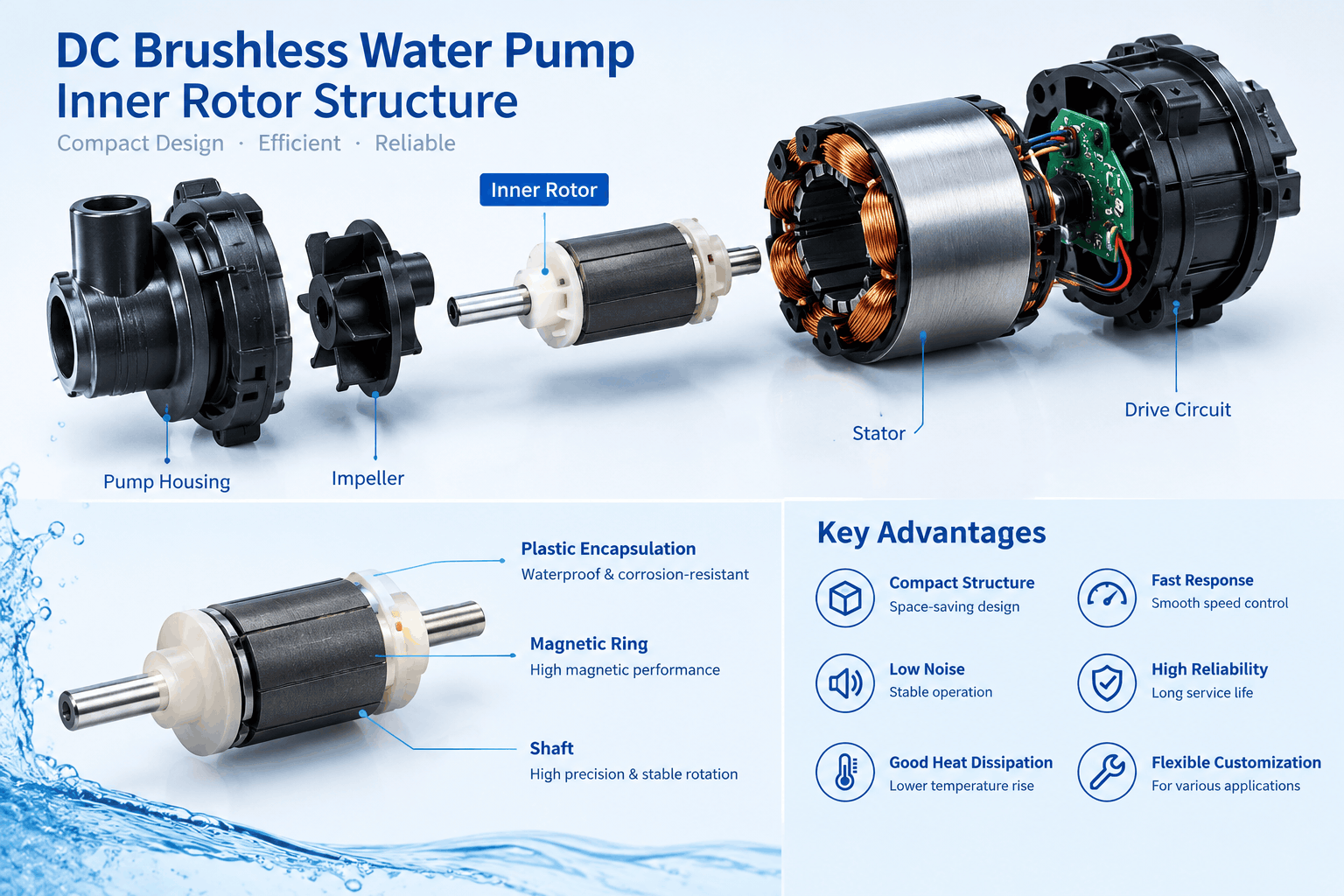
1. What Is a Water Pump Inner Rotor?
A water pump inner rotor is a rotating magnetic assembly positioned inside the motor stator. In a typical brushless DC (BLDC) motor, the stator windings are stationary while the permanent-magnet rotor rotates in response to the magnetic field generated by the energized windings.
In compact water pumps, the rotor assembly may include a permanent-magnet ring, a shaft, and a molded or encapsulating structure. Depending on the design, the impeller may be mounted on or integrated with the rotor assembly to transfer rotational energy to the fluid.
How the Inner Rotor Works in a BLDC Water Pump
When the electronic controller energizes the stator windings in a controlled sequence, the resulting magnetic field interacts with the rotor’s permanent magnets. This interaction generates torque, causing the rotor and connected impeller to rotate. The impeller then transfers energy to the fluid, creating the flow required by the application.
The motor controller can adjust the electrical drive according to system requirements, allowing the pump to operate at different speeds when the motor and control system support this function. The actual flow rate and pressure depend on the complete hydraulic design, including the impeller, pump housing, fluid properties, and operating conditions.
Some compact water pumps use wet-rotor configurations in which the rotor operates in the pumped medium. In these designs, the separation between the wet rotor chamber and the dry electrical components is essential. The specific sealing arrangement depends on the pump architecture; it should not be assumed that every inner-rotor pump uses the same encapsulation or isolation method.
2. Key Advantages of a Water Pump Inner Rotor
2.1 Compact Design and Responsive Speed Control
An inner-rotor arrangement places the rotating magnetic assembly near the motor’s central axis. Depending on rotor dimensions and mass distribution, this configuration can support a compact motor design and a relatively low moment of inertia.
A lower rotor inertia may help the motor respond more quickly to changes in commanded speed. This can be useful in water circulation systems that need to adjust flow according to temperature, pressure, or operating demand.
For OEM engineers, the key consideration is the complete motor design rather than rotor structure alone. Rotor inertia, electromagnetic torque, controller settings, hydraulic load, and bearing friction all influence acceleration, deceleration, and speed stability.
2.2 Stable Operation and Reduced Noise
Noise and vibration are important selection criteria for residential circulation pumps, water purifiers, cooling pumps, and other equipment used near people or sensitive components.
A properly manufactured rotor can contribute to stable rotation when its dimensions, concentricity, magnetization pattern, and dynamic balance are controlled. Consistent magnetic pole distribution also helps the motor operate as intended when combined with a suitable stator and controller.
However, low noise cannot be guaranteed by choosing an inner rotor alone. Bearing quality, impeller geometry, cavitation, hydraulic resonance, mounting conditions, and motor control can all contribute to operating noise. The complete pump should therefore be evaluated under representative working conditions.
2.3 Material Encapsulation and Environmental Protection
Water pump rotors may operate in environments involving water, coolant, elevated temperatures, or other fluids. Material compatibility is therefore a major consideration in rotor design.
Injection-molded magnetic components can combine magnetic material with a polymer-based structure, and certain designs use encapsulation to protect vulnerable components from direct exposure to the surrounding medium. The effectiveness of this protection depends on the material formulation, molding quality, component interfaces, and operating environment.
For long-term applications, buyers should confirm fluid compatibility, temperature limits, dimensional stability, and resistance to thermal cycling. If the design uses a shaft, bearing, or other insert, the interfaces between these components also require careful engineering.
2.4 Integration and Manufacturing Efficiency
An appropriately designed rotor assembly may combine several functional elements into one integrated component. Depending on the design, this can reduce the number of separate parts and simplify downstream assembly.
For water pump manufacturers, integrated injection molding may offer advantages in repeatability and production efficiency, especially when a component has complex geometry or requires a specific magnetic pole arrangement. Tooling feasibility and inspection requirements should nevertheless be reviewed before committing to volume production.
The most suitable design is the one that balances manufacturability, magnetic performance, mechanical reliability, and total cost across the expected production volume.
3. Main Applications of Water Pump Inner Rotors
3.1 Household Water Circulation and Purification Equipment
Household applications include floor-heating circulation pumps, water heater circulation systems, water purifier pumps, booster pumps, aquarium circulation equipment, and selected liquid-cooling products.
These products often require compact dimensions, dependable operation, and acceptable noise levels. The rotor must match the pump’s intended speed range, hydraulic load, fluid conditions, and expected service life.
For manufacturers serving the residential market, consistent dimensions and magnetic performance can help reduce assembly variation. Material selection should also reflect the specific water quality, temperature, and operating environment.
3.2 New Energy Vehicles and Automotive Thermal Management
Electric vehicles and hybrid vehicles rely on thermal management systems to control temperatures in battery packs, electric motors, power electronics, and other components. Electric coolant pumps are one part of these systems.
The rotor used in an automotive pump must be designed for the specified operating temperature, coolant exposure, vibration, and duty cycle. Dimensional stability and magnetic performance must remain suitable under the conditions defined for the application.
Automotive projects may also require documented validation, traceability, and supplier quality procedures. Buyers should provide the relevant technical and qualification requirements at the beginning of development rather than assuming that a standard industrial component will automatically meet automotive needs.
3.3 Industrial Cooling and Specialized Fluid Equipment
Industrial cooling systems, compact circulation units, and selected precision fluid-handling devices may use brushless pumps to deliver controlled fluid movement.
Depending on the equipment, the rotor may need to support continuous operation, frequent speed changes, or a particular balance between size, torque, and energy consumption. Applications involving aggressive fluids or elevated temperatures require additional material and reliability assessment.
For specialized equipment manufacturers, customized rotor geometry and magnetization may help meet installation constraints. These requirements should be assessed together with the motor’s electromagnetic design and the pump’s hydraulic characteristics.
4. Inner Rotor vs. Outer Rotor for Water Pumps
Inner-rotor and outer-rotor designs represent different approaches to arranging the rotating magnetic assembly and stator. Neither structure is universally superior; the choice depends on the required torque, speed, dimensions, thermal design, and manufacturing constraints.
An inner rotor may be appropriate when the application prioritizes a compact central rotating assembly and a particular motor layout. An outer rotor can offer advantages in designs that benefit from a larger rotor radius or different torque characteristics.
For the same rotational speed, increasing the effective radius at which electromagnetic force acts can increase available torque, subject to the motor’s electromagnetic and thermal limits. This is one reason outer-rotor architectures are considered for some applications requiring relatively high torque at lower speeds.
However, the statement that all inner rotors have lower torque density than outer rotors would be too broad. Performance depends on the complete motor design, including active dimensions, magnetic materials, winding configuration, cooling, and operating point.
When choosing between the two, engineers should compare the actual torque-speed curve, efficiency, thermal behavior, installation space, cost, and reliability requirements. The best structure is the one that meets the system specification with an acceptable manufacturing and lifecycle cost.
5. How to Select the Right Water Pump Inner Rotor
Selecting a rotor requires a coordinated review of magnetic, mechanical, thermal, and environmental requirements. The following factors should be included in a technical specification or request for quotation.
5.1 Magnetic Material and Performance
Common material options for molded magnetic components include ferrite-based compounds and bonded NdFeB formulations. Their magnetic properties, cost, temperature behavior, and suitability for particular geometries differ.
Ferrite may be attractive when cost and environmental stability are priorities and the required magnetic performance can be achieved within the available space. Bonded NdFeB may be considered when a stronger magnetic field is needed in a compact design, subject to the selected formulation and operating conditions.
Material selection should be based on the required magnetic circuit and actual working conditions, not simply on the highest available magnetic strength.
5.2 Pole Count and Magnetization Accuracy
The number of magnetic poles, their arrangement, and the magnetization direction must match the motor’s electromagnetic design. Incorrect pole configuration or inconsistent magnetic output can affect commutation, torque production, and overall operating behavior.
Buyers should specify the required pole count and magnetization pattern, along with any relevant magnetic field measurement criteria. Where necessary, sample testing should confirm compatibility with the stator and controller before production approval.
5.3 Shaft Tolerance, Concentricity, and Dynamic Balance
The rotor shaft and magnetic assembly must fit the pump’s bearing system and impeller geometry. Shaft dimensions, concentricity, runout, and dynamic balance can influence vibration, noise, wear, and long-term mechanical stability.
Tolerance requirements should be based on the complete assembly and its operating speed. Buyers should also confirm how critical dimensions will be measured and how the supplier will manage process variation during mass production.
5.4 Encapsulation Material and Fluid Compatibility
For wet-rotor or fluid-exposed applications, the material system must be suitable for the intended medium and temperature range. Relevant factors may include water absorption, chemical compatibility, thermal expansion, mechanical stress, and the integrity of molded interfaces.
The appropriate validation method depends on the actual application. Buyers should communicate the fluid composition, operating temperature, pressure conditions, and expected service duration so that material and design choices can be evaluated realistically.
5.5 Production Consistency and Supplier Quality
A qualified manufacturer should be able to discuss material control, molding parameters, magnetization, dimensional inspection, and production traceability. For customized parts, sample approval should establish a clear reference for later production batches.
It is useful to agree on measurable acceptance criteria before mass production, including critical dimensions, magnetic performance, appearance, and any application-specific tests. This reduces ambiguity and helps both parties manage changes throughout the product lifecycle.
6. Why Injection-Molded Magnetic Rotors Matter for OEM Manufacturing
Injection molding can be particularly useful when a pump rotor requires complex geometry, integrated structural features, or repeatable production at scale. By combining magnetic material with a suitable binder and molding process, manufacturers can create components tailored to a particular motor and pump architecture.
The actual benefits depend on the component design and production requirements. Tooling investment, material performance, cycle time, inspection needs, and production volume should all be considered when comparing injection molding with alternative manufacturing methods.
For OEM projects, early communication between the pump designer and magnetic component supplier can prevent avoidable redesigns. Providing the assembly drawing, required magnetic characteristics, operating conditions, and forecast volume helps the supplier assess manufacturability and identify critical technical questions before tooling begins.
High Kos offers injection-molded magnetic components and related rotor products for applications including water pumps and motors. Buyers can review the injection molded ferrite product range and the company’s magnetic material and manufacturing information when evaluating potential solutions.
7. Why Choose High Kos Magnet for Custom Water Pump Rotors?
High Kos Magnet focuses on the development and production of molded and sintered magnetic products, including magnetic rings and motor rotor components. Its product portfolio includes injection-molded ferrite products and other magnetic solutions for industrial and appliance applications.
For water pump manufacturers, a customized magnetic rotor should be evaluated according to its intended function, material requirements, geometry, magnetization pattern, and operating environment. Early technical communication helps establish whether the proposed design can meet the application’s requirements and what validation may be needed.
When requesting a quotation from High Kos, prepare the rotor drawing or sample, target application, preferred material if known, pole configuration, operating temperature, fluid conditions, expected order volume, and critical tolerances. This information provides a practical starting point for discussing a suitable component and manufacturing route.
Visit the High Kos Magnet official website to explore the product portfolio and contact the team about your project.
Conclusion: Choosing a Reliable Water Pump Inner Rotor
The water pump inner rotor is an important component in DC brushless water pumps, influencing motor operation, mechanical stability, and the integration of the rotating assembly. Its suitability depends on more than rotor structure alone: magnetic material, pole configuration, shaft accuracy, dynamic balance, fluid compatibility, and thermal conditions must all be considered.
For OEM engineers and purchasing teams, the most effective approach is to define the complete application requirements before selecting a material or supplier. Comparing inner- and outer-rotor architectures against the actual torque-speed requirements, installation constraints, and cost targets can lead to a more reliable design decision.
Looking for a customized magnetic rotor for your DC brushless water pump? Contact High Kos Magnet to discuss your drawings, samples, material requirements, and production needs. Our team can help you evaluate the next steps toward a magnetic component solution tailored to your application.
FAQ About Water Pump Inner Rotors
1. What does an inner rotor do in a DC brushless water pump?
The inner rotor contains permanent magnets that interact with the stator’s rotating magnetic field. This interaction generates rotation and drives the impeller or connected pumping mechanism.
2. What materials are used in a water pump inner rotor?
Depending on the design, the rotor may use ferrite-based magnetic compounds, bonded NdFeB materials, or other suitable magnetic configurations. The final choice depends on magnetic requirements, temperature, fluid compatibility, geometry, and cost.
3. Is an inner rotor better than an outer rotor for water pumps?
Not in every application. Inner-rotor designs may suit compact motor layouts, while outer-rotor designs may offer advantages for certain torque and packaging requirements. The complete motor and hydraulic specifications should determine the choice.
4. Why is dynamic balance important for a water pump rotor?
Poor balance can increase vibration, noise, bearing loads, and mechanical wear. Appropriate balance requirements should be defined according to the rotor’s dimensions, rotational speed, and complete pump design.
5. Can an injection-molded magnetic rotor operate in water or coolant?
Some designs are intended for wet-rotor or fluid-exposed applications. Suitability depends on the magnetic material, binder or encapsulation system, interface design, fluid chemistry, temperature, and operating conditions. The complete component should be validated for its intended environment.
6. What information is needed to customize a water pump inner rotor?
Useful information includes the component drawing or sample, dimensions, magnetic material requirements, pole count, magnetization pattern, shaft tolerances, operating temperature, fluid conditions, target volume, and quality criteria.
7. How can I find a manufacturer for custom water pump rotors?
Look for a supplier with relevant magnetic material knowledge, molding and magnetization capabilities, dimensional inspection, and experience supporting customized components. Request samples, define acceptance criteria, and confirm production and traceability requirements before approving mass production.