
Injection molded magnets are valuable components in modern motors, sensors, automotive electronics, water pumps, and industrial equipment. For product designers and purchasing teams, selecting the right magnetic component involves more than comparing material prices. Geometry, magnetic performance, dimensional consistency, operating conditions, and manufacturing capability all influence the final result.
For OEMs and industrial buyers, the challenge is to find a magnetic solution that meets technical requirements while supporting reliable production and long-term supply. Understanding the manufacturing process, material options, and supplier evaluation criteria can help reduce development risks and improve purchasing decisions.
This guide explains how injection molded magnets work, where they are used, what buyers should evaluate, and how to collaborate with a manufacturer on customized magnetic components.
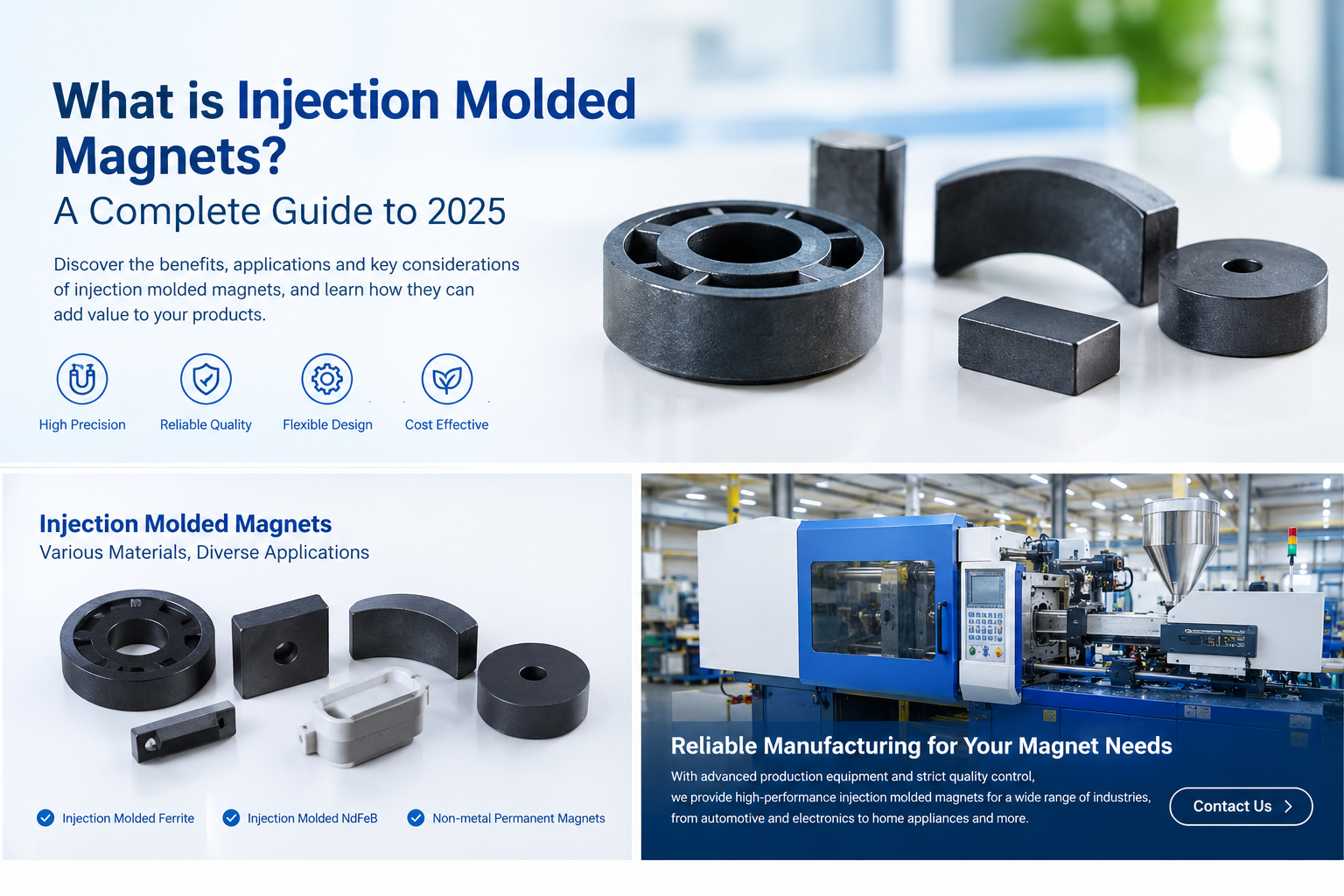
What Are Injection Molded Magnets?
Injection molded magnets are permanent magnetic components manufactured by combining magnetic powder with a suitable polymer binder and shaping the mixture through an injection molding process. After molding, the components may undergo additional operations, including magnetization, inspection, and finishing, depending on the product design.
Unlike conventional magnets that are typically produced through pressing and sintering, injection-molded magnetic materials can offer greater flexibility in component geometry. This makes them useful when an application requires integrated structures, complex shapes, or repeatable dimensions.
The final properties depend on the magnetic powder, binder, material formulation, molding conditions, and magnetization design. Buyers should therefore evaluate the complete component rather than assuming that all molded magnets deliver the same magnetic strength or mechanical performance.
How Injection Molded Magnets Are Manufactured
The production process generally involves several coordinated stages.
Material preparation: Magnetic powder is combined with a polymer binder to create a processable compound. The material formulation affects magnetic properties, flow behavior, mechanical characteristics, and suitability for the intended environment.
Injection molding: The compound is heated and injected into a mold designed around the required component geometry. Proper mold design and process control help achieve consistent dimensions and repeatable production.
Magnetization: Depending on the application, the molded component is magnetized using an appropriate fixture and magnetic field configuration. The required pole count, pole arrangement, and magnetization direction should be defined during engineering development.
Inspection and verification: Manufacturers evaluate dimensions, appearance, and relevant magnetic or mechanical characteristics against agreed specifications. Application-critical requirements should be confirmed before mass production begins.
For B2B projects, these stages need to work together. A component may have the correct external dimensions but still fail in service if its magnetic pattern, temperature behavior, or mechanical fit does not meet the application requirements.
Key Advantages of Injection Molded Magnets for OEM Projects
The main benefit of injection molding is the ability to produce magnetic components that align with the functional and structural requirements of a specific product. However, the value depends on the application and the quality of the engineering process.
Flexible Geometry and Component Integration
Injection molding supports a broad range of component shapes, including rings, curved profiles, and selected rotor geometries. Depending on the design and material system, it may also allow magnetic material to be integrated with other structural elements.
This flexibility can simplify assembly and reduce the number of separate parts in a product. For manufacturers developing compact motors or precision mechanisms, fewer assembly interfaces may help improve alignment and manufacturing consistency.
Nevertheless, not every design is suitable for injection molding. Wall thickness, moldability, structural strength, and the required magnetic properties must be assessed together before a design is finalized.
Consistent Production for High-Volume Manufacturing
When the tooling and production process are properly developed, injection molding can support repeatable manufacturing for OEM programs. Consistency is particularly important in motor assemblies and sensing systems, where dimensional variation or changes in magnetic output may affect the performance of the finished equipment.
Buyers should ask how the supplier controls raw materials, molding conditions, magnetization, inspection, and production changes. A clear quality plan is more useful than a general promise of high precision.
Design Flexibility for Magnetic Pole Configurations
Some applications require multiple magnetic poles arranged around a ring or rotor. Injection-molded magnetic components can be designed for specific magnetization patterns, subject to material capability, geometry, and tooling requirements.
For motor and sensing applications, the required pole count and arrangement should be discussed early with the engineering team. The manufacturer also needs to understand how the magnetic component interacts with the motor, sensor, or surrounding assembly.
Potential for Lower Total Manufacturing Cost
Injection molding may improve overall production economics when component geometry, production volume, and assembly requirements justify the initial tooling investment. Integrating multiple functions into one component can reduce handling and secondary assembly operations in suitable designs.
However, unit price alone is not a reliable measure of cost effectiveness. Buyers should consider tooling, inspection, scrap risk, assembly labor, production volume, and the cost of changing an established design. A technical and commercial review can help identify the most suitable process.
Choosing Materials for Injection Molded Magnets
Material selection is one of the most important decisions in magnetic component development. The best option depends on the required magnetic output, working temperature, geometry, mechanical requirements, cost target, and operating environment.
Injection Molded Ferrite Magnets
Injection-molded ferrite magnets combine ferrite magnetic powder with a polymer binder. They are worth evaluating for applications where cost management, design flexibility, and suitable magnetic performance are important.
Potential applications include fan motors, water pump rotors, magnetic rings, and selected household appliance components. The actual suitability of a ferrite formulation depends on the required magnetic circuit, operating conditions, and component dimensions.
Explore High Kos’s injection molded ferrite products to review relevant product categories and discuss application requirements.
Injection Molded NdFeB and Bonded NdFeB Magnets
Neodymium iron boron (NdFeB) is used where a stronger magnetic field may be required within a limited space. Bonded NdFeB materials combine magnetic powder with a binder and can be processed into shapes suited to particular component designs.
The selection between ferrite and NdFeB should be based on the required magnetic performance, temperature limits, mechanical design, environmental exposure, and budget. Higher magnetic energy does not automatically make a material the best choice for every application.
Buyers can also review High Kos’s neodymium magnet and ferrite magnet manufacturer information when comparing available magnetic material solutions.
How to Compare Material Options
Before selecting a material, prepare a technical specification covering:
- Required magnetic performance and working air gap.
- Component geometry and available installation space.
- Operating temperature and environmental exposure.
- Mechanical loads, vibration, and assembly conditions.
- Required pole count and magnetization direction.
- Annual demand, target cost, and expected product life.
Providing this information allows the manufacturer to assess whether injection molding is appropriate or whether another magnetic manufacturing process deserves consideration.
Applications of Injection Molded Magnets Across Industries
Injection molded magnets are used in applications where magnetic functionality must fit a particular mechanical design. Their suitability should always be validated against the finished equipment’s operating conditions.
Motor Rotors and Magnetic Rings
Motors require magnetic components designed around their electrical and mechanical characteristics. Depending on the motor architecture, molded magnetic rings and rotor components can support compact layouts and specific pole arrangements.
In fan motors, brushless DC motors, and other drive systems, buyers should evaluate the interaction between the magnet, rotor structure, air gap, and stator. Magnetic output, dimensional consistency, balance, and operating temperature may all influence the performance of the complete assembly.
Water Pumps and Fluid Equipment
Magnetic components are used in selected water pump and fluid-handling systems to support motor operation and related functions. In these applications, the material and component design must suit the fluid environment, temperature, mechanical loads, and required service life.
Procurement teams should communicate whether the component contacts a fluid, operates inside a sealed assembly, or is exposed to moisture or chemicals. These conditions may affect the choice of material, binder, surrounding structure, and validation tests.
Automotive Electronics and Industrial Sensing
Automotive systems and industrial equipment may use magnetic rings or other molded components in sensing, actuation, and motion-control applications. These components often need to meet clearly defined dimensional and magnetic requirements.
Before approving a supplier, buyers should identify the relevant quality documentation, traceability expectations, inspection criteria, and application-specific validation needs. Automotive or other regulated applications may require additional qualification processes that should be agreed upon before production.
Household Appliances and Smart Equipment
Household appliances increasingly rely on compact motor systems and integrated mechanisms. Molded magnetic components may help manufacturers develop parts that fit particular product architectures while supporting repeatable production.
The appropriate solution depends on the appliance design, production volume, noise and vibration expectations, working conditions, and target cost. Engineering collaboration is essential when a magnetic component affects several functions within the final assembly.
How to Select a Reliable Injection Molded Magnet Manufacturer
A capable supplier should offer more than a catalog of standard components. For custom B2B projects, engineering communication, process control, and the ability to maintain consistent production are equally important.
Review Engineering and Customization Capabilities
Start by confirming whether the manufacturer can evaluate your drawings, samples, magnetic requirements, and assembly constraints. Ask how the engineering team approaches material selection, mold development, magnetization, and prototype validation.
A supplier with coordinated development and production capabilities may make it easier to resolve design issues before mass manufacturing. This is especially relevant when the component uses a non-standard geometry or requires a specific pole configuration.
Evaluate Quality Control and Traceability
Ask for the inspection plan relevant to your component. Depending on the application, this may include dimensional measurement, magnetic testing, appearance inspection, material verification, and lot traceability.
It is also important to define acceptance criteria before ordering samples. Statements such as “high precision” or “stable quality” should be supported by measurable requirements and an agreed method of verification.
Confirm Production Planning and Supply Continuity
For ongoing OEM programs, production capacity and delivery planning matter as much as initial sample quality. Discuss expected annual volume, forecast changes, lead-time assumptions, packaging, and procedures for handling design revisions.
Buyers should also understand how the supplier manages tooling maintenance, material consistency, and quality issues. A transparent communication process can reduce uncertainty throughout the product lifecycle.
Validate Samples Before Mass Production
Sample approval is an important step between engineering development and volume purchasing. Test the component under conditions that reflect the actual application, including fit, magnetic behavior, temperature exposure, and mechanical operation where relevant.
Document the approved drawing, material, magnetization pattern, inspection criteria, and any special requirements. This creates a shared reference for both parties and helps prevent misunderstandings when production scales up.
Why Choose High Kos Magnet for Injection Molded Magnets?
High Kos Magnet focuses on the research, development, production, and sales of molded and sintered magnetic products. Its product range includes injection-molded ferrite, injection-molded NdFeB, magnetic rings, motor rotor components, and related magnetic solutions.
For B2B buyers, a supplier’s value lies in its ability to understand the application and coordinate the requirements of material selection, component design, tooling, magnetization, and production. High Kos provides a starting point for discussing custom magnetic components for motor, appliance, water pump, and other industrial applications.
Explore the High Kos official website to review the company’s product portfolio. You can also browse injection molded ferrite products and the company’s magnetic manufacturing capabilities to identify relevant solutions.
When contacting a supplier, provide a drawing or sample, the intended application, annual demand, operating conditions, and key magnetic requirements. This information helps the engineering team assess feasibility and prepare a more relevant response.
Conclusion: Finding the Right Injection Molded Magnets
Choosing the right magnetic component requires a balance of magnetic performance, material properties, geometry, manufacturing feasibility, quality requirements, and total cost. Injection molding can be a strong option for applications that benefit from complex shapes, integrated structures, and repeatable production, but the final decision should always reflect the requirements of the complete product.
For OEM manufacturers and industrial purchasing teams, early engineering communication and clear specifications are essential to reducing development risks. Comparing suppliers on technical capability, quality control, and production planning can help establish a more dependable supply relationship.
Planning a new motor, sensor, pump, or appliance project? Contact High Kos Magnet to discuss your drawings, samples, and custom magnetic component requirements. Share your application details to begin a technical conversation about a suitable magnetic solution.
FAQ About Injection Molded Magnets
1. What are injection molded magnets used for?
They are used in selected motor rotors, magnetic rings, water pump components, household appliances, automotive electronics, and sensing equipment. Suitability depends on the material, geometry, magnetic requirements, and operating environment.
2. What is the difference between injection molded ferrite and injection molded NdFeB magnets?
They use different magnetic materials and therefore have different magnetic characteristics, costs, and application considerations. Ferrite may be suitable for cost-conscious designs, while NdFeB may be considered when stronger magnetic performance is needed in a limited space. The correct choice requires application-specific evaluation.
3. Can injection molded magnets be customized?
Yes. Depending on the design and manufacturing process, customization may cover dimensions, geometry, material selection, pole arrangement, magnetization direction, and integration with other components. Buyers should provide drawings, samples, or technical specifications for a feasibility review.
4. Are injection molded magnets suitable for mass production?
They can be suitable for repeatable, high-volume production when the design, tooling, material, and process are properly validated. Production volume and tooling costs should be assessed together before selecting the manufacturing route.
5. What information should I provide when requesting a quotation?
Provide the component drawing or sample, intended application, material preference if known, magnetic requirements, working temperature, expected annual quantity, quality requirements, and target delivery schedule. More complete information helps the manufacturer evaluate feasibility and quotation requirements.
6. How do I choose an injection molded magnet supplier?
Evaluate engineering support, material knowledge, mold development, magnetization capability, inspection methods, traceability, production planning, and communication. For critical applications, request samples and agree on measurable acceptance criteria before mass production.
7. Can High Kos Magnet support custom magnetic components?
High Kos offers molded and sintered magnetic products and supports discussions about application-specific magnetic components. Contact the company with your technical requirements to determine whether the requested design can be supported.