
Ferrite magnetic rings are widely used in electromagnetic interference (EMI) suppression, common-mode filtering, inductors, transformers, and other electronic applications. Their magnetic performance is mainly determined by ferrimagnetism rather than diamagnetism.
Understanding Diamagnetism in Ferrite Magnetic Rings is important because all materials contain some degree of diamagnetic response at the atomic level. However, in manganese-zinc (Mn-Zn) and nickel-zinc (Ni-Zn) ferrites, this weak background effect is overwhelmingly masked by the much stronger ferrimagnetic response.
As a result, diamagnetism does not provide the functional magnetic behavior normally associated with ferrite rings. The ability of ferrite materials to guide magnetic flux and suppress high-frequency interference comes primarily from their ferrimagnetic properties.
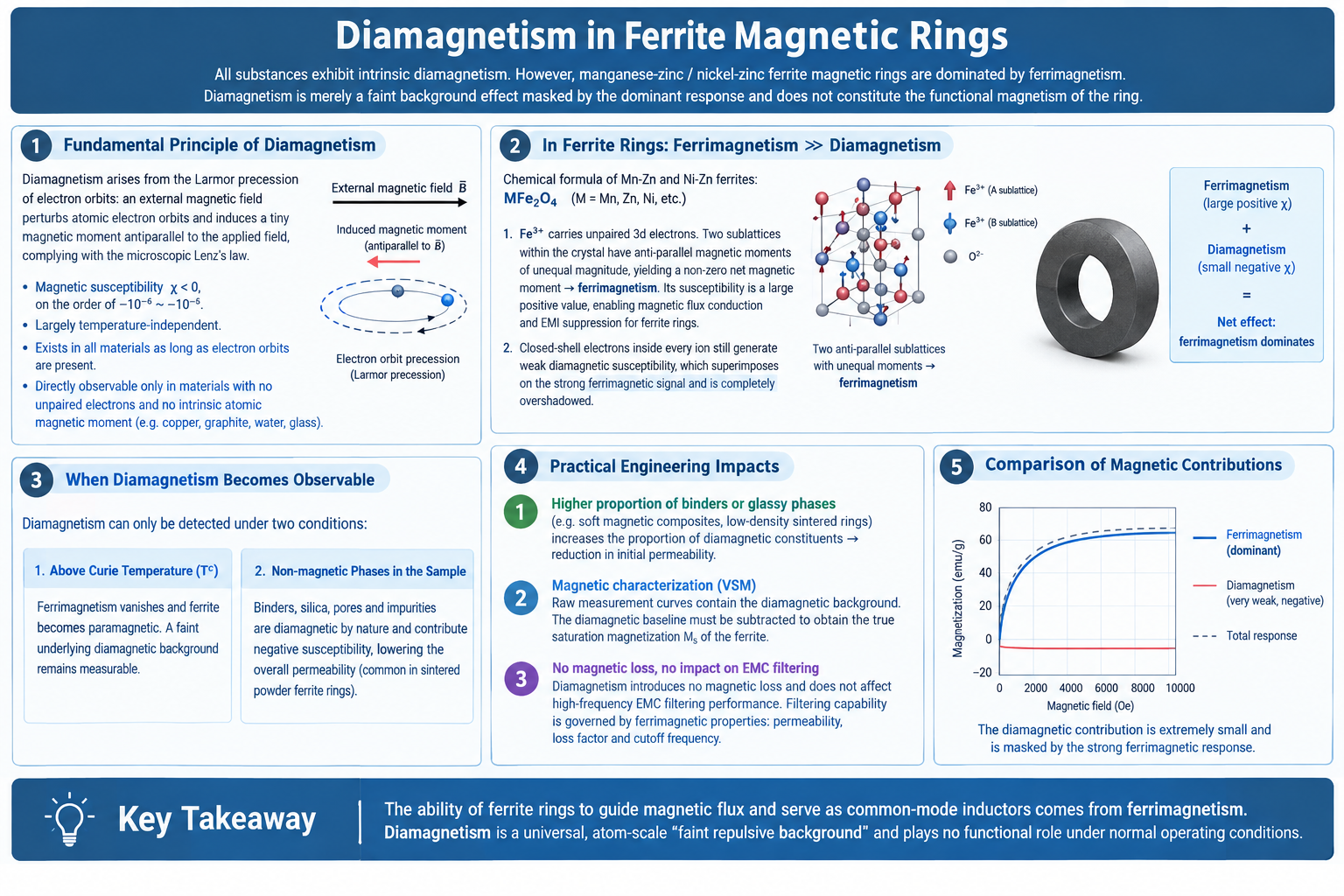
What Is Diamagnetism in Ferrite Magnetic Rings?
Diamagnetism in Ferrite Magnetic Rings originates from the response of electron orbits to an external magnetic field.
When an external magnetic field is applied to an atom, the motion of its electrons is slightly perturbed. This produces a very small induced magnetic moment that opposes the applied magnetic field. This behavior can be understood through Larmor precession and the microscopic form of Lenz’s law.
The magnetic susceptibility of a diamagnetic material is negative:
χ < 0
For typical diamagnetic materials, the magnitude of susceptibility is extremely small, often around the order of 10⁻⁶ to 10⁻⁵.
This is fundamentally different from the strong positive magnetic response associated with ferrimagnetic ferrites.
Why Diamagnetism Exists in All Materials
Diamagnetic behavior is associated with electron orbital motion, so a diamagnetic contribution can exist in essentially all materials.
However, it is not always the dominant magnetic response.
In materials containing strong magnetic moments from unpaired electrons, other magnetic mechanisms can be much stronger. In ferrite rings, ferrimagnetism dominates the overall magnetic response by a very large margin.
Typical Characteristics of Diamagnetism
The main characteristics include:
- Negative magnetic susceptibility
- Extremely weak magnetic response
- Magnetic moment induced opposite to the applied field
- Generally weak temperature dependence
- Present as a background contribution in ordinary materials
In materials without significant intrinsic atomic magnetic moments, such as copper, graphite, water, and glass, this weak effect can be observed more directly.
Diamagnetism in Ferrite Magnetic Rings vs. Ferrimagnetism
To understand Diamagnetism in Ferrite Magnetic Rings, it is necessary to distinguish diamagnetism from ferrimagnetism.
Mn-Zn and Ni-Zn ferrites are commonly represented by the general chemical formula:
MFe₂O₄
where M may include manganese, zinc, nickel, or other suitable metal ions depending on the ferrite composition.
The crystal structure contains different magnetic sublattices whose magnetic moments are arranged in opposite directions but are not equal in magnitude.
The unequal opposing moments produce a net magnetic moment, which is the basis of ferrimagnetism.
Role of Fe³⁺ Ions
Fe³⁺ ions contain unpaired 3d electrons that contribute strongly to the magnetic behavior of ferrite materials.
Within the ferrite crystal structure, magnetic moments associated with different sublattices are coupled in opposite directions. Because their magnitudes are unequal, the moments do not completely cancel.
The result is a strong net magnetic response.
This ferrimagnetic behavior is responsible for the useful magnetic properties required in ferrite components.
Ferrimagnetism Dominates the Magnetic Response
The weak diamagnetic contribution from closed-shell electrons still exists, but it is superimposed on the much stronger ferrimagnetic response.
Consequently, Diamagnetism in Ferrite Magnetic Rings normally has little practical influence on their magnetic performance under normal operating conditions.
The functional characteristics of ferrite rings are instead determined mainly by parameters such as:
- Initial permeability
- Complex permeability
- Magnetic loss
- Saturation magnetization
- Curie temperature
- Frequency response
How Ferrimagnetism Enables Ferrite Ring Applications
The main reason ferrite rings are useful in electronic circuits is their ability to interact strongly with magnetic fields.
Ferrimagnetic behavior allows the material to guide magnetic flux through the ring.
This is particularly important in components used for common-mode noise suppression.
When unwanted high-frequency current passes through a conductor surrounded by a ferrite ring, the changing magnetic field interacts with the ferrite material.
The resulting impedance and magnetic losses help attenuate unwanted electromagnetic noise.
Ferrite Rings in EMI Suppression
Ferrite rings are commonly used around:
- Power cables
- Signal cables
- Communication wires
- DC power lines
- Data cables
- Electronic assemblies
Their effectiveness depends primarily on the ferrite’s permeability and frequency-dependent losses rather than its weak diamagnetic contribution.
Therefore, when engineers evaluate a ferrite ring for EMI filtering, the focus should be placed on ferrimagnetic parameters.
When Can Diamagnetic Contributions Be Observed?
Under normal operating conditions, the ferrimagnetic response of a ferrite ring is much stronger than its diamagnetic background.
However, there are situations where the diamagnetic contribution can become measurable.
Above the Curie Temperature
When the temperature rises above the Curie temperature, long-range ferrimagnetic ordering disappears.
The material changes from a ferrimagnetic state to a paramagnetic state.
At this point, the dominant ferrimagnetic contribution is no longer present in the same form, making weaker magnetic contributions easier to observe.
A small underlying diamagnetic background can therefore become more apparent during certain high-temperature magnetic measurements.
Non-Magnetic Phases in Ferrite Materials
A ferrite ring may contain small amounts of non-magnetic phases depending on its manufacturing process.
These can include:
- Binders
- Glassy phases
- Silica
- Pores
- Processing impurities
Such constituents can contribute negative magnetic susceptibility.
If their proportion becomes significant, the overall magnetic response of the material can be reduced.
This is especially relevant when comparing different formulations, densities, or manufacturing processes.
Manufacturing Factors Related to Diamagnetic Contributions
The influence of Diamagnetism in Ferrite Magnetic Rings can also be considered during material formulation and manufacturing.
A ferrite component is not always composed entirely of the ideal ferrite crystal phase. Manufacturing processes can introduce secondary phases, pores, or other non-magnetic constituents.
Binders and Glassy Phases
In some soft magnetic composites or low-density sintered structures, a higher proportion of non-magnetic material may be present.
Because these phases generally contribute little or negative magnetic susceptibility, increasing their fraction can reduce the effective magnetic permeability of the finished component.
The practical engineering concern is therefore not that diamagnetism becomes the main magnetic mechanism, but that non-magnetic material reduces the proportion of the useful ferrimagnetic phase.
Porosity and Material Density
Porosity can also affect magnetic performance.
A higher pore fraction reduces the effective magnetic material volume and can influence permeability and magnetic flux distribution.
For ferrite manufacturers, controlling density, composition, grain structure, and secondary phases is therefore important for achieving consistent magnetic properties.
Diamagnetism in Ferrite Magnetic Rings and VSM Measurement
Magnetic characterization can reveal the weak background contribution more clearly than normal electronic operation.
A Vibrating Sample Magnetometer (VSM) measures the magnetic response of a material as the applied magnetic field changes.
The raw measurement curve can contain contributions from different magnetic mechanisms.
For a ferrite sample, the dominant signal is associated with ferrimagnetism, but a small diamagnetic background may also be present.
Correcting the Magnetic Baseline
When calculating important parameters such as saturation magnetization, the background contribution may need to be removed from the measurement data.
This allows researchers to obtain a more accurate representation of the ferrite’s intrinsic magnetic behavior.
For this reason, Diamagnetism in Ferrite Magnetic Rings can be relevant during laboratory characterization even though it has little functional significance in normal electronic operation.
Does Diamagnetism Affect EMI Filtering Performance?
Under normal conditions, the answer is essentially no.
The filtering performance of a ferrite ring is governed primarily by its ferrimagnetic properties and frequency-dependent magnetic behavior.
Important parameters include:
- Permeability
- Complex permeability
- Magnetic loss factor
- Impedance
- Operating frequency
- Saturation characteristics
- Core geometry
The weak diamagnetic background does not provide the useful filtering mechanism.
What Actually Controls High-Frequency Filtering?
At high frequencies, ferrite material exhibits frequency-dependent complex permeability and magnetic losses.
These properties determine how effectively a ferrite component presents impedance to unwanted high-frequency current.
Material composition and geometry also influence the frequency range in which the component performs effectively.
Therefore, selecting a ferrite ring for EMC or EMI applications should focus on the frequency response and magnetic loss characteristics rather than diamagnetic susceptibility.
Engineering Significance of Diamagnetism in Ferrite Magnetic Rings
From an engineering perspective, Diamagnetism in Ferrite Magnetic Rings is primarily a background material property rather than a functional design parameter.
It becomes relevant mainly in scientific analysis, material characterization, and understanding the complete magnetic response of a composite ferrite material.
For normal component selection, engineers should instead examine the parameters that directly influence application performance.
For Ferrite Material Selection
Important parameters include:
- Initial permeability
- Effective permeability
- Saturation magnetization
- Curie temperature
- Core loss
- Frequency response
For EMI Applications
Engineers should also consider:
- Target interference frequency
- Impedance versus frequency
- Core dimensions
- Cable configuration
- Material grade
- Operating temperature
These factors have a much greater influence on real-world filtering performance than the weak diamagnetic contribution.
Diamagnetism in Ferrite Magnetic Rings: Key Difference from Ferrimagnetism
The distinction can be summarized as follows:
| Property | Diamagnetism | Ferrimagnetism |
|---|---|---|
| Magnetic susceptibility | Negative | Strongly positive |
| Magnetic response | Very weak | Strong |
| Origin | Induced electron orbital response | Unequal opposing magnetic sublattices |
| Role in ferrite rings | Background contribution | Dominant functional mechanism |
| Flux conduction | Negligible | Important |
| EMI filtering | No direct functional role | Main magnetic mechanism |
| Temperature behavior | Generally weak | Strongly affected near Curie temperature |
This comparison shows why ferrite rings should be considered primarily ferrimagnetic materials in practical electronic applications.
Conclusion
Diamagnetism in Ferrite Magnetic Rings is a real but extremely weak magnetic contribution. Like other materials, ferrite contains a diamagnetic background associated with electron orbital behavior. However, Mn-Zn and Ni-Zn ferrites contain strong ferrimagnetic interactions that dominate their overall magnetic response.
The useful functions of ferrite rings, including magnetic flux conduction, impedance generation, common-mode filtering, and EMI suppression, come primarily from ferrimagnetism.
Diamagnetic effects become more relevant during scientific measurement, above the Curie temperature, or when non-magnetic phases such as binders, glassy materials, silica, and pores contribute significantly to the sample.
For ferrite manufacturing and component selection, the key parameters remain permeability, magnetic loss, saturation characteristics, frequency response, material composition, and geometry. Understanding the difference between the weak diamagnetic background and the dominant ferrimagnetic response provides a clearer basis for designing and selecting ferrite magnetic rings.