
What Is Magnetic Platens Injection Molding
Magnetic platens injection molding is an innovative manufacturing process that combines magnetic powders with thermoplastic materials to produce precise and complex magnetic components. Unlike traditional sintered magnets, this technology uses magnetic platens during injection molding to improve the alignment of magnetic particles. The result is higher efficiency, better consistency, and improved magnetic performance in the final component.
This technique is widely applied in electronics, automotive systems, and medical devices. It allows the production of intricate parts in one step, reduces post-processing, and enables cost-effective large-scale manufacturing.
How Magnetic Platens Injection Molding Works
Material Preparation
The first step involves blending magnetic powders, such as neodymium iron boron (NdFeB) or ferrite, with thermoplastic resins. Uniform mixing ensures consistent magnetic properties and mechanical strength. Advanced formulations can also include additives to improve flowability and reduce defects during molding. See our magnetic materials solutions for detailed options.
Injection Molding with Magnetic Platens
Once the mixture is ready, it is heated and injected into molds equipped with magnetic platens. These platens generate a magnetic field that aligns the particles during the molding process, resulting in components with improved magnetic performance. This approach is particularly effective for miniaturized or complex parts that require precise magnetic orientation. Learn more about our custom manufacturing solutions for tailored options.
Post-Processing and Magnetization
After molding, components are magnetized to achieve their final magnetic properties. Depending on the application, additional finishing such as surface coating, trimming, or machining may be applied. This ensures the parts meet both functional and aesthetic requirements for high-performance applications.
Advantages of Magnetic Platens Injection Molding
- Complex Geometry in One Step: The process enables intricate designs that are difficult to achieve with traditional methods, reducing assembly and machining requirements.
- Enhanced Magnetic Alignment: The use of magnetic platens ensures better particle orientation, enhancing the magnetic efficiency of each component.
- High Production Efficiency: The technique supports high-volume manufacturing with minimal material waste and consistent quality.
- Flexible Design Adaptation: Molds can be quickly modified for custom designs, allowing rapid prototyping and product iteration.
Applications
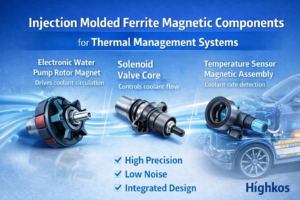
- Automotive Components: Electric motors, sensors, and actuators benefit from precise, compact magnetic parts.
- Consumer Electronics: Headphones, smartphones, and wearable devices use small, high-precision magnetic components produced with this process.
- Medical Devices: High accuracy and repeatability make this technique ideal for medical sensors, diagnostic tools, and precision instruments.
Challenges and Future Trends
While this method improves particle alignment, magnetic strength may still be slightly lower than sintered magnets. Advances in magnetic powders and platen technology are gradually closing this gap. Future trends include using eco-friendly materials, higher-performance powders, and smart manufacturing systems to increase efficiency and product quality.
Conclusion
Magnetic platens injection molding is a flexible, efficient, and precise method for producing magnetic components. Its ability to create complex geometries, support large-scale production, and offer design flexibility makes it a valuable solution for modern industries. Businesses seeking cost-effective, high-quality magnetic solutions can greatly benefit from adopting this advanced process.
FAQ: Magnetic Platens Injection Molding
1. How is this process different from traditional injection molding?
Magnetic platens align particles during molding, improving both precision and magnetic properties.
2. Are the components strong enough for industrial use?
Yes, their performance is sufficient for most industrial, automotive, and electronic applications.
3. What materials are used?
Typically NdFeB or ferrite powders combined with thermoplastics.
4. Is it suitable for mass production?
Absolutely. The process is efficient, consistent, and scalable.
5. How to choose a supplier?
Select manufacturers with experience in magnetic molding, advanced equipment, and strong quality control systems.
Call to Action
Looking for professional magnetic platens injection molding solutions? Contact us today! Our experts provide customized manufacturing services to ensure your projects achieve optimal performance and cost efficiency.