
Injection molded magnetic rings are important functional components used in modern sensors, encoders, and brushless motor systems. Their magnetic performance determines the accuracy of signal transmission and the stability of motor control.
Unlike traditional sintered magnets, injection molded magnetic rings are manufactured by mixing magnetic powder with a thermoplastic polymer matrix and forming the component through injection molding. This production method allows manufacturers to create complex shapes with high dimensional precision while maintaining stable magnetic properties.
The static magnetic field generated by injection molded magnetic rings is the final result of complex microstructural changes during the molding and magnetization process. Understanding how this magnetic field forms is critical for improving device performance.
For more information about magnetic components and customized magnetic solutions, you can explore the product resources at
👉 https://www.highkos.com/
Material Structure of Injection Molded Magnetic Rings
Injection molded magnetic rings belong to the category of polymer bonded magnets. These materials are composed of two major elements:
Magnetic powder filler
Common magnetic powders include:
-
Ferrite magnetic powder
-
NdFeB magnetic powder
These powders provide the permanent magnetic properties required for sensors and motor systems.
Thermoplastic polymer matrix
Typical polymer materials include:
-
PA12
-
PPS
-
Nylon-based engineering plastics
The polymer matrix allows the magnetic powder to be molded into precise geometries while maintaining structural stability.
In the non-magnetized state, the magnetic particles inside injection molded magnetic rings are randomly oriented. Because the magnetization directions cancel each other out, the component does not exhibit a macroscopic magnetic field.
How Static Magnetic Fields Are Generated
The static magnetic field of injection molded magnetic rings is created by organizing the microscopic magnetic moments of the powder particles into a stable macroscopic structure.
Two primary methods are commonly used.
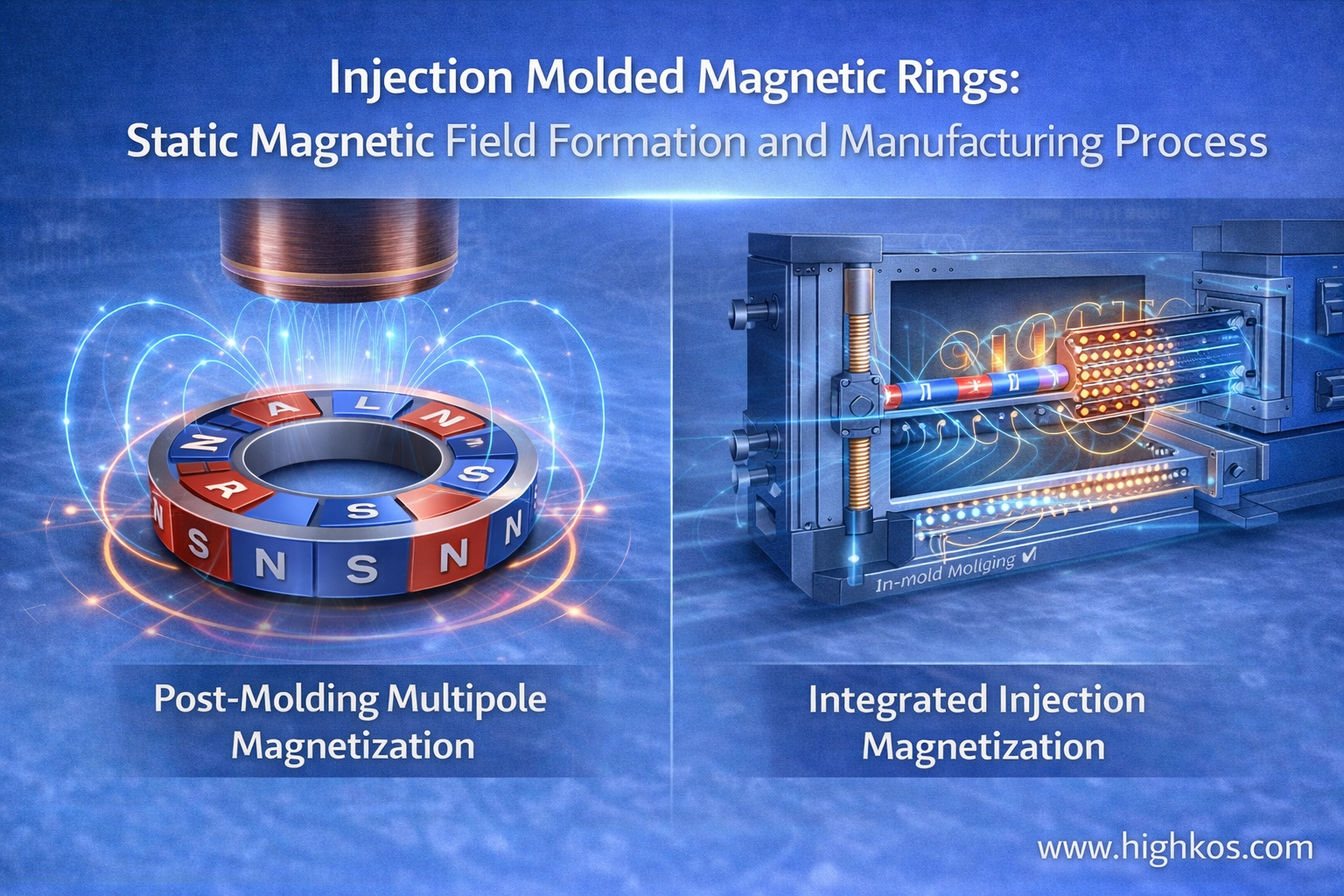
Post-Molding Multipole Magnetization
After the injection molding process is completed, the magnetic ring is exposed to a strong pulsed magnetic field. This process magnetizes the ring and creates alternating N and S poles along the circumference.
Multipole magnetization is widely used in:
-
rotary encoders
-
speed sensors
-
motor position detection systems
Integrated Injection Magnetization
Another advanced manufacturing technique is integrated injection magnetization. In this process, a magnetic circuit is integrated directly into the mold so that particle orientation occurs simultaneously with the injection molding process.
This approach allows better control of magnetic particle alignment and can improve magnetic field uniformity in high-precision applications.
Many modern magnetic component manufacturers are increasingly adopting this technique to achieve higher performance requirements in automotive and industrial systems.
You can learn more about magnetic component manufacturing technologies at
👉 https://www.highkos.com/
Influence of Injection Molding on Magnetic Field Distribution
The static magnetic field inside injection molded magnetic rings is rarely perfectly uniform. The molding process itself significantly affects magnetic field distribution.
Two major factors contribute to this phenomenon.
1. Particle Orientation Affected by Melt Flow
During injection molding, magnetic particles move within the flowing polymer melt. The flow behavior strongly influences how particles align inside the mold cavity.
One critical design factor is the gate position.
When multi-point pin gates are used, the molten material converges inside the mold and forms weld lines. These weld lines can cause differences in particle orientation across the component.
As a result:
-
pole length accuracy may change
-
peak magnetic flux density may decrease
-
magnetic poles near weld lines may behave differently from those near injection points
If the melt solidifies before particles fully align with the external magnetic field, magnetic domains may become disordered. This can lead to weaker local magnetic fields or shifted magnetic pole positions.
2. Local Variations in Magnetic Powder Concentration
Although magnetic powder and resin are thoroughly mixed during compounding, complex cavity flow can still cause slight variations in particle concentration.
These microscopic variations lead to changes in local magnetic permeability. As a result, the magnetic field distribution around the ring may deviate from an ideal sinusoidal waveform.
For high-precision applications such as servo motor position sensing, these distortions may introduce harmonic components that reduce signal accuracy.
Therefore, precise control of molding parameters is essential for producing high-performance injection molded magnetic rings.
Importance in Modern Industrial Applications
As modern technologies demand increasingly precise sensing and motion control, injection molded magnetic rings have become essential components in many industries.
Typical applications include:
-
automotive sensors
-
brushless DC motors
-
industrial automation systems
-
rotary encoders
-
smart home appliances
Compared with traditional magnet manufacturing methods, injection molding offers several advantages:
-
complex geometries
-
high dimensional accuracy
-
lower production cost
-
integrated component design
Because of these benefits, injection molded magnetic rings are becoming increasingly important in next-generation sensor and motor technologies.