
Multipole Magnetization for Injection Molded Magnets in Industrial Applications
Multipole Magnetization for Injection Molded Magnets has become a key technology in modern industrial design, especially in applications that require compact structures, precise magnetic fields, and high efficiency. Compared with traditional single-pole or two-pole magnetization, multipole magnetization allows engineers to tailor magnetic performance to meet increasingly complex system requirements.
Injection molded magnets, combined with advanced multipole magnetization techniques, are now widely used in motors, sensors, solenoid systems, and thermal management equipment.
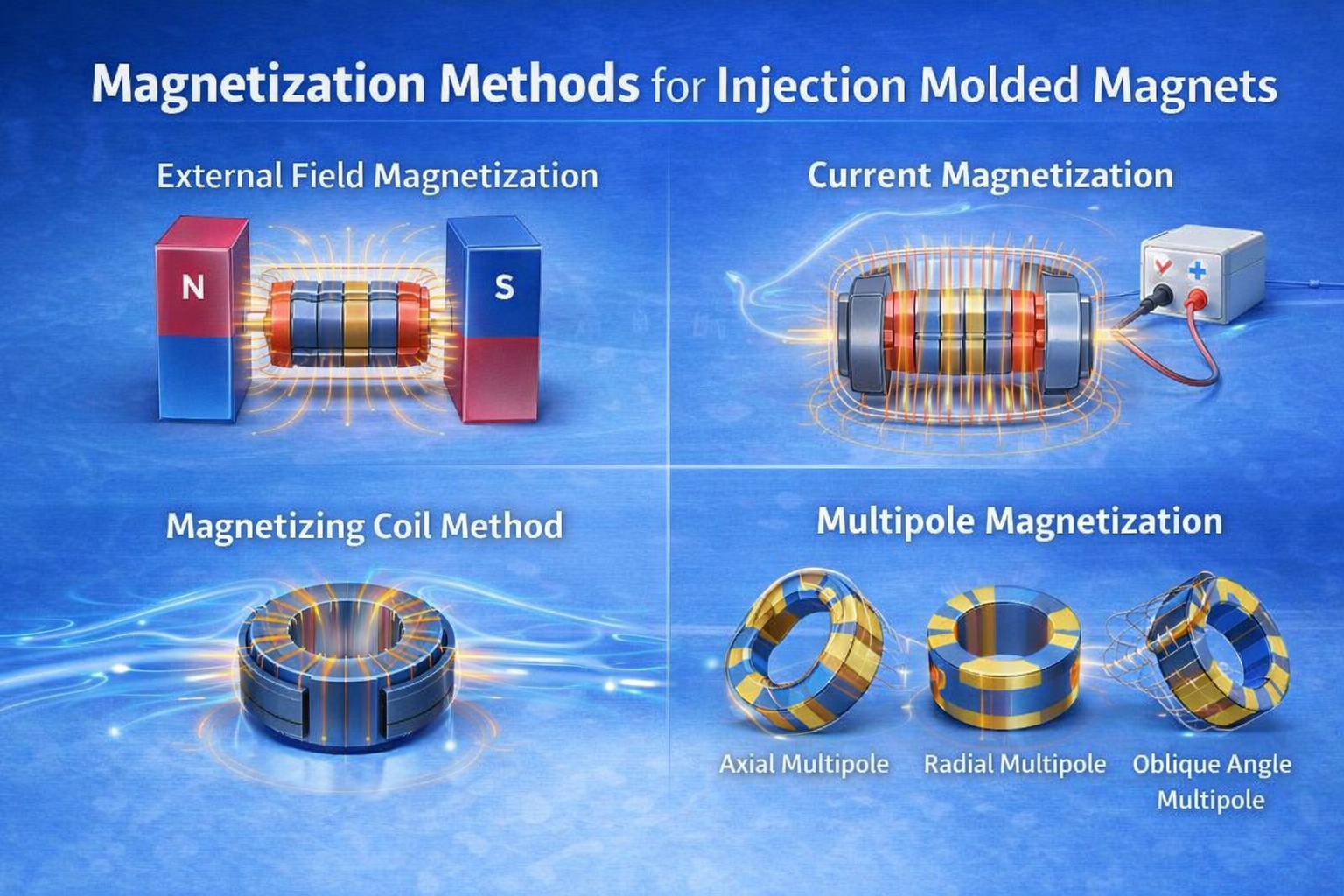
What Is Multipole Magnetization for Injection Molded Magnets?
Multipole magnetization refers to a process in which multiple north and south poles are distributed across a magnetic component in a predefined pattern. When applied to injection molded magnets, this technique enables:
-
Higher magnetic field resolution
-
Improved torque smoothness
-
Better signal accuracy for sensors
-
Reduced vibration and noise
Because injection molded magnets can be produced in complex shapes, multipole magnetization for injection molded magnets offers greater design flexibility than traditional sintered magnets.
Why Multipole Magnetization Matters in Industrial Design
Industrial systems today demand:
-
Smaller and lighter components
-
Higher energy efficiency
-
Lower noise and vibration
-
Stable performance over long lifecycles
Multipole magnetization directly supports these goals by optimizing magnetic flux distribution. This is especially important in B2B applications such as industrial motors, automotive subsystems, and automation equipment.
Common Types of Multipole Magnetization
Axial Multipole Magnetization
Axial multipole magnetization arranges magnetic poles along the axial direction of a magnetic ring or rotor. This method is commonly used in:
-
Brushless DC motors
-
Cooling fan motors
-
Pump drive systems
Advantages:
-
Smooth torque output
-
Reduced cogging
-
Easy integration with motor assemblies
Radial Multipole Magnetization
In radial multipole magnetization, magnetic poles are distributed along the radial direction. The inner and outer surfaces of the magnet exhibit different polarities.
Typical applications include:
-
Precision motor rotors
-
Magnetic couplings
-
Encoders and position sensors
Radial multipole magnetization for injection molded magnets enables high magnetic flux density in compact spaces.
Planar Multipole Magnetization
Planar multipole magnetization places multiple poles on a flat or planar surface of the magnetic component. This technique is often used in:
-
Magnetic sensing plates
-
Linear position detection systems
-
Flow and speed sensors
Because injection molded magnets allow complex geometries, planar multipole designs can be easily customized.
Oblique and Custom Angle Multipole Magnetization
In advanced applications, magnetic poles may be magnetized at oblique angles, forming less than 90° with the end faces of the magnet. This approach is used when:
-
Special magnetic field trajectories are required
-
Space constraints limit traditional designs
-
Customized motor or sensor behavior is needed
Multipole Magnetization vs. Traditional Magnetization
Compared to axial 2-pole magnetization, multipole magnetization for injection molded magnets offers:
-
More precise magnetic control
-
Higher efficiency in rotating systems
-
Reduced electromagnetic noise
-
Better compatibility with miniaturized designs
This makes it a preferred solution for next-generation industrial and automotive systems.
Applications of Multipole Magnetized Injection Molded Magnets
Multipole magnetization is widely applied in:
-
Electric motors and micro-motors
-
Automotive thermal management systems
-
Electronic water pumps
-
Solenoid valves and actuators
-
Magnetic sensors and encoders
In these applications, stable magnetic performance and repeatability are critical for long-term reliability.
Manufacturing Advantages of Injection Molded Magnets
When combined with multipole magnetization, injection molded magnets offer several manufacturing benefits:
-
Integrated molding reduces assembly steps
-
High dimensional accuracy
-
Consistent magnetic performance in mass production
-
Lower overall system cost
These advantages make them ideal for large-scale B2B manufacturing.

Selecting the Right Multipole Magnetization Solution
Choosing the optimal multipole magnetization for injection molded magnets depends on:
-
Required pole number and distribution
-
Component geometry
-
Magnetic field strength requirements
-
Operating temperature and environment
-
Production volume
Early collaboration between magnet suppliers and system designers helps ensure optimal performance.
Conclusion
Multipole Magnetization for Injection Molded Magnets is an essential technology for modern industrial and automotive systems. By enabling precise magnetic field control, improved efficiency, and compact designs, it supports the growing demand for high-performance, reliable magnetic components.
For B2B manufacturers developing motors, sensors, and electromechanical systems, adopting advanced multipole magnetization strategies can significantly enhance product competitiveness and long-term reliability.