
Injection Molded Magnet Magnetization: Key Techniques and Applications
Injection Molded Magnet Magnetization plays a critical role in producing high-performance magnetic components for a wide range of industrial applications. From electric motors and sensors to automotive thermal systems and renewable energy devices, proper magnetization ensures consistent magnetic strength, efficiency, and long-term reliability. In this article, we explore the main methods of magnetizing injection molded magnets, their applications, and why B2B manufacturers rely on these techniques for scalable and reliable production.
What Is Injection Molded Magnet Magnetization?
Injection molded magnets are made by combining magnetic powders with polymer binders through precise injection molding processes. After molding, these magnets require magnetization to align magnetic domains in a specific orientation. Proper magnetization improves:
-
Motor torque and efficiency
-
Sensor accuracy
-
System durability
-
Energy efficiency and performance consistency
B2B manufacturers rely on proper injection molded magnet magnetization to meet the high standards of industrial motors, EV components, and advanced sensors.
Main Magnetization Methods
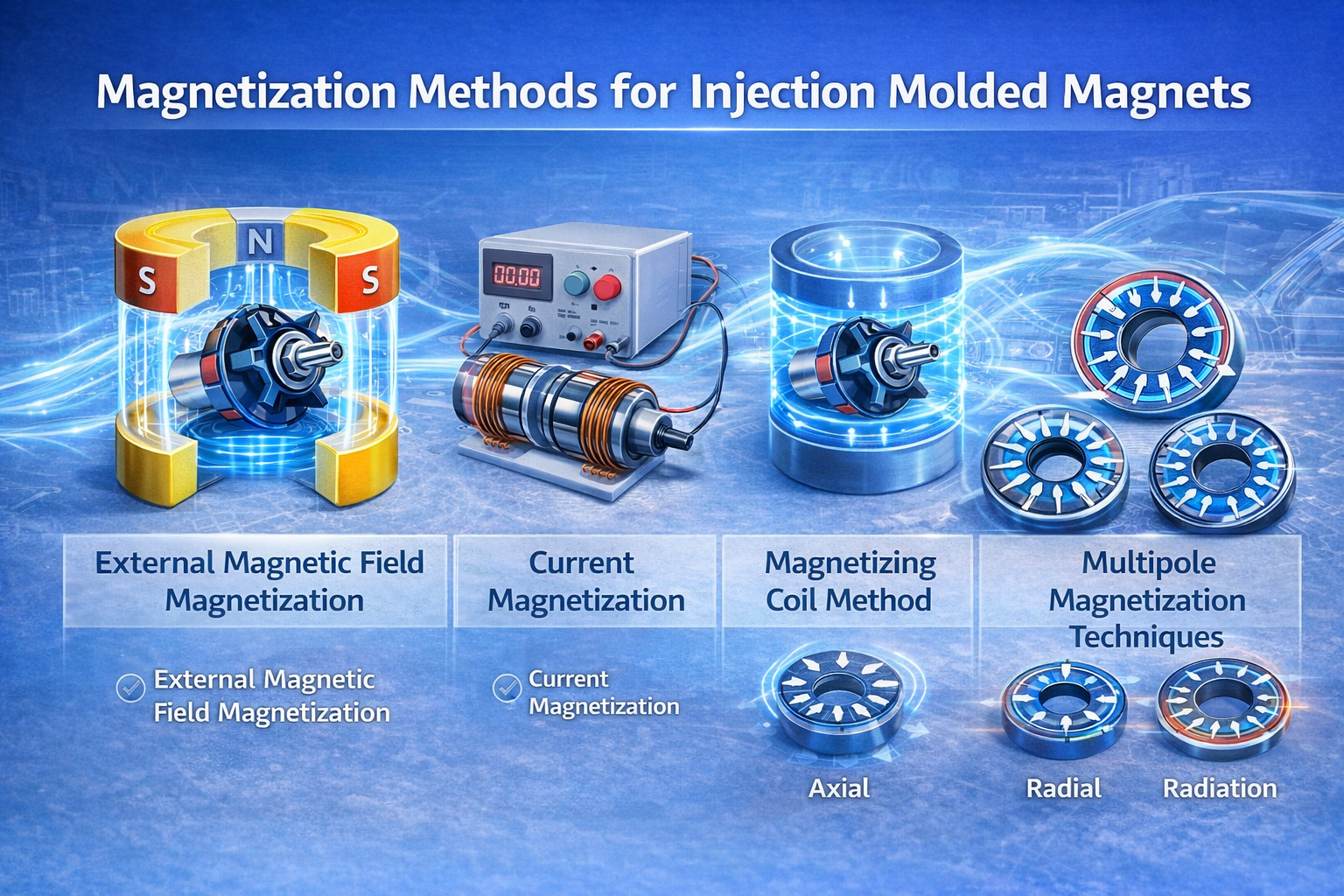
1. External Magnetic Field Magnetization
This method uses strong external magnetic fields, generated by permanent magnets or electromagnets, to magnetize the molded part. Key features include:
-
Full penetration of the magnetic field for uniform magnetization
-
Suitable for simple geometries or single-pole designs
-
Commonly applied in small- to medium-sized rotors and magnetic sensors
Advantages:
-
Easy to implement with standard equipment
-
Consistent magnetic alignment
-
Reliable for high-volume industrial production
2. Current Magnetization
Current magnetization involves generating a magnetic field through electric current. A coil is wrapped around the part, and current flows through it to induce magnetization. This approach is ideal for:
-
Complex geometries
-
High-strength magnetic requirements
-
Industrial motors and precision actuators
Advantages:
-
High magnetic flux achievable
-
Adaptable to different shapes and sizes
-
Suitable for medium- to large-scale production
3. Magnetizing Coil Method
Injection molded magnets can also be magnetized inside specially designed magnetizing coils, where electricity generates a controlled magnetic field.
Key Applications:
-
Electric vehicle motors
-
Compact sensor modules
-
Industrial actuator components
Advantages:
-
Uniform magnetic field ensures consistent part performance
-
Highly repeatable process for batch manufacturing
Multipole Magnetization Techniques
Advanced industrial applications often require multipole magnetization to create specific magnetic field patterns:
-
Axial Multipole Magnetization – Poles aligned along the axis of the magnetic ring, common in motor rotors.
-
Radial Multipole Magnetization – Poles arranged radially, producing opposite polarities on inner and outer surfaces.
-
Planar Multipole Magnetization – Poles distributed on the plane of the component, suitable for complex geometries.
-
Single-Sided Multipole Magnetization – Poles applied only on one surface, often used in magnetic plates.
-
Full Radial (Radiation) Magnetization – Poles radiate from the center outward, with inner and outer surfaces having opposite polarities.
-
Oblique Angle Multipole Magnetization – Poles angled <90° relative to end faces, ideal for rotors with special flux requirements.
Other Specialized Magnetization Methods
-
Axial 2-Pole Magnetization – One end N-pole, other end S-pole, simplest method for basic rotors.
-
Axial Single-Sided Multipole – Multiple poles on one surface, used in sensors and magnetic plates.
-
Axial Double-Sided Multipole – Opposite poles on both surfaces, used in compact high-performance components.
Selecting the Right Method
The choice of injection molded magnet magnetization depends on:
-
Component geometry (ring, plate, or complex shape)
-
Required magnetic field strength
-
Number and arrangement of poles
-
Volume and consistency of production
-
Operating environment (temperature, vibration, EMI)
For example:
-
Simple 2-pole rotors can use external field magnetization.
-
High-efficiency motor rotors often require radial or multipole magnetization using coil techniques.
-
Precision sensors benefit from planar or single-sided multipole magnetization.
Advantages of Proper Injection Molded Magnet Magnetization
-
Consistent torque and performance in motors
-
Accurate sensing in actuators and magnetic devices
-
Reduced energy loss in electromechanical systems
-
Durability under harsh industrial conditions
B2B manufacturers benefit from higher system efficiency, reduced assembly complexity, and longer lifecycle reliability when proper magnetization is applied.
Conclusion
Injection Molded Magnet Magnetization is a cornerstone for modern industrial and automotive magnetic components. From external field and coil methods to multipole and specialized magnetization, each method provides specific advantages for different applications. Proper selection ensures high-performance, reliable, and durable magnetic components.
For B2B clients designing motors, sensors, and industrial devices, optimized magnetization is key to achieving consistent efficiency, lower maintenance costs, and long-term reliability.