
Integrated Magnetic Assemblies for Advanced Thermal Control Systems
As automotive electrification and industrial automation continue to advance, thermal control systems have become one of the most critical subsystems affecting safety, efficiency, and reliability. From battery packs and power electronics to fluid circulation and sensing modules, every component must work together under increasingly demanding conditions.
In this context, integrated magnetic assemblies are emerging as a key enabling technology. By combining magnetic functionality, mechanical structure, and environmental protection into a single compact unit, these assemblies help manufacturers meet strict performance, space, and durability requirements—especially in automotive and industrial thermal control systems.
Understanding Integrated Magnetic Assemblies
Integrated magnetic assemblies are multi-functional magnetic components designed to perform more than just magnetic tasks. Unlike traditional magnet solutions that rely on multiple discrete parts, these assemblies integrate:
-
Magnetic elements
-
Structural support
-
Functional interfaces
-
Protective encapsulation
This design philosophy reduces system complexity while improving dimensional accuracy, repeatability, and long-term stability.
For B2B manufacturers, integrated magnetic assemblies offer a practical way to simplify system architecture without compromising performance.
Why Thermal Control Systems Demand Integrated Magnetic Solutions
Thermal control systems operate in some of the harshest environments within modern equipment. Components must withstand:
-
Wide temperature ranges
-
Continuous vibration
-
Coolant exposure and corrosion
-
Electromagnetic interference from nearby motors and power electronics
Integrated magnetic assemblies are particularly well-suited to these challenges because they are designed as system-level components, not just standalone magnets.
Key Applications in Thermal Control Systems
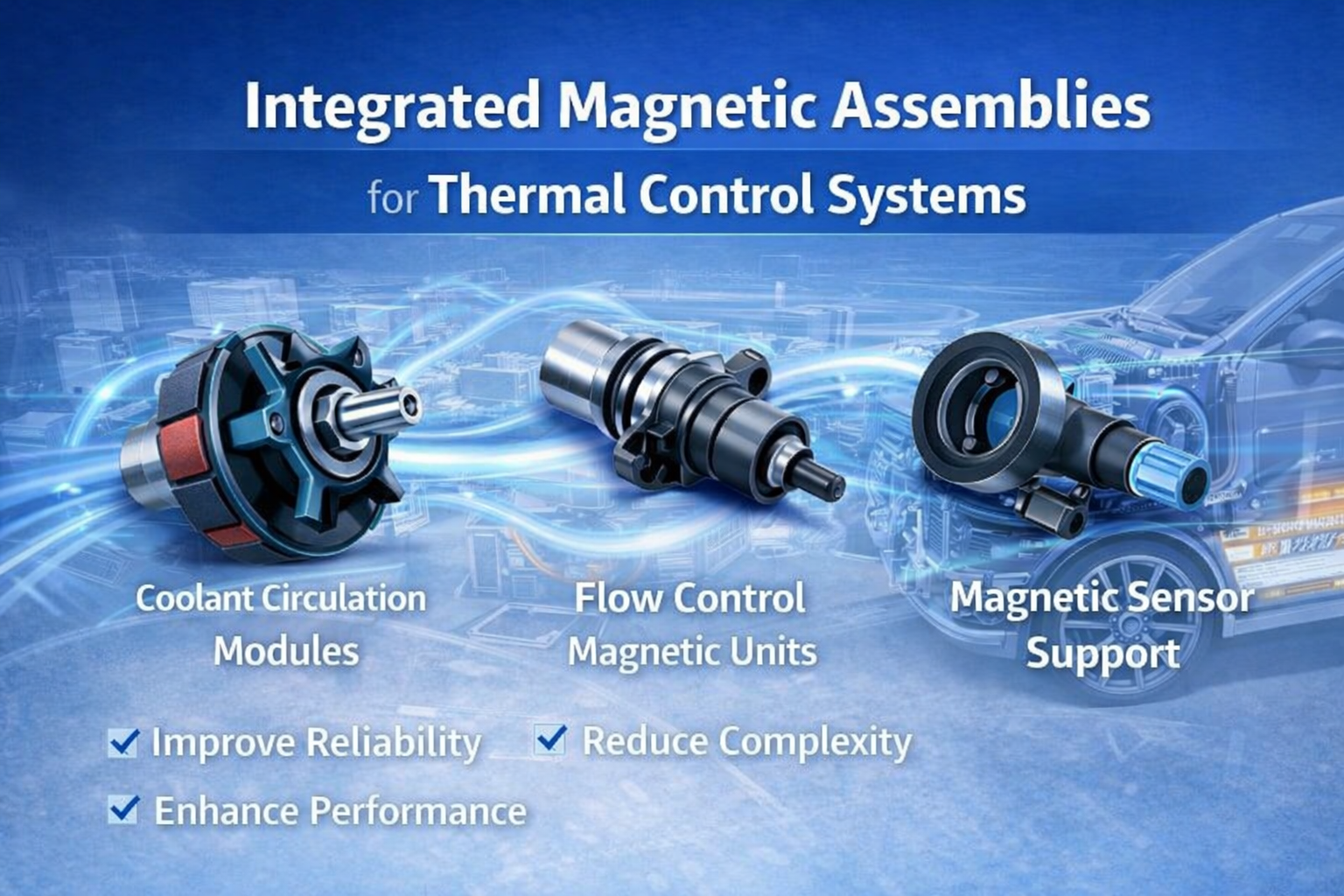
1. Coolant Circulation Drive Modules
Coolant circulation is at the heart of any thermal control system. Integrated magnetic assemblies are widely used in coolant circulation drive modules, where stable rotation and sealing performance are essential.
Key benefits include:
-
Reduced internal component count
-
Improved balance accuracy
-
Lower noise and vibration
-
Enhanced sealing reliability
By minimizing mechanical interfaces, these assemblies help reduce leakage risks and extend service life—especially important in battery and power electronics cooling loops.
2. Flow Control and Switching Units
Modern thermal systems often rely on multi-loop architectures, requiring precise control of coolant direction and flow rate. Integrated magnetic assemblies enable compact and responsive flow control units that support:
-
Fast actuation response
-
Stable magnetic force across temperature fluctuations
-
Compact installation in confined spaces
This makes them ideal for applications where traditional bulky solutions struggle to meet space and performance constraints.
3. Magnetic Support Structures for Sensing Modules
Accurate sensing is critical for closed-loop thermal control. Integrated magnetic assemblies are commonly paired with Hall-based sensing elements to support:
-
Coolant flow rate measurement
-
Temperature monitoring
-
System status feedback
The integrated structure improves signal consistency and offers inherent protection against electromagnetic interference, ensuring reliable data acquisition even in high-noise environments.
Design Advantages for B2B Manufacturers
From a manufacturing perspective, integrated magnetic assemblies offer several clear advantages:
Reduced Assembly Complexity
By consolidating multiple functions into a single unit, manufacturers can significantly reduce:
-
Assembly steps
-
Tolerance stack-up issues
-
Risk of installation errors
Improved Production Consistency
Integrated designs improve dimensional repeatability, which is essential for high-volume production and consistent product quality.
Lower Lifecycle Cost
Although integrated magnetic assemblies may appear more complex at first glance, they often reduce total cost by:
-
Lowering assembly labor
-
Reducing failure points
-
Extending service intervals
For B2B customers, this translates into lower total cost of ownership.
Performance Under Harsh Operating Conditions
Thermal control components must perform reliably under extreme conditions. Integrated magnetic assemblies are engineered to handle:
-
Rapid temperature cycling
-
Long-term exposure to coolant additives
-
Mechanical vibration and shock
-
Strong surrounding electromagnetic fields
These characteristics make them suitable not only for automotive platforms, but also for industrial cooling equipment, energy storage systems, and power electronics modules.
Supporting Compact and Lightweight System Design
As systems become more compact, space efficiency becomes a priority. Integrated magnetic assemblies support high functional density, allowing designers to:
-
Reduce overall system size
-
Lower component weight
-
Improve layout flexibility
This is especially valuable in applications where packaging space is limited, such as EV battery packs and integrated thermal modules.
Applications Beyond Automotive Thermal Control
While automotive systems are a major driver, integrated magnetic assemblies are also widely adopted in:
-
Industrial cooling and circulation systems
-
Energy storage thermal management
-
Smart fluid control devices
-
Power electronics cooling platforms
Their adaptability allows manufacturers to reuse proven designs across multiple product lines, reducing development time and cost.
Why Integrated Magnetic Assemblies Are a Strategic Choice
From a strategic perspective, integrated magnetic assemblies support long-term product competitiveness by enabling:
-
Higher system reliability
-
Simplified supply chains
-
Faster assembly and testing
-
Scalable production for future platforms
As thermal management systems continue to evolve, these assemblies provide a future-ready solution that aligns with industry trends toward integration and efficiency.
Conclusion
Integrated magnetic assemblies are no longer niche components—they are becoming a core building block in modern thermal control systems. By combining magnetic performance with structural integration, they help manufacturers:
-
Improve system efficiency
-
Reduce noise and vibration
-
Enhance durability under harsh conditions
-
Simplify assembly and lower lifecycle costs
For B2B manufacturers looking to optimize next-generation thermal systems, integrated magnetic assemblies offer a balanced and scalable solution that meets both technical and commercial requirements.