
Injection Molded Ferrite Magnetic Components for Thermal Management Systems
In modern automotive and industrial thermal management systems, reliability, precision, and integration are no longer optional — they are essential. From electronic water pumps to solenoid valves and temperature sensors, magnetic components play a key role in controlling coolant flow, heat exchange, and system stability.
Thanks to injection molded ferrite technology, manufacturers can now achieve higher precision, lower noise, stronger corrosion resistance, and fully integrated designs that traditional sintered magnets struggle to match.
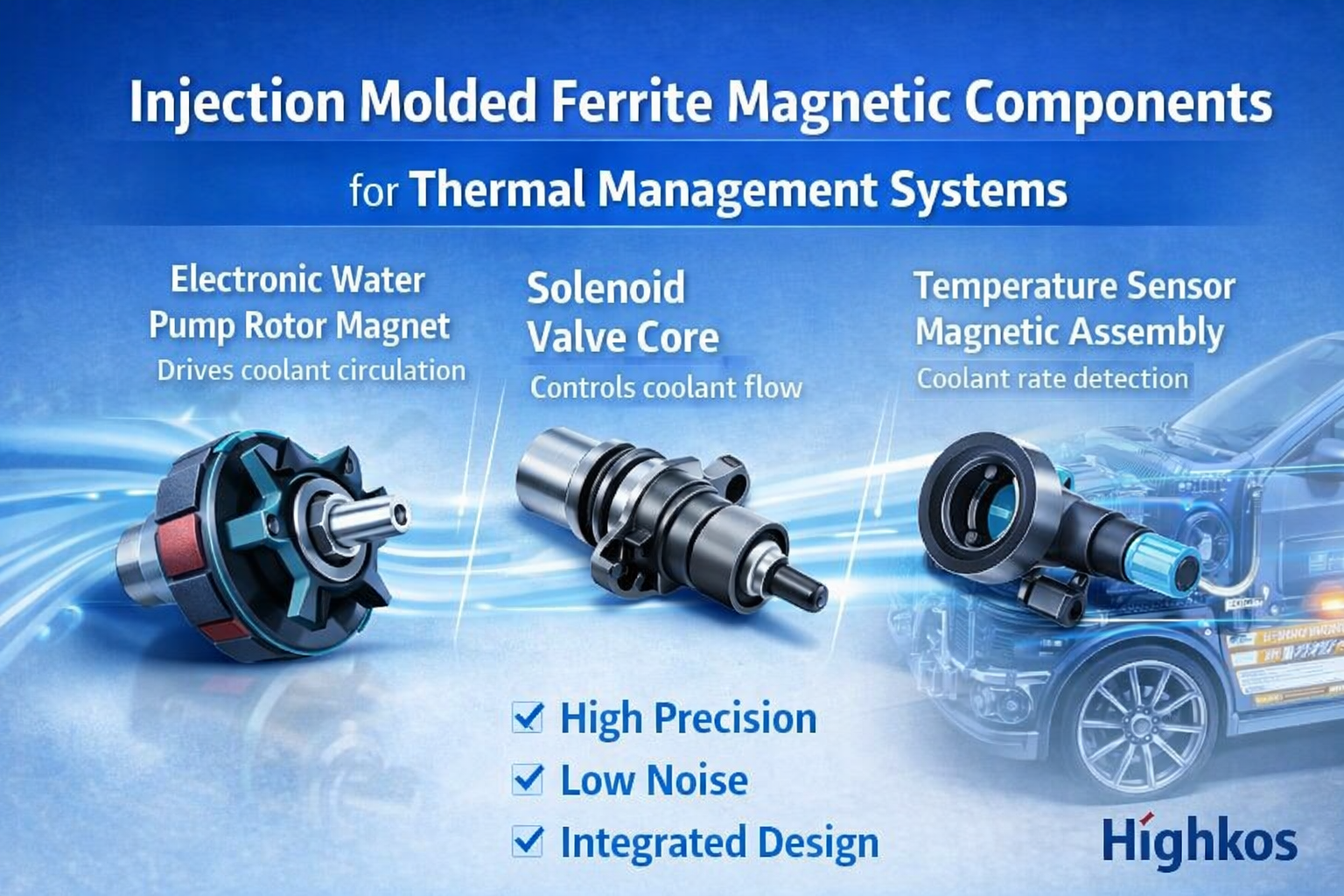
Why Injection Molded Ferrite Magnets Are Widely Used in Thermal Systems
Injection molded ferrite magnetic components are especially suitable for magnetic drive components, sensors, and heat exchange control units due to several core advantages:
-
High dimensional accuracy
-
Excellent corrosion resistance
-
Integrated molding of multiple functional parts
-
Stable magnetic performance across wide temperature ranges
-
Cost-effective mass production for B2B applications
These characteristics make injection molded ferrite a critical material in both automotive and industrial thermal control systems.
1. Electronic Water Pump Rotor Magnet
Application Function
The electronic water pump rotor magnet is responsible for driving coolant circulation to regulate the temperature of:
-
Battery packs
-
Electric motors
-
Power electronics and control units
Stable coolant flow directly affects system efficiency, safety, and lifespan.
Key Technical Advantages
Integrated Injection Molding
Injection molding allows the ferrite magnet, impeller, and bearing to be formed as one single component.
Compared with traditional split designs:
-
Part count is reduced from 5 components to 1
-
Lower risk of coolant leakage
-
Improved structural strength and alignment accuracy
-
Faster assembly and lower production cost
Low-Noise & High Balance Accuracy
-
Dynamic balance accuracy meets G6.3 standard
-
Rotor runout < 0.05 mm
-
Operating noise level < 35 dB(A)
This makes the design ideal for NVH-sensitive applications, such as cabin cooling systems and battery thermal modules.
High-Temperature Resistance
By adding functional fillers (e.g., zirconia), the ferrite material can withstand temperatures up to 150°C, fully meeting the requirements of:
-
Battery heat pump systems
-
High-load electronic cooling environments
2. Solenoid Valve Core for Coolant Control
Application Function
Injection molded ferrite solenoid valve cores are widely used to control coolant flow direction, including:
-
Battery cold plate circuits
-
PTC heater systems
-
Multi-loop thermal management modules
Key Technical Advantages
Fast Response & Stable Performance
-
Coercivity (H<sub>cj</sub>) ≥ 2000 kA/m
-
Stable switching performance from –30°C to 120°C
-
Response time < 50 ms
This ensures precise and reliable valve operation even under extreme temperature fluctuations.
Compact High-Flux Design
Using multi-pole magnetization (e.g., 8-pole or 12-pole designs):
-
Magnetic flux density reaches 0.5 T
-
Achieved within a compact Φ15 mm inner diameter
-
Replaces larger traditional sintered magnet structures
The result is a smaller, lighter, and more efficient solenoid valve assembly.
3. Temperature Sensor Magnetic Assembly
Application Function
In thermal systems, magnetic assemblies work together with Hall sensors to detect:
-
Coolant flow rate
-
Temperature changes
-
System operating status
These signals are critical for real-time thermal control.
Key Technical Advantages
High Sensitivity Detection
Injection molded ferrite magnetic rings (e.g., SMC-20H) feature:
-
Magnetic permeability (μ) of 2000 ±30%
-
Capable of detecting flow rate changes as low as 0.1 L/min
This enables precise monitoring in low-flow and variable-flow conditions.
Strong EMI Resistance
The injection molded encapsulation structure provides:
-
Effective electromagnetic shielding
-
Stable signal output in high magnetic field environments
-
Reliable operation near motors and power electronics
This makes the design especially suitable for motor cooling circuits and high-voltage thermal systems.
Why B2B Manufacturers Choose Injection Molded Ferrite Solutions
Compared with traditional sintered magnets, injection molded ferrite components offer clear advantages for OEMs and Tier 1 suppliers:
-
Higher design flexibility for complex geometries
-
Better consistency in mass production
-
Lower total system cost
-
Easier integration with plastic and metal parts
-
Improved durability in corrosive coolant environments
These benefits help manufacturers improve system reliability while reducing manufacturing and assembly costs.
Conclusion
Injection molded ferrite magnetic components have become a core enabling technology for modern thermal management systems. Whether used in electronic water pump rotors, solenoid valve cores, or temperature sensor assemblies, they deliver:
-
High precision
-
Low noise
-
Excellent thermal stability
-
Compact, integrated designs
For B2B customers in the automotive, EV, and industrial equipment sectors, injection molded ferrite solutions provide a practical and scalable path toward higher efficiency and long-term reliability.