
Most traditional magnetic absolute encoders rely on multi-pole magnetic arrays or multi-track coding structures to distinguish rotational angles and realize absolute positioning, which increases equipment volume, cost, and circuit complexity. Different from conventional multi-pole encoders, the single-pole absolute encoder adopts an ultra-simplified st
ructural design with only one N/S pole pair and a high-precision magnetic sensor chip, which can stably output 0°–360° full-range absolute angular position data
in real time. As a high-efficiency precision detection device, the single-pole absolute encoder completely eliminates the need for cumbersome multi-pole calibration and mandatory power-on homing operations, making it widely applied in compact industrial automation equipment, miniature servo motors, and high-precision rotating machinery scenarios. This article elaborates on the unique working mechanism, prominent technical advantages, necessary calibration requirements and core application logic of the single-pole absolute encoder in detail.
Unique Working Mechanism of Single-Pole Absolute Encoder
The biggest technical difference between a single-pole absolute encoder and ordinary multi-pole absolute encoders is that it abandons the traditional magnetic field strength measurement method and takes magnetic field direction detection as the core positioning logic. For a professionalsingle-pole absolute encoder, a single pole pair can form a complete, independent and non-repeating magnetic field cycle, realizing accurate one-to-one mapping of mechanical angles and magnetic field directions in a full 360° rotation range without redundant identification circuits. The complete high-precision positioning working process of the single-pole absolute encoder is divided into three core links.
Generation of Unique Rotating Magnetic Field
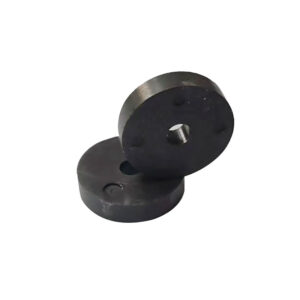
The single-pole absolute encoder is equipped with a high-precision radially magnetized single-pole-pair magnet as its core magnetic source. Unlike multi-pole magnets that produce repeated and overlapping magnetic field changes within a single mechanical rotation, the single N/S pole pair of the single-pole absolute encoder generates continuous, uniform and non-repeating magnetic field direction changes during one full 360° mechanical rotation. Every spatial angle position of the rotating shaft corresponds to an exclusive magnetic field vector direction, which fundamentally eliminates position coding repetition and lays a solid foundation for the absolute positioning capability of the single-pole absolute encoder. This ultra-simplified magnetic structure effectively reduces mechanical assembly difficulty, equipment failure rates and production costs compared with multi-pole magnetic encoders.
Orthogonal Magnetic Field Component Detection
A high-integration magnetic angle sensor IC is fixedly installed at a fixed air gap position adjacent to the magnet. The chip integrates multiple Hall sensing elements, which can synchronously capture two orthogonal X-axis and Y-axis component signals of the spatial magnetic field. Unlike single Hall sensors that only detect magnetic flux density, the orthogonal dual-component detection mode can accurately lock the three-dimensional direction of magnetic induction lines, avoiding detection dead zones and signal repetition problems. The sensor’s high-precision sampling capability ensures stable signal output even with minor air gap fluctuations.
Digital Angle Calculation and Absolute Position Output
The built-in ADC module of the magnetic sensor converts the collected analog X/Y magnetic field component signals into high-precision digital signals. Then, the embedded system adopts the optimized CORDIC algorithm to calculate the included angle between the real-time magnetic field direction and the preset reference zero position. The calculated angle value covers the full 0°–360° mechanical rotation range, and each digital value uniquely corresponds to a shaft mechanical position. After power-on, the encoder can instantly output absolute position data without manual zeroing or homing operations, realizing true power-off position memory.
Core Technical Advantages of Single-Pole Absolute Encoder
The single-pole absolute positioning design breaks through the structural limitations of traditional absolute encoders and has obvious technical and practical advantages in industrial applications.
True Absolute Positioning Without Homing
The most prominent feature of the single-pole absolute encoder is true full-range absolute positioning without power-on homing. In the complete 360° mechanical rotation cycle, each mechanical angle of the single-pole absolute encoder corresponds to a unique magnetic field direction, forming a stable and irreversible one-to-one mapping relationship. No matter the single-pole absolute encoder stops rotating at any angle position or is powered off and restarted after long-term standby, the supporting magnetic sensor can immediately identify and output the current accurate absolute position data. It completely avoids the inherent position loss defect of incremental encoders and the complex cycle discrimination logic required by multi-pole absolute encoders, greatly improving the overall operation efficiency and stability of automated equipment.
Strong Environmental Anti-Interference Ability
The core detection principle of the single-pole absolute encoder focuses on stable magnetic field direction identification rather than unstable magnetic flux density monitoring. Magnetic field strength is extremely susceptible to external interference such as equipment assembly air gap deviation, ambient temperature sharp changes, and on-site electromagnetic radiation, while the magnetic field vector direction detected by the single-pole absolute encoder has ultra-high structural stability and anti-interference performance. This core technical advantage enables the single-pole absolute encoder to maintain consistent high measurement accuracy in complex and harsh industrial environments such as high-temperature operation, mechanical vibration, and minor assembly deviation, with far better operational stability than traditional strength-based detection encoders.
Simplified Structure and Low Operation Cost
Benefiting from its unique structural design, the single-pole absolute encoder only matches one independent pole pair with a single high-precision magnetic sensor chip, completely canceling the complex multi-channel coding circuits and repeated cycle judgment modules that are essential for traditional multi-pole absolute encoders. The ultra-simplified mechanical structure and circuit system of the single-pole absolute encoder greatly reduce the overall equipment volume, lower mass manufacturing and later maintenance costs, and perfectly adapt to the installation and operation requirements of miniaturized, lightweight and high-precision industrial precision equipment.
Necessary Calibration for High-Precision Positioning
Although the single-pole absolute encoder has a natural and reliable full-range absolute positioning advantage relying on magnetic field direction detection, minor nonlinear measurement errors will still occur in actual industrial operation. These errors mainly come from objective factors such as magnet mounting eccentricity, rotating shaft axial deflection, and on-site ambient stray magnetic field interference. To ensure the long-term stable and high-precision operation of the single-pole absolute encoder, one-time professional error calibration and compensation work is indispensable before equipment delivery or on-site use.
Factory pre-calibration and on-site online calibration are two mainstream and effective error compensation methods for single-pole absolute encoder. By collecting full-angle raw measurement data of the single-pole absolute encoder and comparing it with standard mechanical angle data, the system can build a precise error compensation model to accurately correct nonlinear measurement deviations. After professional calibration, the angle measurement accuracy of the single-pole absolute encoder can reach industrial high-precision standards, fully meeting the strict positioning requirements of precision transmission and high-end industrial control scenarios. For standardized calibration processes, refer to Mouser Encoder Technical Specification Guide. To learn more about the difference between absolute and incremental encoders, check ElProCus Absolute Encoder Technical Resources.
Conclusion
In summary, the single-pole absolute encoder realizes efficient, stable and high-precision absolute angular positioning relying on three core technical links: single-pair rotating magnetic field generation, orthogonal magnetic field direction detection, and algorithm-based precise angle calculation. The unique technical logic of the single-pole absolute encoder — “direction detection instead of strength detection” — perfectly solves the core pain points of poor stability, complex structure and high failure rate of traditional encoders. With the comprehensive advantages of power-on instant positioning, strong environmental anti-interference capability, compact structure and low comprehensive cost, the single-pole absolute encoder has become an optimal core component for miniaturized and high-stability industrial precision rotation positioning systems.